Saturday, July 18, 2026, a weekend wrap written after a bruising week for the AI trade and with the Middle East hotter than it was at Friday’s close. US stocks ended the week lower as a fresh scare over the economics of the AI buildout tore through semiconductors, and the Philadelphia Semiconductor Index slid into bear-market territory, now down about 20 percent from its June record even after a year that still has it up more than 60 percent. The trigger was software rather than a capex line. China’s Moonshot AI unveiled Kimi K3, described as the largest open-weight model ever at roughly 2.8 trillion parameters, a separate report said DeepSeek is developing its own inference chip, and a third report suggested Alphabet’s Gemini 3.5 Pro has slipped months behind schedule. On Friday the S&P 500 fell 1.0 percent to 7,457.69, the Nasdaq dropped 1.4 percent to 25,520, and the Dow eased 0.8 percent to 52,146, capping weekly losses of roughly 1.5, 2.9 and 1.0 percent. Oil went the other way, booking its best week since the spring as the US and Iran kept trading blows over the Strait of Hormuz, and overnight the fighting escalated again with a seventh straight night of American strikes and fresh Iranian fire that reached Kuwait.
Top Call: The Chip Rout Is an Over-Positioned Tape Meeting a Real Structural Question, and the Weekend Oil Escalation Is the Bigger Near-Term Risk
The one thing to carry into next week is that the week’s AI selloff bundled together two very different things, and only one of them should trouble a hardware bull. A better and cheaper open model out of China is an efficiency story, and lower cost per unit of intelligence has almost always expanded demand for compute rather than shrunk it, which is exactly how the original DeepSeek scare resolved once the panic faded and why ASML and TSMC could raise spending and pricing plans two days before this rout. What is legitimately new, and worth respecting, is the direction of travel underneath the tape. A DeepSeek move toward its own inference silicon pokes at the one moat everyone assumes is unassailable, and a stumble on Gemini 3.5 Pro suggests the model lead is no longer a given for the US labs, so the value in the AI stack may be migrating from training hardware toward the model and inference layer where China now sits at the frontier. Our read is that the SOX falling into a bear market on a software headline, while still up more than 60 percent on the year, looks like a crowded trade finding an excuse more than a demand break, and we would add with discrimination rather than conviction. The sharper near-term risk is not silicon at all but crude, which just booked a double-digit week and is climbing again this weekend as the Hormuz standoff hardens, because that is the variable most likely to keep a Fed hike alive into the July 28-29 meeting and to reopen the inflation tail that June’s cool prints had begun to close.
The Week in AI: A Second DeepSeek Moment Pushes the SOX Into a Bear Market
The defining event of the week was a confidence shock rather than a fundamental one. Moonshot AI, the Chinese lab behind the Kimi family, released K3 with roughly 2.8 trillion parameters and positioned it as rivaling the best closed systems from the US labs, timed to land just before the World Artificial Intelligence Conference in Shanghai. Paired with a report that DeepSeek is designing its own inference chip to cut dependence on Nvidia, and with word that Google’s flagship Gemini 3.5 Pro has slipped months behind schedule, the market did what it did in January of 2025 and sold the entire hardware complex on the fear that the world may not need as much expensive American silicon as the bulls assume. The Philadelphia Semiconductor Index fell about 11 percent on the week, its worst five days since March of 2025, and widened its drawdown from the June record to 20 percent, the conventional definition of a bear market. Every member of the Magnificent Seven fell, with Alphabet off 3.2 percent and Meta down 2.7 percent leading the megacap losses.
Our take is that the tape is drawing the wrong lesson from a real event. Cheaper and more capable models lower the cost to serve intelligence, and every prior compute cycle has answered a falling unit cost with more workloads and more silicon, not less, which is why we treat Kimi K3 as a demand tailwind dressed up as a threat. The physical evidence has not changed. ASML raised full-year guidance this week and TSMC lifted capex to 64 billion dollars, both of them telling the market the buildout is accelerating, not fading. What we do not dismiss is the second half of the story. The most important model advances this year have come out of China and are open rather than closed, DeepSeek is now reaching toward its own chips, and a US flagship just slipped, and taken together those are the first credible cracks in two of the most consensus assumptions in the market. That is a longer-dated question about who captures the profit of the boom, not a near-term dent in the demand, and the market spent the week conflating the two.
Memory and SK Hynix: The Reflexive Trade Cuts Both Ways Again
The pain concentrated where it always does. Nvidia fell 2.2 percent on Friday, Micron dropped about 5.7 percent, AMD lost 5.3 and Broadcom 5.0, and the memory group again took the brunt of the selloff. The most violent move was in the newly listed name. SK Hynix, whose US shares only began trading a week earlier in the largest foreign listing on record, saw its ADR plunge 13.7 percent on Friday to 152.31 dollars, barely above the 149 offering price, even as some analysts used the drop to reiterate it as a top pick. In Asia the damage was worse. The Kospi sank 6.4 percent on Friday into a Seoul holiday to close near 6,821, and the Nikkei dropped 4.0 percent as Japanese chip-equipment names followed.
Our take is that the whipsaw in the memory names is the clearest evidence that mechanics, not fundamentals, drove much of this week. This is the same group that ripped 13 percent one session and fell 9 the next earlier in the month, and the leveraged single-stock ETFs tied to Samsung and SK Hynix, which launched only two months ago and double the daily moves, keep pouring fuel on exactly those vertical swings. Korea’s regulator has already signaled it will announce measures on those products, which is a market telling you the price action has decoupled from the book of business. Nothing in the memory-scarcity thesis actually broke this week. IBM’s warning that customers are diverting budgets to lock up scarce chips still stands and ASML’s bookings still confirm it, so we read the Korean rout and the SK Hynix round trip as positioning and structural flow rather than a change in the underlying demand.
Netflix: A Beat the Market Ignored for a Soft Guide
The marquee earnings print of the week came Thursday after the close and disappointed on the only line that mattered. Netflix beat the quarter, reporting EPS of 0.80 dollars against a 0.79 consensus on revenue of 12.56 billion that was fractionally shy of the 12.6 billion estimate, with an operating margin of 33 percent. The problem was the outlook. Management guided third-quarter revenue to about 12.86 billion, or roughly 11.7 percent growth, undershooting the 13 billion the street wanted, and held the full-year margin target at 31.5 percent. The stock fell 7 to 10 percent on Friday as investors keyed on the light forward number rather than the in-line quarter.
Our take is that this is the second quarter in a row where a respectable print got punished for a cautious guide, and the reaction says more about the tape than about the company. Engagement is fine, with view hours up in the first half despite a schedule crowded by the Winter Olympics and the World Cup, and the ad tier keeps scaling. What the market wanted was a back-half raise and did not get one, so a premium multiple gave ground. We would separate the company from the signal. Netflix is a clean read on the discretionary consumer rather than an AI-scheme name, and a merely solid guide from it, alongside a soft June retail headline earlier in the week, sketches a consumer that is holding up but no longer accelerating, which is a fine backdrop for a soft landing and a poor one for stocks priced for reacceleration.
Oil and Iran: Best Week Since the Spring, and the Weekend Made It Worse
The overhang that shadowed every session all week tightened further overnight. Brent settled near 85 dollars on Friday and WTI around 79.8, with both benchmarks booking weekly gains near 12 percent, their best week since the spring, on fear of disruption to the Strait of Hormuz and the Red Sea. Then it escalated. US Central Command said early Saturday that a seventh straight night of strikes had hit surveillance sites, military logistics, underground weapons storage and maritime capabilities, and that American airstrikes struck an electricity and desalination plant in Iran’s southern Hormozgan province on the coast of the strait. Kuwait said it intercepted Iranian missiles and drones and that one of its desalination plants was hit, the second such attack in two days. Crossings through Hormuz, which in peacetime carried about a fifth of the world’s seaborne oil, had already thinned to roughly eight vessels on Thursday, a three-week low.
Our take is unchanged from earlier in the week and only more pressing after the weekend. The market has been pricing a risk premium layered onto a strait that is still physically open, which is why Brent ground higher in one-dollar steps rather than gapping through the mid-80s, and a well-supplied global balance can partly absorb that. The switch that turns this from an inflation-and-rates overhang into an outright growth shock is a genuine loss of barrels, whether from a strike on Iran’s Kharg Island export terminal or a real closure of the strait rather than the current thinning of traffic. The weekend strikes on coastal infrastructure and the widening of the fight to Kuwait move that scenario a notch closer, and as long as crude keeps climbing it is the single variable most able to keep a July hike on the table and to undo the disinflation story the week’s data had started to tell.
Macro: Cool Data All Week, but Oil and the Fed Overshadow It
The economic calendar leaned dovish and the market barely cared. June CPI and PPI both came in cool earlier in the month, the disinflation that reopened the rate-cut conversation, and Friday’s import prices and preliminary Michigan sentiment closed a heavy data week without changing the picture much. Yet the bond market moved the other way on oil. The two-year yield pushed toward its 2026 high, the ten-year sat near 4.58 percent, and money markets pulled their next Fed hike bet forward, now leaning toward October, as crude’s climb reawakened the inflation worry that cooler goods and services prices had been soothing. The dollar held firm near 100.7 and the 30-year stayed above 5 percent, close to the highest auction yield since 2007.
Our take is that the tension running under the whole tape is a data set that says cut and a commodity that says wait. The banks validated an accelerating real economy when JPMorgan, Morgan Stanley and BlackRock all crushed estimates this week, and the consumer is steady if decelerating, so the domestic backdrop supports the case that the cooling in CPI and PPI is real. The problem is that a new Fed chair trying to build credibility on prices will not want to ease into a rising oil price and a fresh tariff pipeline, and the Michigan survey’s elevated inflation expectations give the hawks cover. The July 28-29 FOMC is now the pivot, and its outcome hinges less on the labor and inflation prints than on where Brent is trading when the committee sits down.
Sector Spotlights
AI and Semiconductors: The epicenter of the week and the source was new. An open-model shock from Kimi K3, a DeepSeek own-chip report and a Gemini 3.5 Pro delay dragged the SOX into a bear market, down about 11 percent on the week and 20 percent from its June high, with Nvidia, Micron, AMD and Broadcom all lower. We read the model news as demand misread as a threat, and the chip-and-delay news as a real, early challenge to the market’s two core AI bets.
Media and Consumer: Netflix beat but guided the current quarter light and fell 7 to 10 percent, the second straight guide-driven selloff and a read on a consumer that is steady rather than accelerating. Paired with a soft June retail headline, it points to a discretionary backdrop that supports a soft landing but not stocks priced for reacceleration.
Energy: Crude booked its best week since the spring toward 85 dollars Brent, and the weekend strikes on Iranian coastal infrastructure and Kuwait keep the premium building. Energy is the one sector where the geopolitical risk is a tailwind for the shares and a headwind for nearly everyone downstream.
Financials: Still the quiet ballast under a noisy tape. After JPMorgan, Morgan Stanley and BlackRock all beat this week, the group has validated an accelerating real economy and is largely insulated from the chip drama, which is why the Dow fell far less than the Nasdaq.
Geopolitical Tracker
US-Iran and Hormuz: The dominant macro risk and it hardened over the weekend. A seventh straight night of US strikes hit surveillance, logistics, weapons storage and maritime targets, and an American strike hit an electricity and desalination plant on Iran’s Hormuz coast. Kuwait intercepted Iranian missiles and drones and took a second strike on a desalination plant in two days. An interim ceasefire has collapsed with no clear end in sight, and Hormuz traffic has thinned to a three-week low. The switch from a shipping-risk premium to an actual barrel loss remains the most important variable for oil and, through it, for the Fed.
US-China Tech: Newly elevated by the open-model launch. Kimi K3 and DeepSeek’s chip ambitions, arriving just before the Shanghai AI conference, reframe the AI race as one where the frontier of open models and potentially of inference silicon is moving to China, a structural competitive story that sits underneath the week’s US chip selloff.
Trade and Tariffs: A planned 25 percent US tariff on some Brazilian imports adds to the tariff overhang that keeps the goods-inflation pipeline warm, a minor line item today but part of the same backdrop that complicates the disinflation story into the FOMC.
Quick Take: Netflix Q2 Scorecard
| Metric | Consensus | Actual | Read |
|---|---|---|---|
| Revenue | ~$12.6B | $12.56B (+13% YoY) | Fractionally light, essentially in line |
| EPS | $0.79 | $0.80 | Small beat |
| Q3 revenue guide | ~$13.0B | $12.86B (+11.7%) | The miss that moved the stock |
| FY26 op margin | ~31.5% | 31.5% | Held; Q2 margin 33% |
Our take: A good quarter overshadowed by a soft guide for the second time running. The business is healthy, with engagement up and the ad tier scaling, but the market wanted a back-half raise and did not get one, so a premium multiple gave ground. It reads as a steady but decelerating consumer more than a change to the streaming thesis, and we would not let one guide reset the view on a company still compounding double-digit revenue at a 30-plus margin.
Key Events Ahead
| Date | Event | Why It Matters |
|---|---|---|
| Wed Jul 22 | Tesla earnings (after close) | First mega-cap AI-capex verdict; the $25B+ capex hike is the tell |
| Wed-Thu Jul 22-23 | Alphabet earnings | Google Cloud growth and any read on the Gemini 3.5 Pro delay |
| All week | US-Iran / Hormuz; Brent near $85 | Whether the oil premium becomes an actual supply loss |
| All week | Q2 season broadens | 88% EPS beats so far; blended growth 24.7% and the tape still sells |
| Jul 28-29 | FOMC meeting | Warsh’s first decision; hike odds hinge on where oil trades |
Weekend wrap, Saturday July 18, 2026, written after a bruising week for the AI trade and a hotter Middle East. US stocks ended lower as a second DeepSeek moment tore through semiconductors, with Moonshot’s Kimi K3 open-weight model, a DeepSeek own-chip report and a Gemini 3.5 Pro delay pushing the Philadelphia Semiconductor Index into a bear market, down about 20 percent from its June record even as it holds a 60-plus percent gain on the year. Friday the S&P 500 fell 1.0 percent to 7,457.69, the Nasdaq dropped 1.4 to 25,520 and the Dow eased 0.8 to 52,146, capping weekly losses near 1.5, 2.9 and 1.0 percent, while SK Hynix’s week-old ADR plunged 13.7 percent to just above its offering price and the Kospi lost 6.4 into a Seoul holiday. Netflix beat with 0.80 dollars EPS and 12.56 billion in revenue but guided the third quarter light and fell 7 to 10 percent, a second straight guide-driven selloff and a read on a steady but decelerating consumer. Oil booked its best week since the spring with Brent near 85 and WTI around 79.8, both up about 12 percent, and the weekend brought escalation as US Central Command reported a seventh straight night of strikes, hit an electricity and desalination plant on Iran’s Hormuz coast, and Kuwait intercepted Iranian missiles and took a second strike on a desalination plant. We read the chip rout as a crowded trade finding an excuse while respecting that the DeepSeek chip effort and the Gemini stumble poke at the market’s two core AI bets, and we see crude, not silicon, as the sharper near-term risk into the July 28-29 FOMC. Gold eased to about 4,019 and lost 3 percent on the week, bitcoin firmed to 64,095, the dollar held near 100.7 and the 30-year stayed above 5 percent. Tesla and Alphabet headline a huge week ahead. For internal use only. Not investment advice.
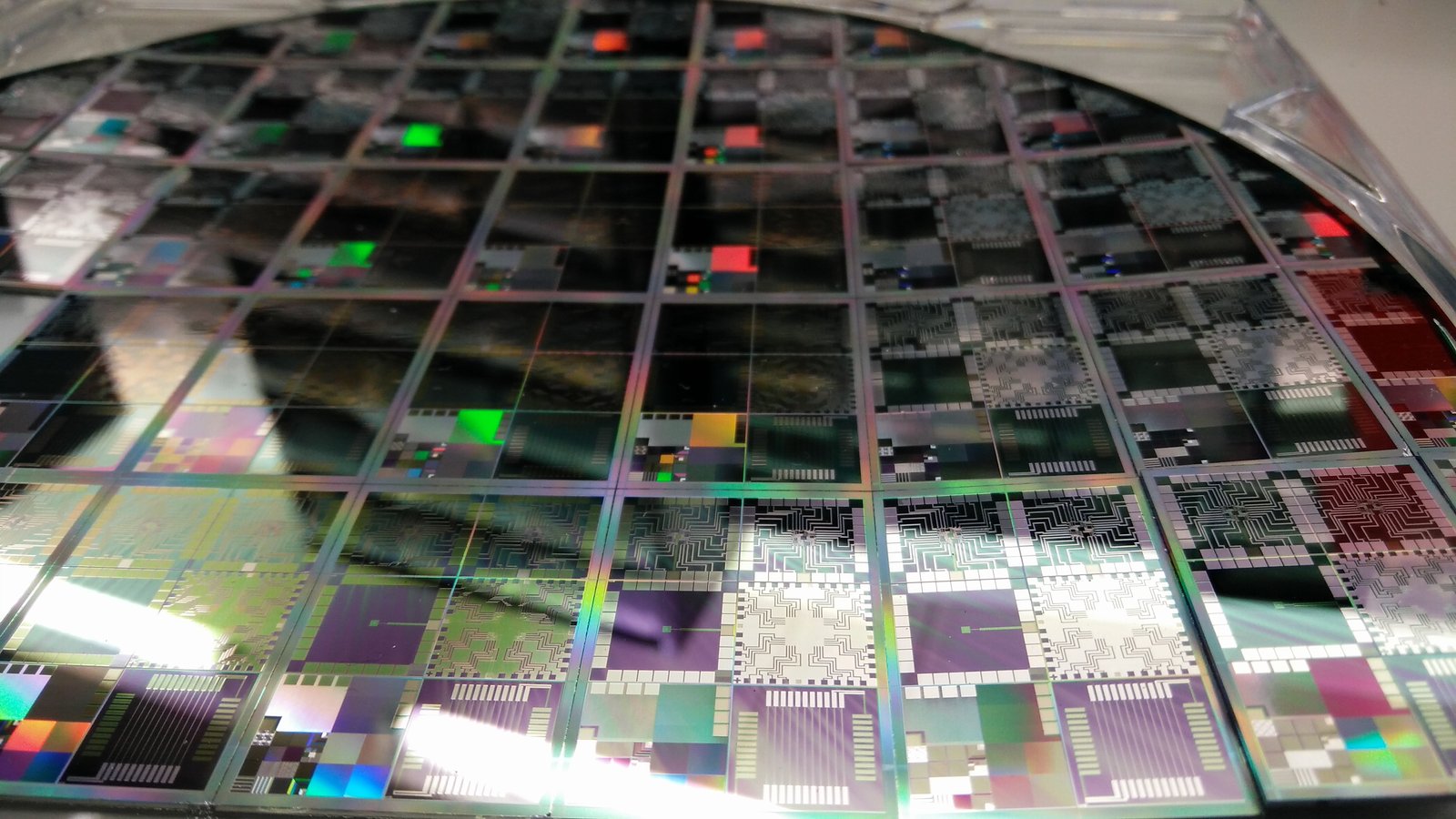
Cover image: a 12-inch wafer of microelectronic testbeds, by DrHughManning, CC BY-SA 4.0, via Wikimedia Commons.