Wednesday, July 22, 2026, and the rebound that dragged chips off a bear-market low is meeting its first real test before the bell. US stock futures are lower, with S&P 500 futures down about 0.5 percent, Dow futures off 0.3 percent, and Nasdaq 100 futures leading the way down near 1.1 percent as the semiconductor complex gives back part of a two-day bounce. The driver is oil, which has swung hard the other way from yesterday’s ceasefire optimism. Brent is up roughly 4 percent toward $95 and WTI is near $88 after an eleventh straight night of US strikes on Iran, and after Secretary of State Marco Rubio told Asian leaders that Tehran’s demand to control and collect tolls in the Strait of Hormuz would set a dangerous precedent and threaten the world economy. The message markets took from that is simple, the peace track has stalled rather than advanced. Layered on top is trade, with a 25 percent tariff on a range of Brazilian goods taking effect today. Against that macro drag, the AI buildout keeps handing the bulls fresh evidence, loudest of all Supermicro’s record order book. And the day’s real verdict lands after the close, when Alphabet and Tesla post the first mega-cap results of the season.
Top Call: Oil Flips the Script and the AI Verdict Comes Tonight
The one thing to carry into the open is that the two forces that have defined this tape all month have both turned active at once, and they point in opposite directions. On the macro side, oil is back as a threat rather than a relief. Brent running up 4 percent toward $95 on an eleventh night of strikes, with Rubio publicly framing Iran’s Hormuz demands as a red line, tells you the market mispriced yesterday’s ceasefire hope and is now repricing a longer, hotter conflict straight into the July 28-29 FOMC. That revives the inflation tail exactly when a hike is already a live question, and it is why futures are giving back a chunk of the two-day chip bounce this morning. On the micro side, the buildout thesis keeps getting louder receipts. After Nvidia’s Nebius stake and IREN’s $2.8 billion of cloud contracts on Monday, Supermicro just disclosed a record backlog of more than $60 billion in new orders and guided gross margin to 15 to 17 percent, roughly double its prior 8.2 to 8.4 percent outlook, sending the stock up about 20 percent after hours. That is the cleanest hard-number confirmation yet that AI server and storage demand did not crack in the DeepSeek scare. Our read is to stay constructive on quality compute, memory and AI-infrastructure names but to respect that the macro can overwhelm the micro on any given session, and today the macro has the upper hand. The tie-breaker arrives tonight. Alphabet and Tesla are the first mega-cap prints, and Alphabet’s capex line, already guided to $180 to 190 billion with 2027 flagged to rise, is effectively the market’s verdict on whether the entire buildout chain keeps spending. Written pre-market, so levels will move by the open.
Chips and the Buildout: The Order Books Keep Saying Yes
The rebound that ran hard on Monday and Tuesday, with SK Hynix up around 9 to 14 percent, Micron up double digits, and AMD and Intel each up about 8 percent, is cooling this morning as the oil-led risk-off pulls the whole complex lower. But it is worth separating the tape from the thesis, because they are telling different stories. The tape is reacting to crude and to nerves ahead of tonight’s prints. The thesis just got its strongest data point of the week. Supermicro’s preliminary quarter showed more than $60 billion of new orders booked in a single three-month stretch and a margin jump that management tied to a richer product and customer mix, the kind of number that only happens when hyperscalers and neoclouds are racing to stand up capacity. Stacked on Micron’s blowout print earlier this month, with revenue up sharply and a Q4 guide near $50 billion, the memory and server layer of the stack is running hotter than almost anyone modeled at the start of the year.
Our take is that this is the same message we have flagged all week, only with more conviction. The open-model shock that triggered the bear-market drop was always an argument about who captures the profits of AI over several years, not about whether the compute gets built this year, and the order books keep answering that second question with an emphatic yes. We would keep using macro-driven weakness to add to the picks-and-shovels layer, where the fresh capital and contracts are actually landing, rather than treating every chip name as one basket. The risk to respect is not demand, it is valuation meeting a higher discount rate if oil keeps the Fed hawkish. That is a reason to be selective, not a reason to abandon the trade.
Oil and Geopolitics: The Ceasefire Trade Unwinds
Crude is the whole story behind this morning’s risk tone, and it has reversed yesterday’s move almost tick for tick. Twenty-four hours ago the market was fading a run at $90 on a floated 10-day truce. Today Brent is back up 4 percent toward $95 and WTI is near $88 because the truce looks further away, not closer. Rubio, speaking to Asian leaders, said Iran’s demand to control and toll the Strait of Hormuz would set a dangerous precedent and threaten the global economy, and he laid out US conditions, reopening Hormuz and committing to nuclear talks, before any sanctions relief. That is a hardening, not a softening, and it came alongside an eleventh consecutive night of US strikes and a disclosure that the campaign has already cost some $37.5 billion.
Our take is that the distinction that has governed the oil price all month still holds, and it is the one number that matters most for the Fed. As long as this stays a shipping-risk premium rather than an actual loss of barrels through Hormuz, the spike is a fear trade that can unwind as fast as it built. But the direction of travel overnight is the wrong one, and a Brent price starting with a nine feeds directly into the core-goods and headline inflation math that keeps a July hike on the table. We read the oil move as the single most important input on the screen today, more important than any individual earnings line until tonight, and we would treat every Hormuz headline as a potential gap risk in both directions.
Trade: A Brazil Tariff Goes Live and a Drug-Tariff Threat Looms
The macro drag is not only the Middle East. A 25 percent US tariff on a broad range of Brazilian goods takes effect today, the product of a yearlong trade investigation, with coffee, beef, oranges, some energy products and aerospace parts carved out to protect supply chains. A separate probe could add another 12.5 percent, which would push the effective rate toward 37.5 percent. On top of that, reports point to a possible 100 percent tariff on imported generic drugs under discussion, a measure that would hit a category where the US relies heavily on overseas supply.
Our take is that trade policy is quietly rebuilding into a second inflation front alongside oil, and the market is underreacting to it because the AI and energy headlines are louder. Yesterday it was a 50 percent threat on Canada, today it is Brazil going live and generics on the table. Each one on its own is manageable, but the pattern is a steady upward push on goods prices at the exact moment the Fed is trying to decide whether the oil spike forces its hand. This is the slow-burn risk with the longest tail, and it deserves more weight than the tape is giving it into the FOMC.
Geopolitical Tracker
US-Iran and Hormuz: The dominant macro risk and the direction worsened overnight. An eleventh straight night of US strikes, Rubio publicly hardening the line on Hormuz tolls and control, and a disclosed $37.5 billion campaign cost have pushed Brent back toward $95. The ceasefire proposal that lifted risk yesterday now looks stalled, and oil is voting for escalation.
Trade Policy: A 25 percent tariff on Brazilian goods is live today, with a further 12.5 percent possible and a 100 percent generic-drug tariff reportedly under study, coming a day after the 50 percent Canada threat. Trade is back as a live, compounding inflation input into the FOMC.
US-China Tech: The open-model shock that started the rout stays in the background this morning as the buildout data reasserts itself, but it remains the structural overhang. Supermicro’s $60 billion backlog is another statement that Western AI compute demand is intact regardless of how fast the open-model frontier shifts.
Quick Take: Earnings That Matter
| Company | Result vs. Street | Our Read | |
|---|---|---|---|
| Supermicro (SMCI) | Prelim Q4 FY26 | Record $60B+ orders; gross margin 15-17% vs. 8.2-8.4% guide; +20% after hours | The cleanest AI server and storage demand tell of the week; margin inflection is the surprise |
| Alphabet (GOOGL) | Q2, after close | Capex guided $180-190B, 2027 set to rise; Cloud +63% | The capex line is the market’s read on the whole buildout; a lift validates the chain |
| Tesla (TSLA) | Q2, after close | Record 480,126 deliveries, 13.5 GWh storage; EPS ~$0.36-0.54e on ~$26.4B rev | Deliveries strong, but margin and EPS are the swing; ~7.6% implied move |
| IBM | Q2, after close | Headline pre-announced July 14; guidance is the focus | Software and AI-consulting read; a steadier, non-scheme cross-check |
Our take: The two prints that decide the AI thesis today are Alphabet’s capex signal and, before either reports, Supermicro’s backlog, which already tells us the money is being spent. If Alphabet lifts capex again and reaffirms a bigger 2027, it green-lights the entire compute chain from Nvidia to Micron to the neoclouds even against a hawkish oil backdrop. Tesla is a different question, a margin and delivery story where record volume can still miss on profitability, and the roughly 7.6 percent implied move says the market has no strong lean. We are watching the capex line far more closely than any single EPS beat.
Key Events Ahead
| Date | Event | Why It Matters |
|---|---|---|
| Wed Jul 22 | Alphabet & Tesla earnings (after close) | First mega-cap AI verdicts; capex signal and margins in focus |
| Wed Jul 22 | IBM earnings (after close) | Guidance read after the July 14 pre-announcement |
| Wed Jul 22 | 25% Brazil tariff live; generic-drug tariff floated | Fresh goods-inflation input into the FOMC |
| Thu Jul 23 | Intel earnings (after close) | Foundry turnaround and reshoring read |
| All week | Brent ~$95; 11th night of Iran strikes | Whether Hormuz risk turns from premium into lost barrels |
| Jul 28-29 | FOMC meeting | Hike odds now hinge on oil and the widening tariff front |
Morning note, Wednesday July 22, 2026, written pre-market as an oil surge tests a fragile chip rebound. US futures are lower, the S&P off about 0.5 percent, the Dow down 0.3, and the Nasdaq 100 leading down near 1.1 percent as semiconductors give back part of a two-day bounce. Brent jumped about 4 percent toward $95 and WTI toward $88 after an eleventh night of US strikes on Iran and after Rubio told Asian leaders that Tehran’s demand to control and toll the Strait of Hormuz would set a dangerous precedent, a signal the ceasefire track has stalled. A 25 percent tariff on Brazilian goods took effect today, with a further levy possible and a 100 percent generic-drug tariff reportedly under study. Against that macro drag, Supermicro disclosed a record backlog above $60 billion and roughly doubled its margin guide, sending the stock up about 20 percent after hours and confirming that AI server and storage demand held. Asia was mostly firmer, the Nikkei up 1.9 percent to a fresh high and Shanghai up about 0.5 percent, while Hong Kong slipped 0.7 percent. Gold rose about 0.9 percent to $4,114, the VIX firmed to 17.5, bitcoin eased toward $65,800, and the dollar held near 101 with the 10-year around 4.6 percent. The verdict comes after the close, when Alphabet and Tesla post the season’s first mega-cap results and Alphabet’s $180 to 190 billion capex line effectively grades the whole buildout. We read the setup as a genuine AI-demand tape pinned under a re-escalating oil and tariff inflation tail, constructive on quality compute into weakness but respecting that macro has the upper hand today. For internal use only. Not investment advice.
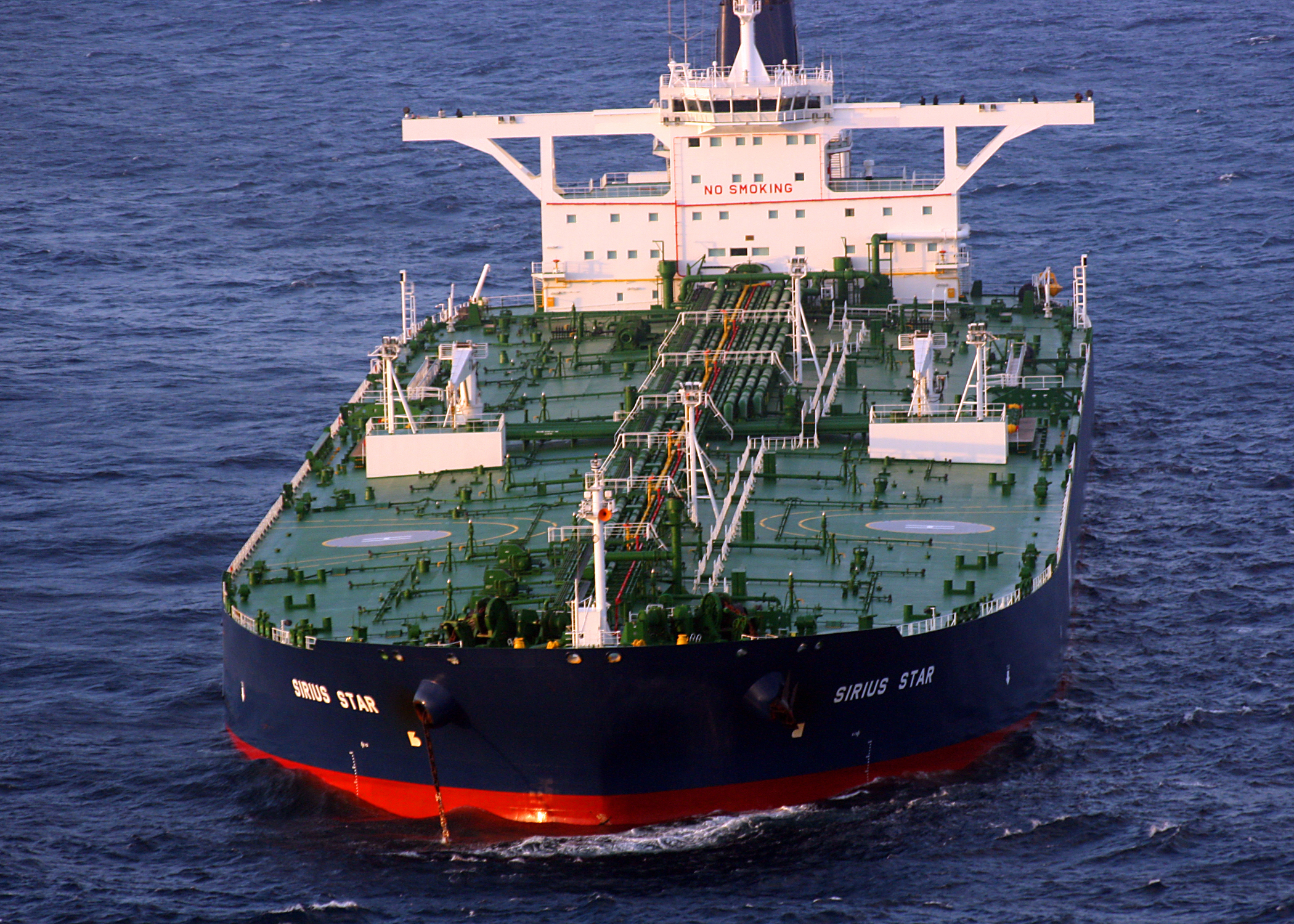
Cover image: the very large crude carrier Sirius Star at anchor. US Navy photo by William S. Stevens, public domain, via Wikimedia Commons.