Friday, July 24, 2026, and after a brutal Thursday the tape is trying to find its feet, with the help of an earnings print almost nobody expected to matter this much. Intel reported after the close and cleared every line, growing revenue 25 percent for its fastest quarter in nearly fifteen years, and the stock is up about 4 percent pre-market even against a savage overnight selloff in Asian chips. That steadies US futures, with S&P 500 futures up about 0.2 percent, Dow futures up 0.4 percent and Nasdaq 100 futures barely positive, after Thursday handed the Magnificent Seven a roughly $800 billion single-day loss on the back of Alphabet and Tesla’s ballooning AI spending. But the calm is fragile, because the macro underneath got worse overnight. Oil crossed $100 a barrel for the first time since May after Iran-backed Houthis struck two Saudi tankers in the Red Sea, the odds of a September Fed hike jumped to roughly 80 percent, and President Trump’s new tariffs on sixty trading partners went live at one minute past midnight. American Express and Verizon both beat before the bell.
Top Call: The Chips Are Selling, So Fade the Capex Panic and Fear the Macro Instead
The one thing to carry into the open is that Intel just answered Thursday’s capex panic from the other side of the trade, and the answer was loud. The market spent all of Thursday punishing Alphabet and Tesla for spending too much on AI and posting negative free cash flow, treating rising capex as a wound. Then Intel printed revenue of $16.1 billion against a $14.4 billion estimate, adjusted earnings of 42 cents versus 21 cents expected, a 59 percent surge in its Data Center and AI segment, and guidance above consensus, and it raised its own 2026 capex to $20 billion and said it may tap the capital markets to fund even more building. Read those two days together and the capex fear looks misplaced. The hyperscalers are not spending into a void, they are spending because the chips are selling, and the clearest proof is that a company as recently troubled as Intel just posted its best growth since 2011 and is confident enough to lift its own spend. The tell in this cycle is not the spenders’ free cash flow, it is the suppliers’ order books, and they are full. We stay constructive on the picks-and-shovels layer, memory, foundry and compute, and would fade the Mag7 capex panic rather than chase it. What we would not fade is the macro. Oil above $100, tariffs on sixty countries and an 80 percent chance of a September hike is a genuine stagflation-lite cocktail, and that, not AI, is the real risk on this screen. Written pre-market, so levels will move by the open.
Intel: The Turnaround Stops Being a Story and Becomes a Number
For two years Intel has been the market’s favorite show-me stock, and last night it stopped asking for patience and simply delivered. Revenue rose 25 percent year over year to $16.1 billion, the fastest growth rate the company has managed in almost fifteen years, and it beat the Street by nearly $1.7 billion. Adjusted earnings of 42 cents doubled the 21 cents analysts expected. The engine was the Data Center and AI segment, up 59 percent, which is exactly the part of Intel that the bears had written off as permanently lost to Nvidia and the custom-silicon crowd. Management then guided third-quarter revenue to a range of $15.8 billion to $16.8 billion, comfortably above the roughly $15.1 billion consensus, and lifted its 2026 capital budget to $20 billion from $18 billion, signaling it will lean into the demand rather than harvest it. The stock, already up more than 160 percent this year, popped as much as 12 percent after hours before settling near a 4 percent premarket gain as the broad Asian chip selloff pulled on it.
Our take is that this print matters well beyond Intel’s own recovery, because it changes the read on Thursday’s rout. The entire capex scare rests on the idea that the AI buildout is a cost with an uncertain payoff. Intel is the counter-evidence, a supplier whose data-center order flow is accelerating fast enough to justify spending more, not less. That is the same message the memory names sent earlier this month and the same one ServiceNow sent on the software side yesterday. When the spenders, the chipmakers and the application layer all confirm the same demand, the honest conclusion is that the demand is real and the equity market is simply repricing who captures the profit and when. We read Intel as a reason to lean into the supplier layer into weakness, while keeping the position sized for a tape that can still punish anything AI-adjacent on a bad macro day.
The Macro Turn: Oil Over $100, Tariffs Live, and a September Hike Back in Play
If Intel is the reason to stay long the AI supply chain, the macro is the reason to keep the seatbelt on. Crude did the damage overnight, with Brent crossing $100 a barrel for the first time since late May, up about 7 percent on Thursday, and WTI near $92, after the Houthi strike on two Saudi tankers opened a second chokepoint in the Red Sea to go with the near-halt at Hormuz. That spike flows straight into the inflation math, and the rates market noticed. The probability of a Federal Reserve hike in September jumped to roughly 80 percent from 68 percent a day earlier, the ten-year Treasury yield pushed to about 4.70 percent, a two-month high, and the dollar firmed. The tell that this is an inflation scare rather than a simple fear trade is gold, which is oddly soft near $4,028 and struggling to hold the $4,000 line, because rising real yields are beating the safe-haven bid.
On top of the oil shock, the trade file reopened at midnight. Washington let its temporary blanket 10 percent tariff expire and replaced it with new duties of 10 to 12.5 percent on sixty trading partners, covering more than 99 percent of US imports, this time under Section 301 of the Trade Act after the Supreme Court struck down the earlier emergency-powers version. Canada, Mexico, India and the United Kingdom sit at the 10 percent floor. Our take is that the timing is what stings. A fresh, economy-wide tariff going live in the same week that oil crosses $100 stacks two independent inflation impulses on top of each other right as the Fed meets on July 28 and 29, and it is exactly the combination that turns a coin-flip on September into an 80 percent probability. The AI story is the bull case for the tape, but this macro is the bear case, and today it has the louder voice.
Asia and Europe: A Split Screen
Overnight was ugly in Asia and better in Europe, and the divide is instructive. Japan’s Nikkei fell more than 2 percent and South Korea’s Kospi dropped over 5 percent, triggering a sidecar curb, as the memory and chip names that led July’s rally were dumped in sympathy with Thursday’s Wall Street rout and the oil spike. Hong Kong’s Hang Seng closed down about 1.3 percent at 24,888 and the Shanghai Composite slipped 1.2 percent to around 3,830. The irony is sharp, because the Asian chipmakers being sold are the same suppliers whose demand Intel just confirmed, which tells you the selling was macro-driven risk reduction rather than a verdict on the business. Europe went the other way, with the Stoxx 600 up about 0.5 percent, the DAX up 0.8 percent, the CAC up 0.4 percent and the FTSE up 0.3 percent, as energy heavyweights caught the oil bid and the region shook off Thursday’s steepest drop in two weeks. STMicroelectronics remained the sore spot after Thursday’s 16 percent collapse on a profit miss, a reminder that not every chip name is riding the same wave.
Geopolitical Tracker
US-Iran, Hormuz and the Red Sea: The dominant macro risk widened again. The Houthi strike on two Saudi tankers created a working second chokepoint in the Red Sea alongside the Hormuz near-halt, and the group has threatened a full blockade of the Bab el-Mandeb Strait. Trump warned he would strike a bridge or a power plant every time a ship is targeted at Hormuz and said he holds Iran responsible for Houthi action, so the escalation ladder still points up.
Shipping and insurance: A major maritime trade group said insurers can cancel policies for vessels that pay tolls to transit Hormuz, injecting fresh uncertainty into an already stressed tanker market. That raises the effective cost of moving barrels even when they still flow, a slow-burn channel that keeps a floor under crude.
Trade policy: The new Section 301 tariffs on sixty countries are now live and, unlike the emergency-powers version the Supreme Court blocked, rest on firmer legal ground, which makes them harder to unwind. It is a quieter headline than oil this morning but a more durable inflation input.
Quick Take: Earnings That Matter
| Company | Result vs. Street | Our Read | |
|---|---|---|---|
| Intel (INTC) | Q2, after close Thu | Rev $16.1B vs $14.4B; adj EPS 42c vs 21c; Data Center & AI +59%; Q3 guide $15.8-16.8B; 2026 capex lifted to $20B; +4% premkt | The demand proof of the season; the turnaround is now a number, and it validates the whole AI supply chain |
| Alphabet (GOOGL) | Q2, Thu (recap) | Cloud +82%; 2026 capex toward $205B; negative FCF; led Thursday’s rout | The spender taking the bill; Intel’s print argues the spend is demand-led, not vanity |
| American Express (AXP) | Q2, before open | EPS ~$4.40 beat; rev ~$19.7B; stock slipped despite the beat | Solid consumer credit read, but a beat that sells off tells you the macro tape is in charge |
| Verizon (VZ) | Q2, before open | EPS ~$1.27 beat; rev ~$35.3B; stock slipped | Steady defensive cash flow; the muted reaction is about yields near 4.70%, not the quarter |
| STMicro (STM) | Q2, Thu (recap) | Missed profit; -16%, worst in Stoxx 600 | The reminder that not every chip name is on the AI curve; analog and auto demand still soft |
Our take: The two prints that define the morning are Intel and Alphabet, and they are two sides of one coin. Alphabet’s raised capex and negative free cash flow are the cost of the buildout showing up before the payoff, which is why it led Thursday’s selloff. Intel is the payoff arriving one layer down, where a supplier grew data-center revenue 59 percent and was confident enough to raise its own spend. Weigh the supplier confirmation more heavily than the spender’s cash burn, because full order books are a fact while voluntary investment is a choice. The AmEx and Verizon beats that still sold off round out the theme of the day, which is that the fundamentals are fine and the macro is the problem.
Key Events Ahead
| Date | Event | Why It Matters |
|---|---|---|
| Fri Jul 24 | AmEx, Verizon, HCA, SLB, Charter earnings | Consumer, telecom and health cross-checks; watch whether beats keep selling off |
| Fri Jul 24 | New home sales, UMich sentiment | First read on how the rate and tariff shock is hitting the consumer |
| Fri Jul 24 | Brent above $100; Red Sea shipping | Whether the second chokepoint turns a price premium into lost barrels |
| Jul 28-29 | FOMC meeting | September hike odds now near 80% as oil and tariffs stack on the inflation side |
| Ongoing | Section 301 tariffs on 60 countries | A durable, legally firmer inflation input that is harder to unwind than the last version |
Morning note, Friday July 24, 2026, written pre-market as Intel’s blowout steadies a tape still bruised by Thursday’s Big Tech capex rout. US futures are modestly higher, with the S&P up about 0.2 percent, the Dow up 0.4 percent and the Nasdaq 100 barely positive, after the Magnificent Seven shed roughly $800 billion on Thursday as Alphabet and Tesla were punished for ballooning AI spending and negative free cash flow. Intel is the counterweight, having grown revenue 25 percent to $16.1 billion for its fastest quarter in nearly fifteen years, with Data Center and AI up 59 percent, guidance above consensus and its own capex raised to $20 billion, sending the stock up about 4 percent pre-market. The macro cut the other way. Brent crude crossed $100 a barrel for the first time since May after Houthis struck two Saudi tankers in the Red Sea, WTI ran to about $92, the odds of a September Fed hike jumped to roughly 80 percent, the ten-year yield pushed to a two-month high near 4.70 percent, and gold slipped toward $4,028 as rising real yields beat the safe-haven bid. Trump’s new tariffs on sixty trading partners went live at midnight under Section 301. Asia sold off hard, with the Kospi down more than 5 percent on a sidecar curb, the Nikkei off 2 percent and the Hang Seng down 1.3 percent, while Europe recovered, the Stoxx 600 up 0.5 percent and the DAX up 0.8 percent. American Express and Verizon both beat but slipped, the VIX rose to 18.7 and bitcoin eased toward $65,000. We read the setup as a real and confirmed AI-demand cycle, best played through the supplier layer, colliding with a genuinely hostile macro of oil, tariffs and a live hike risk that has the upper hand into the FOMC. For internal use only. Not investment advice.
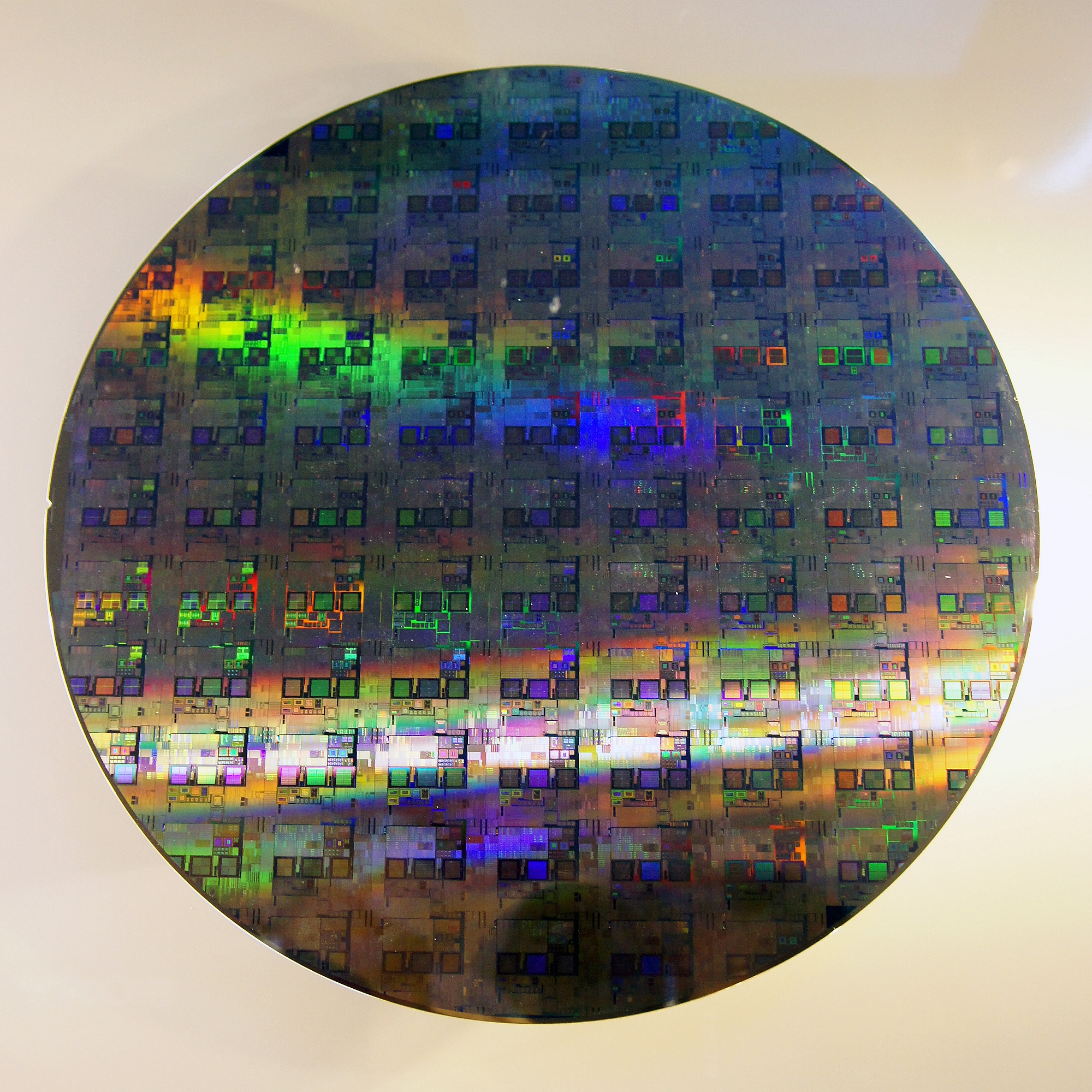
Cover image: a 12-inch silicon wafer patterned with integrated-circuit dies. Photo by Peellden, licensed under CC BY-SA 3.0, via Wikimedia Commons.