Monday, July 27, 2026, and the week that everyone spent the weekend dreading has opened with a gift. The United States and Iran have now gone a third consecutive day without striking each other, Tehran said on Sunday that it will keep holding fire as long as Washington does, and the oil market has responded by tearing the war premium out of the tape. Brent for September delivery fell as much as 7.6 percent to about $89.43 a barrel, its first trip below $90 since the escalation began, with West Texas Intermediate down 6.7 percent to roughly $83.37. Equity futures grabbed it with both hands. Dow futures are up 613 points at 52,737, S&P 500 futures are 0.88 percent higher at 7,512.75, Nasdaq 100 futures lead at 28,682.75 for a gain of 1.42 percent, and the Russell 2000 is along for the ride at plus 1.06 percent. Bonds rallied alongside, with the ten-year yield down about five basis points to 4.63 percent, and the VIX slid more than 5 percent to the mid-17s. Overnight in Shanghai, memory chipmaker CXMT staged one of the great listing debuts on record.
Top Call: The Fed Just Got Its Inflation Problem Solved by Diplomacy, So Own the Relief but Do Not Confuse It With a Resolution
The single most consequential number this morning is not in any equity market, it is Brent below $90. Four sessions ago crude was above $100 and the market was pricing a roughly 80 percent chance of a September Fed hike; today the barrel has round-tripped something like 13 percent and that entire inflation impulse has been handed back. That does more for the rate outlook than anything Kevin Warsh can say from the podium on Wednesday, and it explains why the bond market rallied in lockstep with stocks rather than against them, a correlation that only shows up when the driver is genuinely a supply shock unwinding rather than a growth scare. We would take the relief. Fading a de-escalation that is simultaneously lowering the oil price, lowering yields, weakening the dollar and lifting the megacap complex into the biggest earnings week of the season is a low-quality trade.
What we would not do is pay up for it as though the conflict is settled. This is a pause, not a deal. Reporting suggests one reason Washington stopped is that the Pentagon is running low on missile interceptors and air defense munitions in the region, which means the halt has an operational logic as much as a diplomatic one, and Trump’s own framing was that the US is “locked and loaded” while it talks. Qatar and Pakistan are still passing messages rather than brokering terms, and control of the Strait of Hormuz remains unresolved on the water. The practical read is that by Wednesday afternoon the marginal driver of this market stops being crude and becomes earnings and the Fed, and that handoff is where the risk sits. Written at 9:15am Eastern, so the print at the open and anything out of the Gulf can reset this before lunch.
The Oil Unwind: A Supply Shock That Deflated Faster Than It Inflated
Watch how quickly this reversed, because it tells you what the move was. Brent went from the high eighties to above $100 in roughly a week on the Houthi tanker strikes and the near-halt of Hormuz traffic, then gave the entire gain back in four sessions on nothing more than the absence of new violence. Physical barrels never actually stopped flowing in the volumes the price implied. That was a risk premium, priced off the tail of a blockade that has not yet happened, and risk premia deflate at exactly the speed at which the tail recedes. Gold, notably, went up rather than down on the day, holding near $4,098 for a gain of about three quarters of a percent, which looks contradictory next to a risk-on tape until you notice the dollar is weaker against every G10 peer and real yields are falling. Lower real yields beat a fading haven bid, and that is the cleaner explanation.
Our take is that the oil market has now correctly priced the pause and has stopped pricing the war, which leaves crude asymmetric from here. There is not much premium left to squeeze out below $90 if the calm holds, but a single tanker hit or a resumed strike puts five to eight dollars straight back in the price. For the equity market that asymmetry matters less than the level, because what the Fed and the megacaps care about is where the barrel sits when they set guidance, and today it sits somewhere the inflation math works again.
CXMT: The Supplier Bid Reaches Its Logical Extreme
The overnight headline with the longest half-life came out of Shanghai. ChangXin Memory Technologies, China’s leading DRAM maker, raised 57.92 billion yuan, roughly $8.6 billion, in Asia’s largest initial public offering of the year, then opened and ran as much as 535 percent above its 8.66 yuan offer price to 55.03 yuan before closing up 466 percent. That values the company north of 3.6 trillion yuan, about $530 billion, which makes it the most valuable company listed onshore in China, ahead of Industrial and Commercial Bank of China, and larger than Intel. A company most Western investors could not have named a month ago is now worth more than the American chipmaker that just posted the fastest growth quarter of its last fifteen years.
This is the AI supplier trade in its purest and most speculative form, and it cuts two ways. On the bullish side it is a third-party confirmation of the same thing Intel and Micron have been saying, which is that memory demand is real and the cycle has legs. On the cautious side, a debut like this is a statement about China’s cost of capital rather than about CXMT’s earnings power, and what that capital is buying is domestic capacity in commodity DRAM. High-bandwidth memory stays insulated for now, because the process and packaging gap there is measured in years and SK Hynix holds roughly 58 percent of that market, but conventional DRAM is where the Chinese build lands first. We would read CXMT as constructive for the memory narrative near-term and as a live medium-term pricing risk for the commodity end of Micron’s and Samsung’s books. It also explains the internals in Hong Kong, where the Hang Seng closed up 243 points at 25,207 with the tech sub-index adding 1.6 percent while energy names lagged for obvious reasons.
The Data: A Headline Miss That Is Not a Capex Miss
June durable goods orders landed at 8:30 and disappointed on the surface, rising 0.3 percent against a consensus looking for 1.6 percent, though May was revised a shade less bad to negative 4.0 percent. Look one line down and the story changes. Orders excluding transportation rose 0.6 percent, and non-defense capital goods excluding aircraft, the series that actually feeds the business investment line of GDP, rose 0.9 percent against an expected 0.8 percent. The headline was aircraft noise; the capex signal held. That distinction matters going into Thursday, when the advance reading of second-quarter GDP is expected at 2.3 percent and core PCE is forecast to have cooled to 0.1 percent on the month with the annual rate holding at 2.6 percent.
Germany added a second constructive data point overnight, with the Ifo business climate index rising to 86.6 in July against expectations of 86.0, a third straight monthly improvement. The composition was the encouraging part, since the expectations component jumped to 86.7 from 84.3 even as the current assessment slipped, and manufacturing sentiment improved to negative 9.6 from negative 12.5. German firms are looking through the Gulf conflict, which is a reasonable thing to do on a day when the oil price is falling. The Dallas Fed manufacturing index at 10:30 is the only other US release today and is expected at negative 12.0 against negative 15.1 prior.
Asia and Europe: A Uniform Bid
There was no dissent overnight. The Nikkei added 0.24 percent with the broader Topix up 0.60 percent, Korea’s Kospi rose 0.44 percent with the small-cap Kosdaq up 1.49 percent, and Australia’s ASX 200 gained 0.97 percent. China outperformed, with the CSI 300 up 1.15 percent to 4,702.43 and the Shanghai Composite up the same to 3,858.25, carried by the CXMT frenzy and the broader semiconductor complex. Europe opened higher across the board, with the Stoxx 600 pushing toward 650 and the DAX leading on the Ifo beat, while the Bank of England is expected to hold at 3.75 percent later this week and Singapore’s monetary authority tightened over the weekend.
The read from the overnight session is that this is a macro-driven move rather than a stock-picking one. Nothing led by more than about one and a half percent, energy underperformed everywhere, and the beneficiaries were the rate-sensitive and import-heavy corners that suffer most from expensive crude. That is the signature of a genuine discount-rate relief rally, and it is the sort of move that broadens rather than concentrates, which is a healthier setup going into megacap earnings than the narrow tape we had last week.
Geopolitical Tracker
US-Iran: Neither side has struck since Friday, when Trump declined to approve the military’s attack plan for the day, and a senior Iranian official told Reuters on Sunday that Tehran will refrain as long as Washington does. UN envoy Waltz framed it as the President giving talks “some space.” Trump himself said the Iranians are “getting more and more serious as the days go by” while stressing that the US remains ready to resume. Qatar and Pakistan continue to carry messages between the two capitals.
The constraint nobody is pricing: Reporting indicates the pause is partly driven by dwindling US stocks of missile interceptors and air defense munitions in the region. That is a materially different reason to stop than a diplomatic breakthrough, and it argues the pause is more durable in the short run and weaker as a foundation for a settlement.
Hormuz and the Red Sea: Both chokepoints remain unresolved. Traffic is recovering because the shooting stopped, not because anything structural changed, which is why the barrel can reprice violently in either direction on a single headline.
Trade: The Section 301 tariffs on roughly sixty trading partners that went live Friday remain the quiet inflation input in the background, and one that falling oil does not offset. Expect to hear it in megacap guidance language this week.
Quick Take: Earnings and Deals That Matter
| Name | Print / Deal | Detail | Our Read |
|---|---|---|---|
| CXMT (Shanghai) | IPO debut | Raised RMB57.9B ($8.6B), Asia’s biggest 2026 IPO; +535% intraday, +466% close; ~$530B cap, past ICBC and Intel | The supplier bid at its extreme; bullish for the memory narrative, a medium-term pricing risk for commodity DRAM |
| Cadence (CDNS) | Q2, after close tonight | Street $2.05 EPS (+24% YoY) on $1.58B rev (+24%); guide was $1.555-1.595B, margin 44.5-45.5%; beat all four prior quarters | The cleanest read on AI chip design demand; a raise confirms the silicon pipeline eighteen months out, not just today’s orders |
| SK Hynix | Q2, Tuesday | First print since the $29.4B Nasdaq debut; ~KRW84T revenue consensus; one estimate at KRW60.4T op profit, ~8% under the ~KRW65T street | The bar is high and HBM contract pricing is the swing factor; an operating-profit miss would test the whole memory complex |
| argenx (ARGX) | M&A | Buying Forte Biosciences (FBRX) for ~$2.2B cash at $77/share, a ~40% premium; adds anti-CD122 antibody FB102; closes Q3 | Cash-funded and pipeline-driven, priced off the July 9 vitiligo data; biotech M&A is paying up again. FBRX +39% pre-market |
| Microchip (MCHP) | M&A | Acquiring Israeli edge-AI chipmaker Hailo; terms undisclosed and immaterial to results; adds 100+ customers, 10,000+ developers | A distressed tuck-in of a company once valued above $1B; cheap optionality on edge inference, and proof the AI capital cycle has casualties |
Our take: Tonight’s Cadence print is the one to actually watch, because electronic design automation sits upstream of everything the market is arguing about. Cadence bills against chips being designed now for silicon that ships in 2027 and 2028, so a beat and raise is a forward-looking demand confirmation of a kind that neither Intel’s shipped revenue nor Alphabet’s capex plan can give you. If Cadence guides up, the argument that last week’s megacap spending is chasing a real order book gets considerably stronger before Microsoft and Meta report Wednesday. The two deals tell the other half of today’s story. argenx paying a 40 percent cash premium for a single Phase 1b asset says balance sheets are open again now that the rate scare has eased, while Microchip picking up Hailo for an undisclosed and immaterial sum says the edge-AI startup cohort is being cleared out at distressed prices. Abundant capital at the top of the stack and forced consolidation at the bottom is exactly what a maturing capital cycle looks like.
Key Events Today and This Week
| Date | Event | Why It Matters |
|---|---|---|
| Mon, 10:30am | Dallas Fed manufacturing (Jul) | Expected -12.0 vs -15.1; regional check on whether cheaper crude is reaching factory sentiment |
| Mon, 5:00pm | Cadence (CDNS) Q2 call | Upstream AI design demand; the forward-looking read the megacap prints cannot provide |
| Tue | SK Hynix Q2; Visa, Coca-Cola | First HBM datapoint since the Nasdaq listing, with one estimate 8% below the street |
| Wed, 2:00pm | FOMC decision, Warsh presser at 2:30 | No projections and no forward guidance; roughly 35% priced for a hike, and the oil collapse just took the urgency out |
| Wed, after close | Microsoft, Meta Q2 | Whether the AI spenders can fund the buildout without Alphabet’s free-cash-flow punishment |
| Thu | Apple, Amazon Q2; Q2 advance GDP; June core PCE | GDP seen +2.3%, core PCE +0.1% m/m and 2.6% y/y; the hard-data verdict on the oil and tariff impulse |
| Ongoing | US-Iran pause, Hormuz | Three days without strikes; the entire oil unwind rests on a fourth |
Morning note, Monday July 27, 2026, written at 9:15am Eastern before the opening bell, so pre-market levels can and will move by the open. The United States and Iran have now held fire for a third consecutive day after Tehran said on Sunday it would refrain as long as Washington does, and the oil market has torn out the war premium accordingly, with Brent down 7.6 percent to about $89.43 and WTI down 6.7 percent to roughly $83.37. Equity futures rallied hard on the read-through to inflation and rates, Dow futures up 613 points at 52,737, S&P 500 futures up 0.88 percent at 7,512.75, Nasdaq 100 futures up 1.42 percent at 28,682.75 and Russell 2000 futures up 1.06 percent, while the ten-year yield fell about five basis points to 4.63 percent and the VIX slipped over 5 percent to the mid-17s. Gold firmed to roughly $4,098 on a weaker dollar and lower real yields, and bitcoin held near $65,359. Overnight in Shanghai, memory maker CXMT surged as much as 535 percent in its debut after an $8.6 billion offering, closing up 466 percent at a valuation above $530 billion that makes it China’s most valuable listed company and larger than Intel. June durable goods orders missed on the headline at plus 0.3 percent against 1.6 percent expected, but core capital goods excluding aircraft rose 0.9 percent and beat, and Germany’s Ifo index improved for a third straight month to 86.6. argenx agreed to buy Forte Biosciences for about $2.2 billion in cash, and Microchip is acquiring edge-AI chipmaker Hailo. We read the setup as a genuine discount-rate relief rally that deserves to be owned but not extrapolated, since the strike halt is a pause with an operational logic rather than a settlement, and by Wednesday the marginal driver shifts from crude to the Federal Reserve and four megacap prints. For internal use only. Not investment advice.
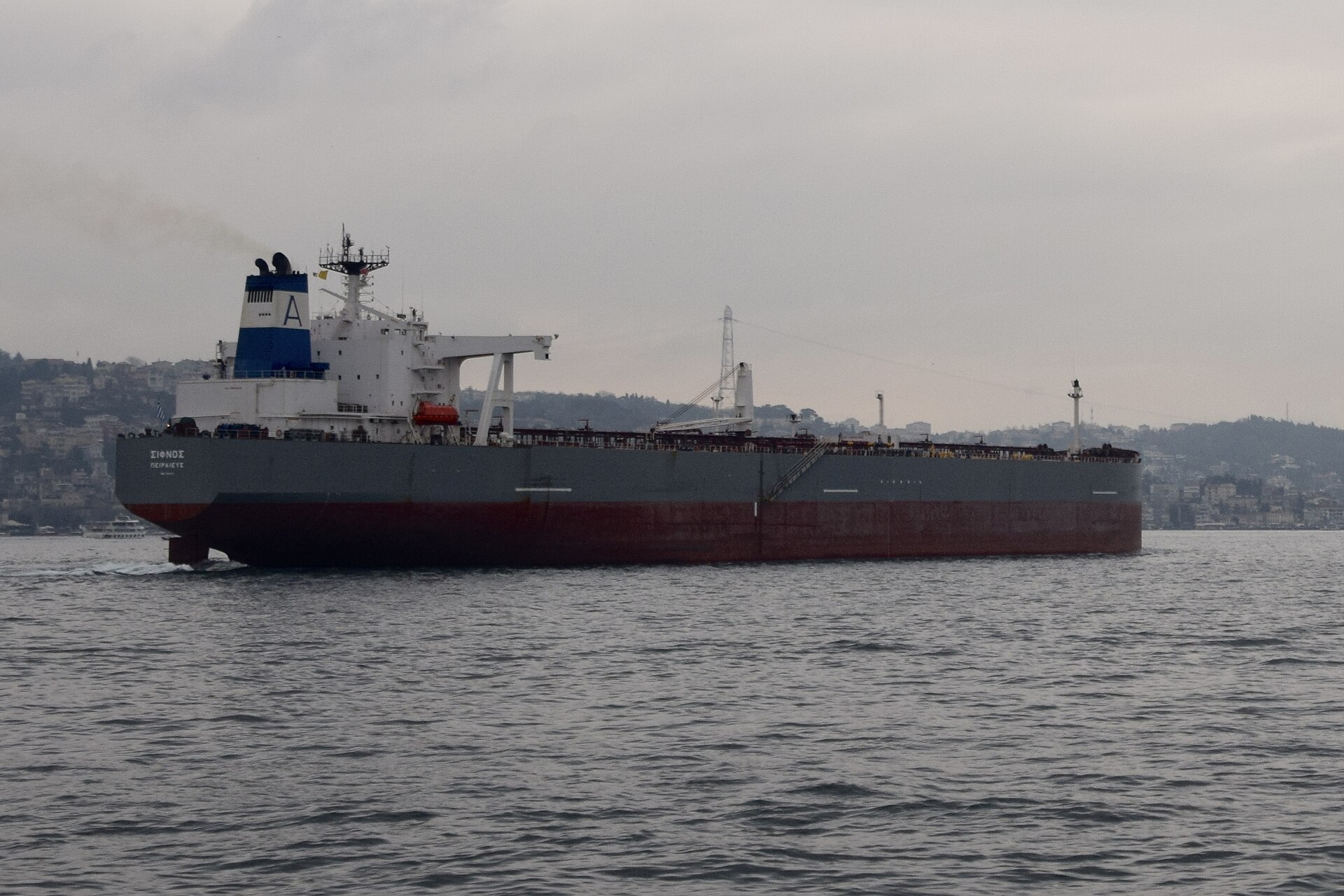
Cover image: a crude oil tanker transiting the Bosphorus Strait at Istanbul. Photo by Ank Kumar, licensed under CC BY-SA 4.0, via Wikimedia Commons.