Tuesday, July 28, 2026, and the relief rally lasted exactly one session. Overnight the global semiconductor complex came apart in a way that has no recent parallel outside of a policy shock. Korea’s Kospi crashed 10.8 percent to 6,023.66, tripping a twenty-minute market-wide circuit breaker on the way down, with Samsung Electronics off 13.4 percent and SK Hynix off 14.7 percent. SK Hynix’s US-listed shares closed at $143, below the $149 IPO price they debuted at seventeen days ago. Tokyo’s Nikkei fell 4.0 percent to 62,364.92 and Taiwan’s Taiex dropped 4.7 percent with TSMC down 3 percent. The proximate cause is a report from The Information that a state-backed enterprise in Shanghai has begun mass-producing domestically developed immersion deep ultraviolet lithography machines, which knocked ASML down 8.4 percent on Monday and dragged ASM International 7.1 percent and BE Semiconductor 9.7 percent lower with it. Underneath that sits a second story: Nvidia is in talks to guarantee roughly $250 billion of financing for OpenAI, and the market did not like the arithmetic. Yet the rest of the tape is fine. Dow futures are up 509 points at 52,891 and S&P futures are marginally higher at 7,458.50, with only the Nasdaq 100 down, at 28,013.50 for a loss of 0.63 percent.
Top Call: The Market Is Repricing a Moat, Not an Order Book, and That Is a Much Harder Thing to Bound
Five machines. That is the reported 2026 output of China’s new domestic immersion DUV line, rising to twenty next year, aimed at 28-nanometer-class production using multi-patterning as a workaround for finer geometries, with deliveries earmarked for SMIC and Hua Hong by year end. It is several generations behind what ASML ships as standard DUV today and it is not remotely comparable to EUV. Against that, ASML shed close to $44 billion of equity value in a single session, more than four times its entire implied 2026 China revenue. Those two facts cannot both be a statement about earnings. What repriced was the terminal value, and specifically the assumption that the export-control regime buys the Western toolchain a permanent rent. That assumption has taken its first real hit, and once a moat becomes a question rather than a given, no near-term revenue line is capable of settling the argument.
Our read is to respect the direction and fade the magnitude, while accepting that this is a slower story than one day of tape implies. The Chinese tool is a credible mature-node substitute, which matters enormously for power, analog, automotive and commodity DRAM, and matters very little for the leading edge that drives the AI trade’s actual profit pool. But a moat cannot be re-proven quickly, so the equipment complex should carry a wider multiple range from here even if the numbers keep beating. Written at 9:00am Eastern before the bell, so the open can and probably will move this, and note the dispersion: this is a single-theme unwind sitting inside a market where the Dow is up half a percent on consumer and industrial earnings.
Seoul: Why a Lithography Headline Cost the Memory Names Fourteen Percent
The Kospi’s 10.8 percent collapse is the part of this that deserves the most scrutiny, because on its face it makes no sense. Samsung and SK Hynix do not compete with ASML, they are among its largest customers, and a cheaper domestic Chinese alternative for mature-node lithography does nothing to their cost base or their high bandwidth memory position. The transmission runs through a different channel entirely. If China can make its own immersion DUV, then Chinese memory capacity stops being hostage to export licences, and CXMT, which listed in Shanghai yesterday at a valuation north of $530 billion and gave back 4 percent today, gets a path to scaling commodity DRAM at a cost of capital and a policy tolerance nobody else can match. That is a supply story, and supply stories kill shortage rents.
The number under attack is precise. Consensus has SK Hynix reporting roughly KRW 84.1 trillion of revenue and KRW 64.1 trillion of operating profit for the second quarter when it prints tomorrow, an operating margin somewhere around 76 percent and an all-time record by a wide margin. A 76 percent operating margin is not an equilibrium, it is a scarcity payment, and the entire memory re-rating of the past nine months has been the market slowly agreeing to capitalise it. Yesterday it found a story about how the scarcity ends. Notice what the market is not arguing about: the stock fell 14.7 percent going into what is expected to be the single best quarter in the company’s history. Nobody disputes the print. They dispute the third year of the forecast, and that is a much less comfortable debate to be long into.
Nvidia’s $250 Billion Backstop and the Return of the Circularity Question
The second blow landed Monday in New York. Nvidia is reportedly in talks to provide roughly $250 billion in financing guarantees that would let OpenAI lease a ten-gigawatt data centre being developed by SoftBank’s energy arm in southern Ohio, and separately is weighing as much as $350 billion of financing for OpenAI to buy Nvidia GPUs. The stock fell close to 5 percent and broke below $200. The objection is the obvious one and it has been made before: when the chip vendor underwrites its customer’s ability to buy the chips, reported demand and reported revenue stop being independent observations, and the roughly $750 billion of interlocking commitments Nvidia has now accumulated across the ecosystem begins to look less like a customer list and more like a balance sheet.
We think the concern is legitimate and the framing is lazy. A guarantee is a contingent liability, not revenue recognition, and vendor financing has been a normal feature of every capital-goods buildout from railways to telecom to aircraft. The real question is not whether the structure is circular, it is whether the underlying compute gets consumed by end demand that pays cash. On that, the most useful datapoint of the past twenty-four hours came from a company nobody was watching. Cadence beat and raised on Monday night, with revenue up 24 percent to $1.584 billion, adjusted EPS of $2.11 against $2.05 expected, full-year guidance lifted to $8.05 to $8.15, and a record backlog of $8.1 billion. Cadence bills against chips being designed now for silicon that ships in 2027 and 2028, and it takes no money from Nvidia. That is a clean, uncontaminated read on forward silicon demand, and it accelerated.
The Rotation Underneath: This Is Not Risk-Off
Look past the semis and the tape is genuinely healthy. Dow futures are up 509 points, the Russell is positive, the VIX is unchanged at 18.64, and credit is not signalling anything. Coca-Cola beat and raised and is up 3 percent pre-market, UPS beat on both lines and lifted full-year guidance, Boeing delivered 171 aircraft and turned free cash flow positive, and the FTSE 100 and Stoxx 600 are both higher on the back of consumer results including Unilever. A market where the Dow rises almost a percent while the Nasdaq 100 falls two thirds of a percent is not deleveraging, it is reallocating.
The single most telling scoreboard entry is that Apple has retaken the title of the world’s largest company at roughly $4.96 trillion, passing Nvidia at about $4.8 trillion and closing on $5 trillion. Apple is the megacap carrying the smallest AI capital expenditure bill of the group. Three months ago that was the bear case on the stock. Today it is the reason it is winning, and the same logic explains why Alphabet was punished last week for a capex plan running toward $205 billion. The market has moved from paying for AI ambition to paying for AI-adjacent cash generation, and the last four sessions have all been variations on that single trade.
Rates, the Fed and the Oil Assist
The macro backdrop is quietly doing the equity market a favour. The ten-year yield eased three basis points to 4.63 percent, the two-year sits at 4.31 percent and the thirty-year at 5.12 percent, and the Federal Open Market Committee convenes today for a decision tomorrow afternoon with the funds rate at a 3.75 percent upper bound. September hike odds have fallen back to roughly 56 percent from the 80 percent the market was pricing at the peak of the oil spike less than a week ago, and that repricing is entirely the work of crude. Brent is down a third consecutive session to $84.52 and WTI to $81.80, having closed Monday 11.3 percent lower, which means the barrel has now given back more than fifteen dollars from its high above $100.
That matters for tomorrow. Kevin Warsh walks into the press room with an inflation impulse that has largely self-corrected, which removes the pressure to sound hawkish and lets him hold without committing to anything. The risk in the other direction is that a chip-led equity drawdown plus a cooling barrel gives the doves an opening, and any hint of that would be read as a growth worry rather than a gift. Conference Board consumer confidence at 10am is the only data point between here and the decision, with June at 91.2 and consensus expecting modest improvement.
Geopolitical Tracker
US-Iran: A fourth consecutive day without strikes. Trump described the discussions as “good talks” and separately as “friendly,” while Iran’s Foreign Ministry publicly denied that any negotiations are underway and said Tehran “will never allow the United States to determine the timing of war and peace.” That contradiction is not necessarily a bad sign, since Iranian domestic politics require the denial, but it does mean there is no framework in place and no verification mechanism.
Hormuz: Still the binding constraint. Fewer than ten commodity vessels transited on Monday morning against roughly one hundred on a normal pre-war day. Traffic is recovering because the shooting stopped, not because anything structural was resolved, so the barrel remains a single headline away from a five to eight dollar repricing in either direction.
Oman: Muscat has launched a regional diplomatic push aimed at a political settlement, joining Qatar and Pakistan as message-carriers. Three separate intermediaries is a sign of activity and also a sign that no single channel has traction.
Technology controls: The DUV report is now a geopolitical story as much as a market one. If Beijing can domestically source immersion lithography for mature nodes, the marginal effectiveness of the existing export-control architecture declines, and the policy response is likely to be tighter rules on EUV-adjacent components and materials rather than an acceptance of the status quo. That is a live risk for the equipment names in both directions.
Quick Take: The Earnings That Actually Matter
| Name | Detail | Our Read | |
|---|---|---|---|
| Cadence (CDNS) | Q2 beat and raise | Rev $1.584B (+24.2%), adj EPS $2.11 vs $2.05; FY guide up to $8.05-8.15 from $7.85-7.95; record $8.1B backlog; +3.5% after hours | The most important print of the week and nobody is discussing it. Uncontaminated forward read on 2027-28 silicon, and it accelerated |
| SK Hynix | Q2, tomorrow | Consensus ~KRW84.1T rev, ~KRW64.1T operating profit, ~76% margin, an all-time record; stock fell 14.7% into it | The quarter is not the debate. HBM contract pricing commentary and any capex signal are what the memory complex trades on |
| Coca-Cola (KO) | Q2 beat, raised FY | Adj EPS $0.97 vs $0.93; rev $13.38B vs $13.16B; zero-sugar volume, concentrate pricing, World Cup lift; +3% pre-market | Pricing power intact with no volume give-back. The defensive bid has a fundamental leg, not just a rotation leg |
| UPS | Q2 beat, raised FY | Adj EPS $1.76 on $1.5B adj profit; GAAP net $604M vs $1.28B yr-ago; FY guide to $91.2B rev and ~$7.22 adj EPS | Turnaround is converting. The GAAP-to-adjusted gap is large and worth watching, but the guidance raise is the signal |
| Boeing (BA) | Rev beat, loss wider | Rev $24.6B (+8%) vs $24.26B; 171 deliveries (+14%); FCF positive; defense to a $15M operating loss on a $280M Air Force One charge | Commercial is finally working and cash turned. The charge is contained and known; we would look through it |
| Nvidia (NVDA) | No print, financing news | Reportedly weighing ~$250B of guarantees for a 10GW OpenAI lease plus up to $350B of GPU purchase financing; ~$750B of ecosystem commitments; -5% Monday, below $200 | A contingent liability, not revenue. But disclosure quality now matters more than the next beat, and the market has said so |
Our take: The scoreboard this morning splits along a line that has nothing to do with quality and everything to do with theme. Coca-Cola, UPS and Boeing all delivered and are being rewarded, which is what a functioning earnings season looks like. Cadence delivered the most consequential result of the group and was almost entirely ignored, because a beat and raise from an electronic design automation vendor does not fit either of the two narratives the market woke up arguing about. That asymmetry is the opportunity. If the bear case is that AI demand is circular and the Western toolchain moat is eroding, then a record design backlog from a company with no Nvidia funding and no China exposure to speak of is the single cleanest piece of contradicting evidence available, and it was published nine hours before the rout. Boeing is the other one worth flagging: 171 deliveries and positive free cash flow is the first quarter in a long time where the commercial business looks self-funding, and the Air Force One charge is a known, bounded, non-recurring item that the headline loss number obscures.
Key Events Today and This Week
| Date | Event | Why It Matters |
|---|---|---|
| Tue, 10:00am | Conference Board consumer confidence (Jul) | June was 91.2; the only data between here and the Fed, and a soft print reads as growth risk now rather than rate relief |
| Tue, after close | Visa FQ3; Ford Q2 | Visa street $3.23 on $11.35B is the cleanest read on consumer spend velocity; Ford street $0.36 with tariffs and EV losses in focus |
| Tue-Wed | FOMC convenes, decision Wed 2:00pm, Warsh presser 2:30 | Hold is the base case with roughly 35% priced for a move; September hike odds have fallen to ~56% as crude gave back $15 |
| Wed | SK Hynix Q2 | Record consensus into a 14.7% one-day drawdown; HBM pricing commentary is the swing factor for the whole memory complex |
| Wed, after close | Microsoft, Meta Q2 | The first megacap capex updates since Alphabet was punished for spending. The market’s tolerance has narrowed further this week |
| Thu | Apple, Amazon Q2; Q2 advance GDP; June core PCE | GDP seen +2.3%, core PCE +0.1% m/m and 2.6% y/y; Apple prints days after retaking the largest-company title at $4.96T |
| Ongoing | US-Iran, Hormuz | Fourth day without strikes, but Tehran denies talks exist and transit is still under 10% of normal volume |
Morning note, Tuesday July 28, 2026, written at 9:00am Eastern before the opening bell, so pre-market levels can and will move by the open. A report from The Information that a state-backed Shanghai enterprise has begun mass-producing domestic immersion DUV lithography machines, five this year and twenty next, at 28-nanometer capability and destined for SMIC and Hua Hong, triggered a global semiconductor unwind that took ASML down 8.4 percent on Monday and erased roughly $44 billion of its equity value. Asia amplified it overnight, with Korea’s Kospi crashing 10.8 percent to 6,023.66 through a twenty-minute circuit breaker, Samsung down 13.4 percent, SK Hynix down 14.7 percent with its US-listed shares closing at $143 against a $149 IPO price, the Nikkei down 4.0 percent to 62,364.92 and Taiwan’s Taiex down 4.7 percent. Hong Kong bucked it at 25,310.85 for a gain of 0.4 percent while Shanghai fell 1.2 percent to 3,813.31. Compounding the pressure, Nvidia is reportedly weighing roughly $250 billion of financing guarantees for an OpenAI data centre lease plus as much as $350 billion for GPU purchases, reviving the circular-financing debate and knocking the stock nearly 5 percent below $200. The rest of the market held up: Dow futures are up 509 points at 52,891, S&P futures up 0.14 percent at 7,458.50 and the Russell positive, with only the Nasdaq 100 lower at 28,013.50, down 0.63 percent. Coca-Cola beat and raised on $0.97 adjusted EPS and $13.38 billion of revenue, UPS beat and raised, Boeing topped on revenue with 171 deliveries and positive free cash flow despite a $280 million Air Force One charge, and Cadence beat and raised Monday night with a record $8.1 billion backlog. Brent fell a third session to $84.52 and WTI to $81.80 as the US-Iran strike pause held a fourth day, the ten-year eased to 4.63 percent, gold slipped to $4,031.70 and bitcoin fell to $63,408. The FOMC convenes today ahead of Wednesday’s decision. We read this as a terminal-value repricing of the Western equipment moat rather than an earnings event, layered onto a market already questioning how AI capex is being funded, and we would respect the direction while fading the magnitude. For internal use only. Not investment advice.
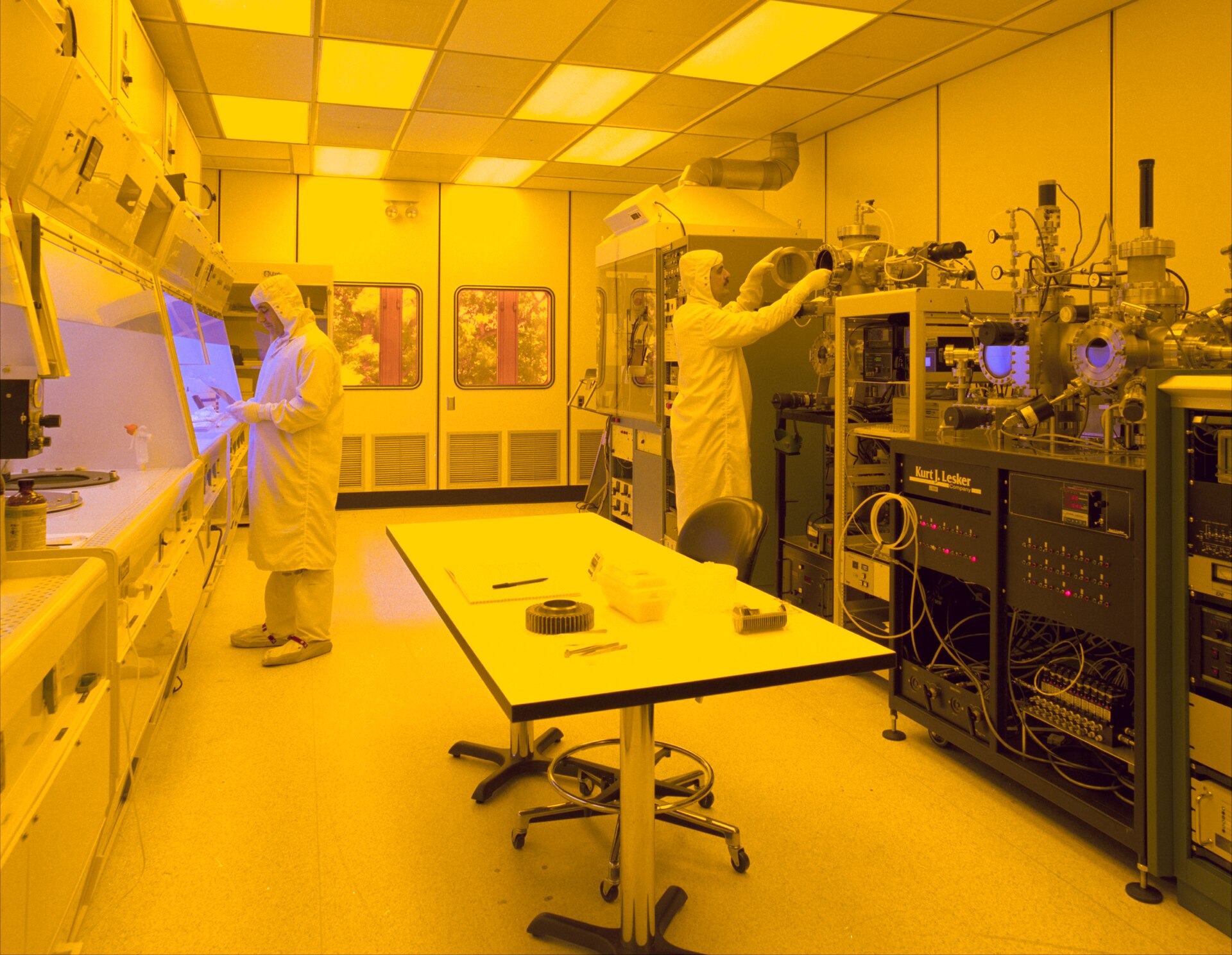
Cover image: a photolithography cleanroom under yellow safelight, the illumination used to protect photoresist during wafer exposure. Photo by Duk, released into the public domain via Wikimedia Commons.