Wednesday, July 29, 2026, and two separate things broke overnight that happen to point the same direction. SK Hynix reported the most profitable quarter any memory company has ever produced, with revenue of KRW 79.32 trillion and operating profit of KRW 60.54 trillion at a 76 percent operating margin, up 557 percent year on year, and the market treated it as a miss because consensus wanted roughly KRW 84 trillion and KRW 64 trillion. The Kospi fell as much as 9.8 percent, tripped a market-wide circuit breaker for the second consecutive session, a first in the index’s history, and closed down 5.98 percent at 5,663.24. That is more than 18 percent off in two days and roughly 40 percent below the June high, putting July on track to be the worst calendar month the Kospi has ever recorded. Meanwhile Iran’s Revolutionary Guard fired ballistic missiles at US forces in the Middle East late Tuesday, CENTCOM intercepted all of them, and President Trump told Fox News that Iran is “going to get a beating.” Brent jumped 6.6 percent to $89.61 and WTI 6.4 percent to $84.31. The Federal Reserve announces at 2:00pm Eastern into all of it.
Top Call: A Record Quarter Is Now a Miss, and That Is the Whole Story of This Market
SK Hynix earned a 76 percent operating margin. Gross margin was 83 percent. First-half revenue passed KRW 100 trillion for the first time in the company’s existence. DRAM average selling prices rose about 30 percent sequentially and NAND rose in the mid-50s, enterprise SSD revenue doubled quarter on quarter, and HBM4 began mass shipments with a production ramp scheduled for the second half. On any reading of the business, this was an extraordinary print. The stock fell 9.61 percent, having been down more than 18 percent intraday, and took the entire Korean market through a circuit breaker with it.
The gap between those two facts is where the actual information is. What management did not provide was a shareholder return policy or, more importantly, the pricing mechanism behind the long-term supply agreements it has now finalised with roughly ten major customers. Those agreements were presented as securing supply stability. Investors wanted them presented as securing price. With CXMT freshly capitalised out of Asia’s largest IPO of the year and Chinese domestic lithography now a live story rather than a theoretical one, the only thing that would settle the debate about whether a 76 percent margin is durable is a contracted price floor with a stated duration. Management gave volume and withheld price, and a market that has spent nine months capitalising scarcity read the omission as negotiating leverage starting to move toward the buyer. Written at 8:45am Eastern before the bell, so the open will move this.
We were half wrong yesterday and it is worth saying so plainly. We wrote that we would respect the direction of the chip unwind and fade the magnitude. The direction held. The magnitude did not fade at all. Korea got worse rather than better, the Nasdaq 100 closed in correction territory, and the Philadelphia Semiconductor Index went into a bear market, down more than 20 percent from its high. Fading a repricing on day two was premature, and the lesson we take is that when the argument is about terminal value rather than a quarter, there is no natural stopping point that earnings can supply.
Seoul: The Anatomy of a Twenty Percent Two-Day Drawdown
The mechanics of the Korean move deserve attention because they are partly structural rather than fundamental. SK Hynix closed down 9.61 percent at KRW 1,401,000 and Samsung Electronics down 5.23 percent at KRW 208,500, but the intraday lows were far uglier, at roughly 18 percent and 13 percent respectively. The Kosdaq was down more than 10 percent at one point. Kioxia fell 13.85 percent in Tokyo and SoftBank Group dropped 6.95 percent, dragging the Nikkei down 1.49 percent to 61,434.19. When two names carry as much index weight as Samsung and SK Hynix do in Korea, passive and index-tracking money has no way to express a view on memory pricing without selling the country, so the benchmark becomes the instrument and the move overshoots what any individual analyst would justify.
One number in the release deserves a caveat rather than a celebration. Reported net income of KRW 93.92 trillion exceeds reported revenue of KRW 79.32 trillion, a net margin of 118 percent, which is arithmetically impossible from operations alone and reflects large non-operating items rather than trading performance. It should not be annualised or used in any multiple. The operating line is the real one, and the operating line was excellent and still short of what the market required.
The balance sheet is the underappreciated part of the story. Cash rose KRW 33.6 trillion in the quarter to KRW 88 trillion against KRW 18.6 trillion of debt, leaving a net cash position of KRW 69.4 trillion. A company with that much cash, generating that much operating profit, that declines to say anything about returning capital while its stock is being marked down on a terminal-value argument, is making a choice about how it wants to be valued. Management flagged phased investment in the P&T7 packaging facility, the M17 NAND base and a new cluster while promising capital expenditure discipline. Discipline and a new cluster in the same sentence is not a message, and the tape said so.
The Oil Shock That Cost Nothing and Repriced Everything
Late Tuesday the Islamic Revolutionary Guard Corps launched what CENTCOM called an attempted surprise attack, firing multiple ballistic missiles at US forces in the region. Initial US estimates put the count at no more than four. All were intercepted, with five interceptions reported over Jordan, where a US airbase and a Central Command facility were among the targets. There were no reported US casualties. Separately, Iran-aligned militias operating from Iraqi territory launched drones at Saudi oil facilities in the Eastern Region for a second consecutive day, and Saudi air defences destroyed them without any disruption to production. US and Saudi forces conducted joint strikes on Iran-aligned targets in Iraq on Tuesday in retaliation for more than thirty drone attacks over seventy-two hours, killing at least twenty members of the Popular Mobilisation Forces.
Add that up and the physical outcome is zero barrels lost. Every projectile was intercepted, no facility was damaged, no export terminal stopped loading. Brent still rose 6.6 percent, recovering roughly a third of the collapse from above $100 down to $84.52 over the preceding four sessions. That is a pure risk-premium move, and it tells you something uncomfortable about how thin the market’s confidence in the pause always was. The four-day de-escalation was worth about sixteen dollars a barrel. One night of intercepted missiles bought back about five and a half of them, and Trump’s promise of retaliation means the next leg is a policy decision rather than a market one.
The consequence that matters is not the barrel, it is the curve. Odds of a September hike, which had fallen to roughly 56 percent on Monday as crude collapsed, are back near 76 percent this morning. Twenty points of policy expectation moved on an event that destroyed no supply. The transmission from Hormuz to the front end of the Treasury curve is now fast enough that geopolitical headlines are effectively monetary policy inputs, and that is the single most important structural feature of this market right now.
What Warsh Actually Has to Do at 2:00pm
The decision itself is close to settled. Consensus and futures both point to a hold at a 3.50 to 3.75 percent range, the fifth consecutive meeting without a move, with roughly a third of the market still pricing a hike, which is an unusually wide distribution this close to a meeting. There is no Summary of Economic Projections and no dot plot at this meeting, so the entire information content of the afternoon sits in the statement language and Kevin Warsh’s press conference at 2:30pm. This is only his second meeting as Chair, and he told Congress on July 14 that the Fed has no tolerance for persistently elevated inflation.
His problem is that the inflation impulse he could comfortably ignore on Monday came back on Tuesday night. Between Friday and this morning the case for sounding relaxed about energy has been substantially weakened by a 6.6 percent move in crude that had nothing to do with the underlying supply and demand balance. He is caught between two bad framings. If he treats the oil move as noise, the September curve prices further tightening anyway and he loses control of the narrative. If he treats it as a genuine risk, he validates a hike into an equity market where the Nasdaq 100 is already in correction and the semiconductor index is in a bear market, and where the ten-year at 4.61 percent has done none of the work for him. The most likely outcome is a hold with language that keeps every option live and commits to nothing, which is the correct policy and also the least satisfying thing markets can receive on a day this jumpy.
Vertiv Is the Number Nobody Is Talking About
The most useful earnings datapoint of the morning is not from a chipmaker. Vertiv beat on both revenue and earnings and is down 13 percent pre-market because organic revenue growth decelerated to 17.8 percent year on year against a FactSet consensus of 23.6 percent. Vertiv builds the power distribution and thermal management systems that AI data centres physically require. It is about as close to a pure read on capital expenditure actually landing on the ground as the public market offers, and it does not depend on any single customer’s narrative.
A nearly six-point organic growth shortfall from that company, on the same morning that Microsoft and Meta prepare to guide capital spending after the close, is a genuine question rather than a rounding error. Either orders are lumpy and this is timing, or the conversion of announced capex into shipped, installed and revenue-recognised equipment is running slower than the headline commitment numbers imply. Both explanations are plausible and only one of them is benign. Consensus has Microsoft at $4.24 of earnings on roughly $87.62 billion of revenue for the June quarter, with fiscal 2027 capex estimates now near $190 billion against $65 billion in fiscal 2025, and Meta at $7.23 on $60.26 billion with 2026 capex tracking around $138 billion inside a guided range of $125 billion to $145 billion and 2027 estimates near $173 billion. Alphabet was punished last week for spending. The market’s tolerance has narrowed since. Tonight is the test of whether the punishment is now automatic.
The Rotation Trade Gets Its First Real Test
Tuesday was a textbook rotation. The Dow rose 537.24 points, or 1.03 percent, to 52,747.32 while the Nasdaq Composite slipped 0.22 percent to 24,876.91 and the S&P 500 added 0.21 percent to 7,428.78. Money left AI beta and bought cash flow. SanDisk fell 14 percent, AMD, Arm, Micron and Seagate all lost more than 8 percent, Dell fell 8.1 percent and Intel 5.8 percent, while the index went up.
This morning that trade is being tested for the first time. Dow futures are down 359 points at 52,585 while Nasdaq 100 futures are essentially unchanged at 27,913 and S&P futures are flat at 7,463.75. The defensive leg is the one giving ground, helped by Procter and Gamble missing on revenue at $21.2 billion against a $21.38 billion consensus, with net income down to $3.04 billion from $3.62 billion a year ago and the stock off more than 3 percent. Elsewhere the results were good: GE HealthCare rose 12 percent on $1.13 of adjusted earnings against $1.04 expected with full-year guidance reaffirmed, Generac gained 5.5 percent on $2.91 versus a $2.01 forecast, and Biogen beat and raised. Ford closed Tuesday’s session with a 7.2 percent after-hours gain on a 42-cent adjusted quarter and a raised full-year EBIT outlook of $10.5 billion to $11 billion despite more than $1 billion of tariff costs, and Visa beat modestly at $3.32 on $11.63 billion.
Europe is the tell that this is sector rotation and not a global risk-off. The Stoxx 600 opened at 646.90 and is holding, with energy and mining leading, the DAX up around 0.3 percent and Rio Tinto up 2.5 percent on its best first half in four years. Hong Kong went the other way from Seoul entirely, with the Hang Seng up 233 points or 0.9 percent to 25,469 on bargain hunting, while mainland benchmarks were dragged lower by chips. A world in which Korean memory falls 6 percent, Hong Kong rises 0.9 percent and European miners lead is not deleveraging. It is a very specific asset class being repriced.
Geopolitical Tracker
US and Iran: The four-day strike pause is over. The IRGC fired ballistic missiles at US positions late Tuesday and framed it as continuing resistance while threats persist. All were intercepted. Trump has promised heavy retaliation, so the next escalation is scheduled rather than random, which is a different risk profile than the past week and arguably a worse one for anyone short volatility into the close.
Hormuz: The IRGC intercepted three oil tankers in the Strait. Iran has rejected Oman’s proposal for a joint management mechanism and countered with unilateral management of its own side, which is a rejection dressed as a counteroffer. The transit constraint remains the binding variable for crude and it has not improved.
Saudi Arabia: A second consecutive day of drone attacks from Iraqi territory on Eastern Region petroleum facilities, all intercepted, no production impact. Riyadh has reserved the right to respond at a time of its choosing and has asked Baghdad to stop its territory being used as a launchpad. Saudi participation in Tuesday’s joint strikes in Iraq means the Kingdom is now an active party rather than a target, which widens the conflict’s geography.
Israel: Trump met Netanyahu at the White House on Tuesday. Reporting indicates Netanyahu pressed the case on a suspected Iranian nuclear facility under construction referred to as Pickaxe Mountain. A strike on a hardened nuclear site would be a materially different event from intercepted missiles and is the tail risk worth naming.
Quick Take: The Earnings That Actually Matter
| Name | Detail | Our Read | |
|---|---|---|---|
| SK Hynix | Q2 record, missed | Rev KRW79.32T (+257% YoY) vs ~84T est; OP KRW60.54T (+557%) vs ~64T; 76% op margin, 83% GM; DRAM ASP +~30% QoQ, NAND +mid-50s; HBM4 mass shipments started; net cash KRW69.4T; -9.61% | The quarter was never the debate. Ten long-term agreements disclosed without a pricing mechanism, and no shareholder return policy, is the market’s answer on whether the rent is contracted or spot |
| Vertiv (VRT) | Q2 beat, growth decel | Beat on revenue and EPS but organic growth +17.8% YoY vs 23.6% FactSet consensus; -13% pre-market | The most informative print of the morning. Closest public read on AI capex physically landing, and it slowed materially the day two hyperscalers guide |
| Microsoft (MSFT) | FQ4, after close | Street $4.24 EPS on ~$87.62B rev, +15%; FY27 capex consensus near $190B versus $65B in FY25 | A softer FY27 capex number is now the bull case, a complete inversion of how this stock traded a year ago. Azure growth alone will not carry it |
| Meta (META) | Q2, after close | Street $7.23 EPS on $60.26B rev vs $5.16 and $47.52B a year ago; 2026 capex ~$138B in a $125-145B guided range; 2027 estimates ~$173B | Meta has the weakest capex-to-cash-flow story of the megacaps and the least tolerant shareholder base right now. Any raise at the top of the range gets sold |
| Lam Research, Arm, Qualcomm | After close | Lam FQ4 after an FQ3 with $5.84B revenue and record $1.47 non-GAAP EPS; Arm and Qualcomm both report tonight | Lam is the cleanest test of whether the China domestic-tool narrative is showing up in real Western semicap orders yet, or is still purely a multiple story |
| P&G, GEHC, Generac, Biogen, Ford, Visa | Mixed, mostly good | P&G rev $21.2B vs $21.38B, net income $3.04B vs $3.62B, -3%; GEHC $1.13 vs $1.04, +12%; Generac $2.91 vs $2.01, +5.5%; Biogen beat and raised; Ford +7.2% AH on raised FY EBIT; Visa $3.32 vs $3.29 | The non-AI economy is fine. P&G is the one soft spot and it is a volume and mix problem, not a demand collapse. This cohort is why the Dow outperformed by 125bp yesterday |
Our take: The scoreboard has an unusual shape this morning. The two companies most central to the AI trade both delivered results that would have been celebrated three months ago and both were punished, while a healthcare imaging company and a generator manufacturer were rewarded for ordinary beats. That is not a quality signal, it is a signal about what investors are willing to underwrite. For SK Hynix and Vertiv the market is no longer paying for growth, it is paying for evidence that the growth has a contracted floor underneath it, and neither company supplied one. SK Hynix had the strongest possible opportunity to end the argument, with ten long-term agreements freshly signed and KRW 69.4 trillion of net cash on hand, and it chose to disclose the volume and withhold the price. Vertiv is the more actionable of the two because it is a physical measurement rather than a narrative: if AI capital expenditure were converting into installed equipment at the rate the commitment headlines imply, an organic growth line of 17.8 percent against 23.6 percent expected would be very hard to produce. Microsoft and Meta get to respond to that at four o’clock.
Key Events Today and This Week
| Date | Event | Why It Matters |
|---|---|---|
| Wed, pre-market | P&G, Vertiv, GE HealthCare, Generac, Biogen, General Dynamics, Aon | Already out. Vertiv’s 17.8% organic growth against 23.6% expected is the number to carry into tonight |
| Wed, 10:30am | EIA weekly crude inventories | First inventory read since the strike pause collapsed. A draw on top of a 6.6% Brent move compounds the September hike math |
| Wed, 2:00pm | FOMC decision, funds rate 3.50-3.75% | Hold is the base case with roughly a third priced for a hike. No SEP and no dot plot, so the statement language carries everything |
| Wed, 2:30pm | Warsh press conference | Only his second. He has to address a 6.6% oil move that destroyed no supply without either dismissing it or ratifying a September hike |
| Wed, after close | Microsoft, Meta, Qualcomm, Arm, Lam Research, Starbucks, Chipotle | The capex verdict. Alphabet was punished for spending last week and the market’s tolerance has narrowed since |
| Thu | Apple and Amazon Q2, Q2 advance GDP, June core PCE | Apple carries the smallest AI capex bill of the group, which is currently the reason it is winning |
| Ongoing | US retaliation against Iran | Trump has promised heavy strikes. The escalation is now scheduled rather than random, and Hormuz transit has not recovered |
Morning note, Wednesday July 29, 2026, written at 8:45am Eastern before the opening bell, so pre-market levels can and will move by the open. SK Hynix reported the most profitable quarter in its history, KRW 79.32 trillion of revenue and KRW 60.54 trillion of operating profit at a 76 percent operating margin, up 557 percent year on year with HBM4 mass shipments underway, and missed consensus of roughly KRW 84 trillion and KRW 64 trillion. The stock fell 9.61 percent to KRW 1,401,000 after trading down 18 percent intraday, Samsung Electronics fell 5.23 percent, and the Kospi tripped a market-wide circuit breaker for the second consecutive session, a first in its history, closing down 5.98 percent at 5,663.24, more than 18 percent lower in two days and roughly 40 percent below the June high. Kioxia fell 13.85 percent and SoftBank 6.95 percent, taking the Nikkei down 1.49 percent to 61,434.19, while Hong Kong rose 0.9 percent to 25,469. Late Tuesday the IRGC fired ballistic missiles at US forces, all intercepted by CENTCOM with five interceptions over Jordan, and Trump promised Iran a beating, sending Brent up 6.6 percent to $89.61 and WTI up 6.4 percent to $84.31 despite no barrels being lost. September hike odds moved from roughly 56 percent to 76 percent. Iran-backed militias hit Saudi Eastern Region oil facilities for a second day with no production impact, and Iran rejected Oman’s joint Hormuz proposal. The Nasdaq 100 closed Tuesday in correction and the Philadelphia Semiconductor Index in a bear market even as the Dow rose 537.24 points to 52,747.32. This morning Dow futures are down 359 points at 52,585 with P&G missing on revenue, while Nasdaq 100 futures are flat at 27,913 and S&P futures flat at 7,463.75. Vertiv fell 13 percent on 17.8 percent organic growth against 23.6 percent expected. The FOMC decides at 2:00pm with Warsh at 2:30pm, and Microsoft, Meta, Qualcomm, Arm and Lam Research report after the close. We read this as a market that has stopped paying for AI growth and started demanding a contracted price floor underneath it, and we were premature yesterday in fading the magnitude of the chip unwind. For internal use only. Not investment advice.
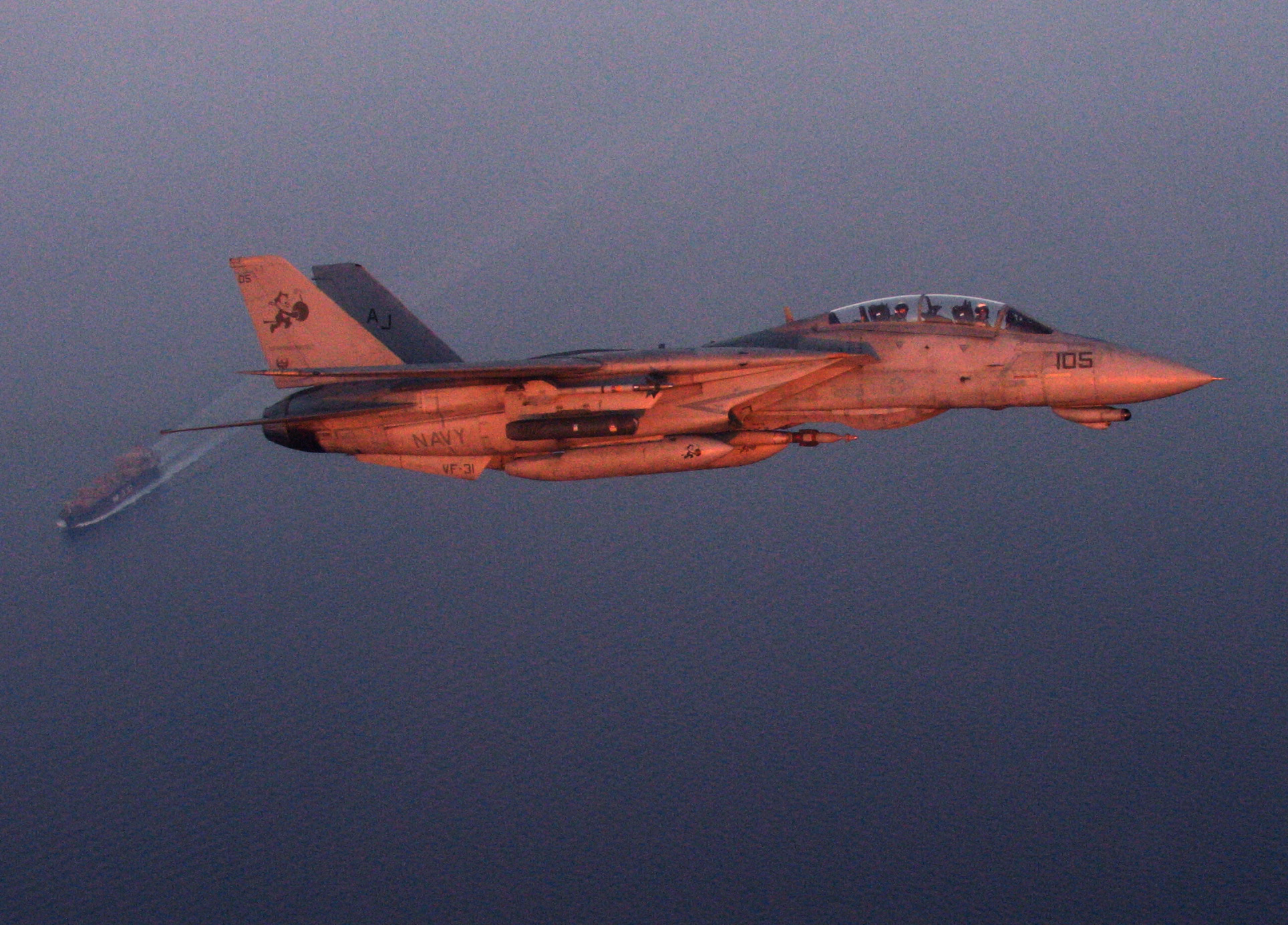
Cover image: a US Navy F-14D Tomcat banking over an oil tanker during a sunset maritime security mission in the Persian Gulf. Photo by Lt. j.g. Scott Timmester, US Navy, public domain via Wikimedia Commons.