Thursday, July 30, 2026, and the AI trade finally sorted itself into two piles overnight. Microsoft reported $90.01 billion of revenue against an $87.63 billion consensus, said Azure grew 43 percent and passed $100 billion of annual revenue for the first time, then guided fiscal 2027 capital expenditure to a range of $255 to $260 billion against roughly $190 billion this year, and the stock is up almost 8 percent pre-market. Meta reported $60.80 billion of revenue, ahead of the $59.50 billion estimate, missed on earnings at $6.18 against $7.13 to $7.22 expected, watched free cash flow fall to $784 million, and is down 9 percent. One company raised its spending by 35 percent and was rewarded. The other nudged up the bottom of its range by $5 billion and was punished. That is the whole market in two prints. Behind it, the Dow fell 1,153.18 points on Wednesday for its worst session since April 2025 after Kevin Warsh held rates with three dissents and the 30-year Treasury yield touched 5.244 percent, the highest since July 2007.
Top Call: The Split Is About Cash Conversion, Not About Spending
The convenient story for the past week has been that investors have turned against capital expenditure. Alphabet was sold for spending. Microsoft and Meta were supposed to face the same jury. Instead Microsoft told the market it would spend a quarter of a trillion dollars next fiscal year, more than a third above this year’s already enormous number, with quarterly capex topping $50 billion in the September quarter, and the stock added roughly $250 billion of market value in the after-hours session.
The distinguishing variable is whether the spending arrives attached to a revenue line the market can see and count. Microsoft’s did. Azure accelerated to 43 percent growth from 40 percent, crossed $100 billion of fiscal-year revenue, is guided to 45 percent constant-currency growth in the September quarter, and Microsoft 365 Copilot went from more than 20 million paid seats in April to more than 30 million. Net income was $35.77 billion at $4.81 per share against $27.23 billion and $3.65 a year ago. That is a company converting infrastructure into contracted software revenue in the same quarter it buys the infrastructure.
Meta’s did not. Revenue grew 28 percent, which is excellent, but expenses grew 55 percent to $42 billion, net income fell 14 percent to $15.8 billion, second-quarter capital expenditure nearly doubled year on year to $31.1 billion, and free cash flow came in at $784 million. A company with 3.6 billion users generating almost $61 billion of quarterly revenue produced less than a billion dollars of free cash. Third-quarter revenue guidance of $61 billion to $64 billion has a low end below the $63.15 billion consensus. There is no equivalent of Azure inside Meta, no line item where a customer signs a contract for the compute, so the entire spend has to be underwritten on faith that advertising engagement and future model capability will eventually pay for it.
So we would refine what we wrote yesterday. We said the market has stopped paying for AI growth and started demanding a contracted floor underneath it. The floor part was right and Microsoft supplied one. The framing was too broad. Investors will happily fund an enormous build if the seller can point to the invoice. What they will not fund is a build whose return is described rather than demonstrated. Written at 9:10am Eastern before the opening bell, so pre-market moves of this size frequently give back a third of themselves by ten o’clock.
The Bond Market Is the Regime Story and It Is Not Only About the Fed
Wednesday was ugly in a way that had little to do with equities. The Federal Open Market Committee held the funds rate at 3.50 to 3.75 percent for a fifth consecutive meeting, and three officials dissented in favour of an immediate 25 basis point hike: Beth Hammack, Neel Kashkari and Lorie Logan. Warsh, who has called inflation a choice, said afterward that he had asked for a good family fight and got one. The statement was notably shorter than the Powell-era norm. Markets took the whole package as insufficient. The 30-year rose 10.5 basis points to 5.201 percent and printed 5.244 percent intraday, a level last seen in July 2007. Mark Cabana at Bank of America called it a classic central-bank credibility shock. Robert Sockin at PGIM said the biggest failure of the press conference was that Warsh never explained why the committee held. The Dow closed at 51,594.14, down 2.19 percent, the S&P 500 fell 1.52 percent to 7,316.15 and the Nasdaq Composite lost 1.74 percent to 24,442.94, more than 10 percent below its high.
The more interesting detail is the shape of the move. The two-year yield sits at 4.26 percent this morning, two basis points lower than Wednesday. The thirty-year is at a nineteen-year high. If this were purely a hawkish repricing of Fed policy, the front end would be leading. It is not. The long end is being repriced for supply and for fiscal risk, and there is a specific new source of supply that the market has been slow to name.
Hyperscalers issued roughly $159 billion of corporate bonds in the first five months of this year, up 47 percent year on year and more than those same five companies borrowed in the previous five years combined. Amazon alone did a roughly $54 billion deal in March. Bank of America expects the group to finish the year somewhere between $140 billion and $175 billion, and total AI-related issuance is tracking toward $570 billion. Coverage ratios on those deals have been thinning. Then last night Microsoft told the market its capital budget is going to $255 to $260 billion. Some of that is funded from operating cash flow, but not all of it, and the marginal dollar competes directly with Treasury issuance for the same duration buyer. A thirty-year yield at a nineteen-year high while the two-year falls is what it looks like when the bond market decides the AI build is a fiscal event rather than a technology event.
This Morning’s Data Argues Against the Hawks
The 8:30am releases complicated the September story rather than confirming it. Second-quarter GDP grew at a 1.5 percent annualised rate in the advance estimate, against a 2.1 percent consensus and a 2.1 percent first quarter. Consumer spending, investment and exports all contributed, offset by a decline in government spending, and the deceleration came from a downturn in government outlays plus slower investment and exports. June PCE prices fell 0.1 percent on the month and rose 3.7 percent from a year earlier, down from 4.1 percent in May. Core PCE rose 0.1 percent on the month, cooler than the 0.2 percent expected, and 3.3 percent year on year from 3.4 percent. Initial claims came in at 197,000 against 187,000 prior.
Put plainly, growth undershot by 60 basis points and both inflation gauges moved the right way. That is not the data set of an economy that needs a rate hike in six weeks. Fed funds futures still put September at roughly 65 percent, up from about 55 percent going into Wednesday’s decision, and the gap between what the data says and what the curve prices is the interesting tension in this market. Our read is that the curve is not forecasting the economy, it is forecasting the Fed’s need to defend its credibility after Wednesday, which is a different and considerably less stable thing to be positioned for. If Warsh gets a second cooling print before September, the hawkish pricing has very little to hold onto except the oil complex.
Korea Got the Best Possible News and Sold It Anyway
Samsung Electronics posted the best quarter in its corporate history. Consolidated revenue of KRW 171.5 trillion was an all-time high, up 28 percent sequentially, and operating profit of KRW 89.5 trillion was up 1,814 percent year on year and ahead of the KRW 88.13 trillion consensus. It was the third consecutive record quarter. The Device Solutions division alone produced KRW 127.5 trillion of revenue and KRW 89.2 trillion of operating profit. Earnings per share rose 52 percent to KRW 10,849. Management said it has delivered samples of the industry’s first 12-layer HBM4E to major customers with more than 20 percent performance improvement over HBM4, expects third-quarter HBM4 revenue to more than triple sequentially and to account for 60 percent of total HBM revenue in the second half, and secured a 2nm high-performance computing order from a major US customer.
Then came the part that should have ended the argument outright. On the conference call Samsung said that, based on orders already in hand, it expects the supply and demand gap to widen further in 2027 than in 2026, and that capital expenditure will rise accordingly. That is the memory industry’s largest producer telling the market the shortage deepens next year. It is precisely the forward statement that SK Hynix declined to make on Wednesday.
The Kospi opened up more than 5 percent, reached 5,976.82 intraday, and closed down 1.23 percent at 5,593.56. Samsung itself traded up more than 7 percent and finished down 0.72 percent at KRW 207,000. SK Hynix fell 5.64 percent to KRW 1,322,000. The index has now lost 1,162 points, about 17 percent, in three sessions. The one soft spot in the Samsung release was the mobile division, which swung to a KRW 0.7 trillion operating loss on rising component costs even as revenue grew 13.7 percent, and that is a quiet second-order signal worth filing away: when memory prices rise this fast, the phone business inside the same building becomes the first customer to feel it.
There is a flow detail worth holding onto, because it changes the interpretation. Foreigners were net buyers of KRW 1.33 trillion, their first net purchase in four sessions, while individuals sold KRW 1.42 trillion. The seller into this bounce was domestic retail, not the international money that drove the panic on Monday and Tuesday. Retail deleveraging after a 17 percent three-day drawdown is mechanical and finite in a way that a foreign reallocation out of Korean memory would not be. Local analysts also point out that earnings estimates have not actually started coming down, so the damage so far is to sentiment and to margin balances rather than to the forecast. That does not make the tape any less painful, but it makes it a different problem, and a more solvable one, than the terminal-value argument the market was having on Tuesday.
The Strike Map Moved Into the Strait Itself
US Central Command carried out what it described as a heavy wave of strikes against Iran overnight, hitting dozens of targets in a roughly two-hour operation, in response to Tuesday’s attempted ballistic missile attack on American forces. Trump had said on Wednesday that it was America’s turn to hit them. Iranian state media reported blasts in the port city of Bandar Abbas and on Qeshm, the island that sits inside the Strait of Hormuz.
That target selection is the news, not the volume of ordnance. Bandar Abbas and Qeshm are the physical infrastructure of the Strait. Striking them puts the chokepoint itself into the exchange rather than treating it as the thing both sides are manoeuvring around. Separately, a drone hit two gas vessels at Egypt’s Damietta port on the Mediterranean, the Energos Winter floating storage and regasification unit and the LNG carrier Gaslog Salem, setting the first alight and spreading fire to the second. The crews are accounted for, the fires were controlled, and nobody has claimed responsibility, but this was the first attack on Egyptian soil in the conflict and it sits roughly two thousand miles from the Gulf. The Caspian Pipeline Consortium has suspended operations at its Black Sea terminal after tanker attacks. The Houthis have declared Saudi ships transiting toward the Indian Ocean to be targets, and shipping is looking at Suez routings as an alternative while Hormuz transits stay depressed.
Against all of that, Brent is down. It spiked above $92 overnight and has settled back to $90.41, off 0.37 percent, after surging 7.9 percent on Wednesday. WTI is at $83.29, about 1.4 percent lower. The market has been conditioned by four weeks of intercepted missiles and undamaged facilities to fade every headline, and that conditioning has been profitable. The two numbers that would break it are not headlines at all. Commercial crude inventories just posted their largest draw since mid-June, and the Strategic Petroleum Reserve has declined for eighteen consecutive weeks to its lowest level since 1983. The buffer that has quietly absorbed each of these scares is close to gone, and the next genuine supply interruption will hit a market with no policy cushion behind it.
Europe Delivers, and the Non-AI Economy Keeps Being Fine
European markets are marginally lower with the Stoxx 600 at 640.79, down 0.37 percent, the FTSE 100 at 10,573.67 and the DAX essentially flat at 25,003.98, but the corporate news underneath is good. Shell reported $9.8 billion of adjusted earnings with record upstream production in Brazil and record refinery utilisation, absorbed Middle East outages, announced a fresh $3 billion buyback and rose 1.6 percent. Rolls-Royce lifted first-half underlying operating profit 46 percent and raised full-year guidance to £4.7 billion to £4.9 billion from £4.0 billion to £4.2 billion, sending the shares up about 4 percent to near a five-year high. Rentokil fell 17 percent on weak North American residential lead flow.
In the US pre-market, Fortinet is up 10.6 percent on a beat and raised full-year guidance, Corcept is up 20.6 percent, Teladoc is down 21.9 percent on mixed results and a cut to full-year sales guidance, FTAI Aviation is down 12.8 percent and Tenable is down 11 percent. Of the roughly 95 S&P 500 companies that have reported, 88 percent have beaten estimates by a median of 7 percent. The economy outside the AI complex continues to be unremarkable in the best sense, which is exactly why the index-level drawdown has been so concentrated in a single theme.
Geopolitical Tracker
US and Iran: CENTCOM executed a heavy wave of strikes on dozens of Iranian targets in a two-hour operation overnight, following Tuesday’s intercepted missile attack on US forces in Jordan. Blasts were reported at Bandar Abbas and on Qeshm island. Iran has threatened a response and continues to insist on unilateral control of its side of the Strait.
Hormuz: Transits remain at low levels. With Qeshm and Bandar Abbas now in the target set, the chokepoint has moved from being the object of the dispute to being part of the battlefield. Shipping is actively pricing Suez alternatives.
Egypt and the Mediterranean: A drone struck the Energos Winter FSRU and the LNG carrier Gaslog Salem at Damietta, the first attack on Egyptian territory in this conflict, with no claim of responsibility and no injuries. If confirmed as part of the same campaign, it extends the maritime risk premium roughly two thousand miles west of the Gulf.
Saudi Arabia and Iraq: Both are now drawn in, with Iran-aligned militias operating from Iraqi territory and the Houthis threatening Saudi shipping bound for the Indian Ocean. The Caspian Pipeline Consortium has suspended Black Sea terminal loadings after tanker attacks, adding a Russian and Kazakh export dimension to what began as a Gulf conflict.
Quick Take: The Earnings That Actually Matter
| Name | Detail | Our Read | |
|---|---|---|---|
| Microsoft (MSFT) | FQ4 beat, capex raised, stock up | Rev $90.01B vs $87.63B est; net income $35.77B, EPS $4.81 vs $3.65 LY; Azure +43% vs 40.2% est and >$100B for FY26; Copilot >30M seats from >20M in April; FQ1 guide $89.85-90.95B, Azure +45% cc; FY27 capex $255-260B vs ~$190B; +7.8% pre-market | The cleanest possible demonstration that the market will fund an enormous build when the build has a contracted revenue line attached. Azure accelerating while capex rises 35% is the only combination that works right now |
| Meta (META) | Q2 revenue beat, EPS miss, stock down | Rev $60.80B vs $59.50B est, +28%; EPS $6.18 vs $7.13-7.22 est; expenses +55% to $42B; net income -14% to $15.8B; Q2 capex $31.1B vs $17.0B LY; FCF $784M; FY26 capex narrowed to $130-145B; Q3 guide $61-64B vs $63.15B est; -9% pre-market | Free cash flow of $784 million on $60.8 billion of revenue is the number. Meta is funding the largest build of any megacap with the least visible monetisation path and a guidance low end beneath consensus |
| Samsung (005930.KS) | Q2 record, faded the rally | Rev KRW171.5T all-time high, +28% QoQ; OP KRW89.5T, +1,814% YoY vs 88.13T est; DS division OP KRW89.2T; EPS KRW10,849, +52%; 12-layer HBM4E samples out; Q3 HBM4 revenue to more than triple QoQ; sees 2027 supply gap wider than 2026; MX operating loss KRW0.7T on component costs; closed -0.72% | Samsung gave the forward statement SK Hynix withheld and the stock still round-tripped from +7% to -0.72%. That is positioning, not fundamentals, and the foreign net buying underneath says the marginal seller is domestic retail |
| Lam Research (LRCX) | FQ4 record, guided above | Rev $6.72B; non-GAAP EPS $1.82 vs $1.72 est; record revenue, operating margin and EPS; next-quarter guide about $8.1B, ahead of forecasts; shares recovered | The most direct rebuttal to the China domestic-tool panic that started Monday. Western semicap order books have not yet seen any of it, and an $8.1B guide says the equipment cycle is still accelerating |
| Qualcomm (QCOM) | Mixed, sold | Adjusted EPS $2.21 vs $2.23 est; shares down more than 7% | Handset-levered semis are now a separate asset class from AI infrastructure semis. The multiple compression is happening to the former while the latter still gets funded, and that spread keeps widening |
| Shell, Rolls-Royce | Both beat and returned capital | Shell adjusted earnings $9.8B, record Brazil upstream, record refinery utilisation, new $3B buyback, +1.6%; Rolls-Royce H1 operating profit +46%, FY guidance raised to £4.7-4.9bn from £4.0-4.2bn, +4% | Europe is quietly having a very good earnings season in exactly the sectors the AI trade ignores. Energy with a war premium and aerospace with a raised guide are why Stoxx drawdowns keep being shallower than Nasdaq ones |
| Apple, Amazon | After the close | Amazon Street $1.82 EPS on ~$196.25B revenue, with Prime Day shifted into Q2, AWS acceleration and record advertising; Apple Street $1.89 EPS with revenue growth guided 14-17% and gross margin 47.5-48.5% | Amazon is the real test tonight. It carries the heaviest AI debt load of the group after a roughly $54B bond deal in March, so AWS growth against capex is the same question Microsoft just answered well and Meta just answered badly. Apple is the control experiment: the smallest AI bill in the group |
Our take: Two companies spent enormous sums on the same technology in the same quarter and the market moved them 18 percentage points apart. That spread is the single most useful piece of information available this morning, and it is not a judgement about artificial intelligence at all. It is a judgement about accounting visibility. Microsoft can show a customer paying for the capacity, because Azure is a metered product with a bill, so a capital budget going to $260 billion reads as a supply constraint being relieved. Meta cannot, because its capacity feeds a recommendation engine and a model roadmap whose returns arrive diffusely and later, so an identical dollar of spending reads as a cost. Samsung sits in a third category, having supplied a genuinely bullish 2027 forward statement into a market too heavily positioned to receive it. The lesson for tonight is that Amazon will be graded on whether AWS growth is visibly accelerating alongside the capex, not on the size of the capex, and Apple will be graded on almost nothing else because it has chosen not to enter this argument at all.
Key Events Today and Ahead
| Date | Event | Why It Matters |
|---|---|---|
| Thu, 8:30am | Q2 advance GDP 1.5% vs 2.1% est; June PCE +3.7% YoY, core +3.3%; claims 197K | Already out. Growth undershot and both inflation gauges cooled, which is a poor foundation for the 65% September hike pricing |
| Thu, pre-market | Mastercard, Shell, Rolls-Royce, Fortinet, Teladoc, Tenable, FTAI | Mastercard consensus $4.78 on $9.08B. The consumer payments read matters more than usual with GDP decelerating |
| Thu, after close | Apple and Amazon | Amazon is the third data point in the capex-versus-cash-flow test and the one with the largest bond stack. Apple is the megacap that opted out of the spending race |
| Fri | Roblox and the tail of megacap week, plus month-end rebalancing | July has been brutal for Korean and US semis and strong for energy, so month-end flows into a bruised tape are worth watching |
| Ongoing | US and Iran escalation | Strikes have now reached Bandar Abbas and Qeshm inside the Strait, and an unclaimed drone hit LNG vessels at Damietta in the Mediterranean |
| Ongoing | Long-end Treasury supply | The 30-year at 5.244% with the 2-year falling is a duration and supply signal. Hyperscaler issuance of $159B year to date competes directly for that buyer |
| Sept 16-17 | Next FOMC | Three dissents already want a hike. Two more cooling PCE prints between now and then would leave the hawkish camp arguing from oil headlines alone |
Morning note, Thursday July 30, 2026, written at 9:10am Eastern before the opening bell, so pre-market levels can and will move by the open. Microsoft reported fiscal fourth-quarter revenue of $90.01 billion against an $87.63 billion consensus with net income of $35.77 billion and earnings of $4.81 per share, Azure growth accelerating to 43 percent and passing $100 billion of annual revenue for the first time, Microsoft 365 Copilot above 30 million paid seats, and fiscal 2027 capital expenditure guided to $255 to $260 billion against roughly $190 billion this year, and the stock is up about 8 percent pre-market. Meta reported revenue of $60.80 billion, up 28 percent and ahead of the $59.50 billion estimate, but earnings of $6.18 per share missed by more than a dollar, expenses rose 55 percent to $42 billion, net income fell 14 percent to $15.8 billion, second-quarter capital expenditure nearly doubled to $31.1 billion, free cash flow fell to $784 million, full-year capex was narrowed to $130 to $145 billion, and third-quarter revenue guidance of $61 billion to $64 billion has a low end beneath consensus, leaving the stock down 9 percent. On Wednesday the FOMC held at 3.50 to 3.75 percent with Hammack, Kashkari and Logan dissenting for a hike, the 30-year Treasury rose 10.5 basis points to 5.201 percent and touched 5.244 percent, its highest since July 2007, and the Dow fell 1,153.18 points or 2.19 percent to 51,594.14 for its worst day since April 2025, with the S&P 500 down 1.52 percent to 7,316.15 and the Nasdaq Composite down 1.74 percent to 24,442.94. This morning second-quarter GDP printed 1.5 percent against 2.1 percent expected, June PCE fell 0.1 percent on the month to 3.7 percent year on year from 4.1 percent, core PCE rose 0.1 percent to 3.3 percent from 3.4 percent, and claims came in at 197,000. September hike odds sit near 65 percent. Samsung posted record revenue of KRW 171.5 trillion and operating profit of KRW 89.5 trillion, up 1,814 percent, said the supply and demand gap widens further in 2027, and still closed down 0.72 percent as the Kospi round-tripped from up 5.5 percent to close down 1.23 percent at 5,593.56, a three-session loss of 17 percent, with SK Hynix down 5.64 percent and foreigners net buyers for the first time in four days. US Central Command struck dozens of Iranian targets overnight including Bandar Abbas and Qeshm inside the Strait of Hormuz, a drone hit two gas vessels at Egypt’s Damietta port, and Brent nonetheless eased 0.37 percent to $90.41 after touching $92. Lam Research posted record results with a guide near $8.1 billion, Qualcomm fell more than 7 percent on a slight miss, and Shell and Rolls-Royce both beat and raised. Apple and Amazon report after the close. We read the Microsoft and Meta split as evidence that the market is discriminating on cash conversion rather than rejecting capital spending, which refines rather than confirms what we wrote yesterday about the market demanding a contracted floor. For internal use only. Not investment advice.
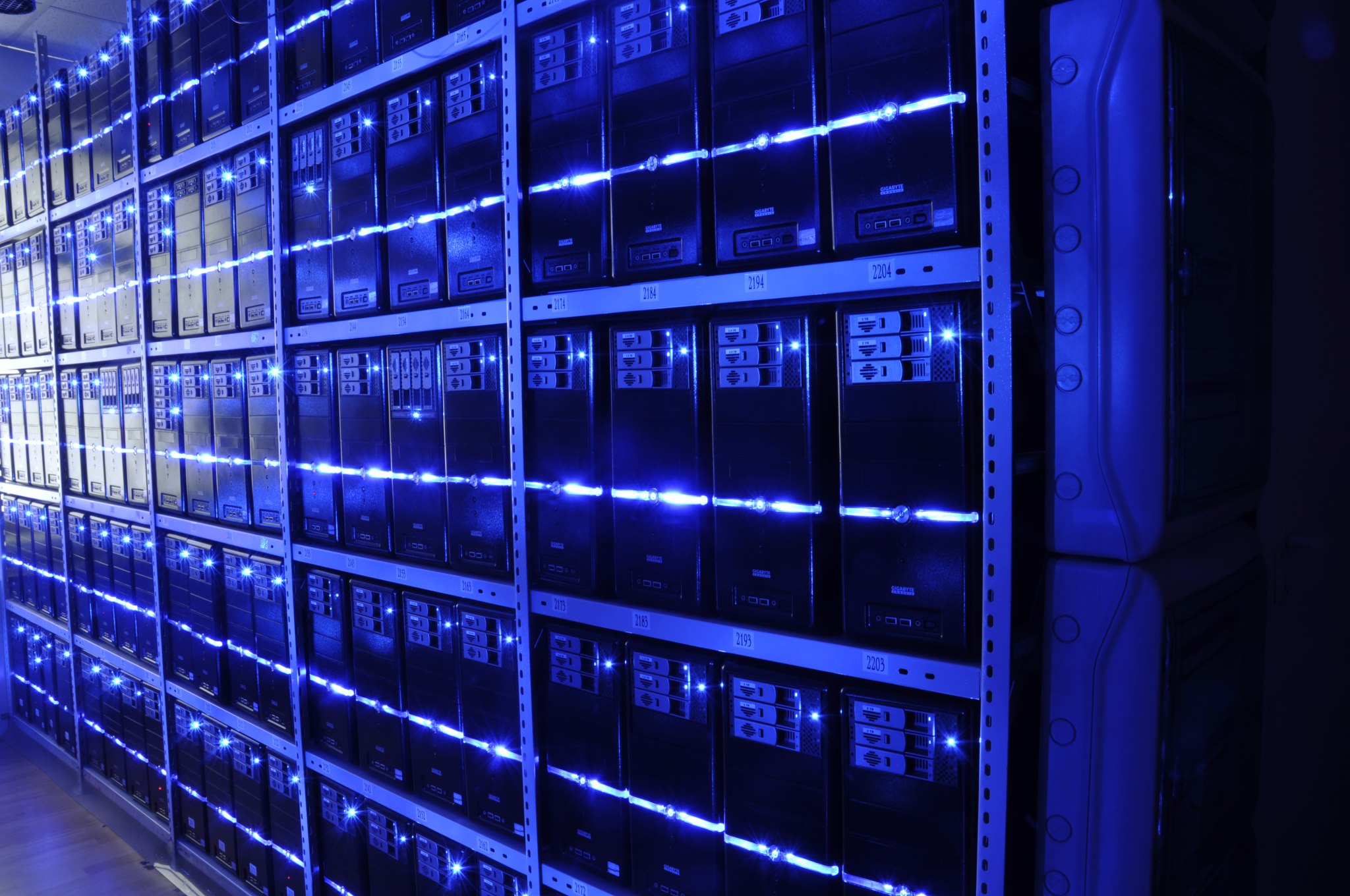
Cover image: the server hall of a commercial data centre, the physical form that several hundred billion dollars of announced AI capital expenditure is meant to take. Photo by BalticServers.com, licensed under CC BY-SA 3.0, via Wikimedia Commons.