Friday, July 31, 2026, the last session of a month that produced a bear market and a record rally inside four weeks. Apple did something unusual last night. It beat on revenue at $109.42 billion against $108.86 billion expected, beat on earnings at $2.02 against $1.89, grew iPhone revenue 22 percent to $54.3 billion and Mac revenue 29 percent to $10.4 billion, and the stock is down 7.2 percent pre-market. The reason is one sentence from chief financial officer Kevan Parekh: September-quarter revenue is guided to $111.69 billion to $113.74 billion, growth of 9 to 11 percent against a 12 percent consensus, because of supply constraints and severe DRAM and NAND price inflation. Hours earlier Amazon told the market that AWS grew 37 percent to $42.2 billion, its fastest rate since 2021 and six points above the 31 percent consensus, and that 2026 cash capital expenditure is going to roughly $220 billion from the $200 billion guided in April, partly because memory and component prices have risen. Amazon is up about 13 percent. The same input showed up twice in one night, once as a cap on revenue and once as an overrun on capital spending, and the market paid up for one and marked down the other.
Top Call: The Shortage Has Moved From the Sellers to the Buyers
For nine months the memory cycle has been a supplier story. SK Hynix printed a 76 percent operating margin. Samsung posted three consecutive record quarters and told the market on Wednesday that the supply and demand gap widens further in 2027 than in 2026. Micron, SanDisk, Western Digital and Seagate have all been repriced as scarcity assets. Every one of those data points sits on the revenue side of a memory maker’s income statement.
Apple’s guidance is the first time this quarter that the same shortage has been priced on the other side, as a cost borne by the customer, by a company large enough that nobody can dismiss it as an idiosyncratic supply chain problem. Apple is the single largest buyer of NAND on earth and one of the largest buyers of mobile DRAM. If Apple cannot secure enough memory at a price that protects its September quarter, then the marginal buyer of memory in the second half of this year is not a hyperscaler with an unlimited budget, it is a device maker with a gross margin target. Amazon’s capex revision says the identical thing in a different currency. The extra $20 billion is not all new capacity, some of it is the same capacity at a higher price.
That reframes the Korean trade rather than invalidating it. If DRAM contract prices are high enough to visibly bend Apple’s guidance and to inflate Amazon’s capital budget, the pricing power on the supplier side is real and it is being confirmed by the invoices rather than by management commentary. What it also means is that the earnings upgrade cycle in memory is now mechanically connected to an earnings downgrade cycle somewhere else, and the somewhere else is starting with consumer hardware. Samsung’s own mobile division swung to a KRW 0.7 trillion operating loss on rising component costs in the same quarter it reported record group profit, which was the tell nobody wanted to read on Wednesday. Written at 8:55am Eastern before the opening bell, so a 13 percent pre-market print in Amazon and a 7 percent decline in Apple can both give back a third of themselves by ten o’clock, and on the last trading day of a month with this much dispersion, rebalancing flows will do some of that work regardless of the news.
Amazon Made It Three Out of Four on Cash Conversion
We wrote yesterday that the market is not punishing capital expenditure, it is punishing capital expenditure that arrives without a visible revenue line attached. Amazon is the cleanest confirmation of that framework so far. Total revenue was $200.6 billion, up 20 percent. Operating income rose 43 percent. AWS accelerated to 37 percent, the fastest quarterly growth in more than four years, and management said plainly that it will not have enough capacity to satisfy demand in either 2026 or 2027. Third-quarter net sales are guided to $197 billion to $202 billion. Against that, a capital budget of roughly $220 billion read to investors as a supply constraint being relieved rather than as money disappearing into a research project.
Line the four megacap prints up and the pattern is unambiguous. Microsoft raised fiscal 2027 capex to $255 to $260 billion with Azure accelerating to 43 percent and rose 9 percent. Amazon raised 2026 capex to about $220 billion with AWS accelerating to 37 percent and rose 13 percent. Meta narrowed its capex range upward with no metered product to point at, produced $784 million of free cash flow, and fell 9 percent. Apple spends the least of the four on artificial intelligence and fell 7 percent for a reason that has nothing to do with its own spending at all. The market is not running an anti-capex screen. It is running a screen on whether the customer of the capacity can be named.
There is a debt dimension underneath this that keeps being underweighted. Amazon carries the heaviest bond stack of the group after a roughly $54 billion deal in March, hyperscalers issued about $159 billion of corporate bonds in the first five months of the year, and Bank of America expects the full-year figure between $140 billion and $175 billion. Raising the capital budget by another $20 billion in an environment where the 30-year Treasury sits within a couple of basis points of a 19-year high is not free, and the equity market’s applause this morning is being delivered by a different set of investors than the ones who have to absorb the paper.
Korea Recovered in One Session What It Lost in Three, Which Is Not the Same as Recovering
The Kospi rose 17.9 percent to 6,695.45, the largest single-day gain in the index’s history. SK Hynix closed limit-up at 29.95 percent, at KRW 1,718,000. Samsung Electronics rose about 28 percent. Three sessions ago the same index fell more than 17 percent across Monday, Tuesday and Wednesday, tripping circuit breakers twice, on a China domestic lithography scare and a Samsung print that was read as peak margin.
Both moves are the same phenomenon with opposite signs. The specific catalyst for the reversal was not a change in the memory outlook, which has been consistently strong for a month. It was Microsoft’s Wednesday night print easing the AI spending panic, the completion of hedge fund deleveraging that had forced the selling, and a rare direct personal purchase of SK Hynix shares by SK Group chairman Chey Tae-won. A chairman buying stock is a signal about perceived value, not about second-half contract prices. When a market of this size moves 18 percent in a day on that combination, what is being repriced is leverage and forced flow, not the discounted value of future DRAM.
We would treat this as a positioning round trip rather than an all-clear. The useful evidence is that earnings estimates for the Korean memory complex never actually came down during the crash, which is what made the drawdown a sentiment event, and by the same logic they have not gone up this morning either. A 30 percent daily limit move in the second-largest memory producer in the world is a symptom of a market that has lost the ability to price the asset in an orderly way in either direction. That instability is itself a risk factor for the next three weeks, and it argues for sizing discipline rather than for a directional view.
Semis Had Their Best Session in 15 Months and the Bond Market Did Not Confirm It
Thursday in the United States was a broad recovery. The S&P 500 rose 1.66 percent to 7,437.63, the Dow gained 613 points or 1.19 percent, and the Nasdaq Composite added 2.78 percent. The Philadelphia Semiconductor Index rose 8.19 percent, its largest single-day gain since April 2025. Underneath, the moves were extreme: SanDisk gained 26.0 percent, Micron 18.4 percent, Lam Research about 18 percent for its best day since 1999, AMD 13.0 percent, Marvell 12.2 percent, Intel 11.3 percent and Nvidia only 2.7 percent. The VIX fell 17.3 percent to 17.09. This morning S&P 500 futures are up 0.47 percent at 7,507.75, Dow futures up 0.53 percent at 52,660 and Nasdaq 100 futures up 1.11 percent at 28,552.
The dispersion inside that semiconductor rally is worth pausing on. Nvidia participated least. Memory and equipment participated most. That is a rotation within the AI complex, out of the logic winner everybody already owns and into the physical bottleneck the market spent this month deciding was real, and UBS now models DRAM demand growth of 36 percent in 2027 against 22 percent in 2026. It is a rational allocation, but it also means the index-level recovery is being carried by the most crowded and most volatile part of the tape.
The bond market has not signed off. The 10-year eased a basis point to 4.67 percent this morning and the 30-year remains around 5.22 percent, within a whisker of Wednesday’s 5.244 percent, the highest since July 2007. Equities have given back essentially none of Wednesday’s fear and the long end has given back essentially none of its yield. Wednesday’s Federal Open Market Committee hold at 3.50 to 3.75 percent with three dissents in favour of an immediate hike is unchanged as a fact, and last night’s news flow added roughly $20 billion of announced capital spending to the pile of duration that has to be financed. A stock market at a monthly high alongside a 30-year yield at a 19-year high is not a tension that resolves quietly.
Oil Is Rising Into a Ceasefire, Which Tells You the Number That Matters
Brent is up 1.37 percent at $90.25 and WTI is up 1.54 percent at $84.87 on a morning when the United States has paused airstrikes on Iran overnight. That combination looks wrong until you look at the flow data. Commonwealth Bank of Australia estimates that traffic through the Strait of Hormuz has recovered to roughly 30 to 35 percent of pre-war levels. Recovery is the word being used in the headlines, and the substance of it is that two-thirds of normal transit volume through the world’s most important oil chokepoint is still missing on day 153 of this war.
The market has been trading the headline count rather than the barrel count for four weeks, and that has been profitable because every escalation has ended with intercepted missiles and undamaged facilities. Thursday’s heavy wave of American strikes across southern Iran, which itself ended a five-night pause and was built substantially against the coastal surveillance and maritime enforcement apparatus of the strait, has now been followed by another pause. The structural facts underneath have not improved. Central Command’s blockade accounting stands at 20 vessels redirected, two disabled and two boarded. The US Treasury has sanctioned two Iranian firms it says run an IRGC-backed scheme forcing commercial vessels to buy transit insurance. Iran and Oman are negotiating a joint mechanism to set transit fees, which is the quiet institutionalisation of a toll on a waterway that was free in February. Iran continues to insist it has no negotiations with the United States and that its only talks are with Oman.
Brent at $90 with a third of Hormuz working is a market pricing an eventual normalisation it has no evidence for. The asymmetry has not changed since we flagged it on Wednesday: the Strategic Petroleum Reserve has fallen for eighteen consecutive weeks to its lowest level since 1983, so the policy buffer that has absorbed each of these scares is close to spent.
Big Oil Banked the War and Spent It on Debt, Which Is Its Own Forecast
Exxon Mobil earned $14.5 billion in the second quarter, more than double a year ago and its best quarter since 2022, which works out to about $160 million a day. Revenue of $116 billion beat the $97.8 billion expected, although adjusted earnings of $3.52 per share missed by eight cents. Chevron earned $12.1 billion against $2.5 billion a year ago, with adjusted earnings of $6.06 per share beating by 50 cents and revenue of $70 billion against $62 billion expected. Between them the two majors booked $26.6 billion of quarterly profit generated almost entirely by a war premium.
The interesting part is what they did with it. Both companies are steering the windfall into debt reduction rather than into buybacks or accelerated capital programmes. That is a capital allocation decision that contains a price forecast. Management teams that believed $90 Brent was durable would be leaning into the cycle. Management teams that believe they are holding a temporary transfer from consumers to producers, created by a conflict that could stop on any given morning, repair the balance sheet instead. Investors reading the energy complex should weight that behaviour more heavily than any published price deck, and it sits awkwardly against an equity market that has spent July rerating energy on the assumption the premium persists.
Europe Printed a Record by Owning Neither Side of the Memory Argument
The Stoxx 600 rose 0.9 percent to 655.45 this morning, above the previous all-time high set on July 6, and is heading for a fourth consecutive monthly gain. The technology subindex rose 1.7 percent, tracking Asia. The DAX gained 0.7 percent to 25,798.10 and the FTSE 100 gained 0.7 percent to 10,971.47.
Europe has now outperformed the United States through a month in which the Nasdaq entered a correction, the Philadelphia Semiconductor Index entered a bear market and recovered, and Korea produced both a record crash and a record rally. The explanation is structural rather than clever. Europe has ASML on the equipment side, essentially no memory manufacturing, no hyperscaler capital budget to defend and a heavy weighting toward energy, banks, defence and industrials, all of which have had a good quarter on their own terms. Shell delivered $9.8 billion with a fresh $3 billion buyback yesterday and Rolls-Royce raised full-year guidance by roughly 17 percent. When the argument driving American index volatility is about the return on AI capital, an index that never made the bet has nothing to give back.
Geopolitical Tracker
US and Iran: Airstrikes are paused again after Thursday’s heavy wave against dozens of IRGC targets across southern Iran, which itself ended a five-night pause. This is day 153. Trump has previously characterised the earlier pause as an Iranian request; Tehran denies both the request and the existence of any US talks.
Hormuz: Transit traffic has recovered to roughly 30 to 35 percent of pre-war levels per Commonwealth Bank of Australia. Central Command reports 20 vessels redirected, two disabled and two boarded. The chokepoint is functioning at a third of capacity and the market is treating that as good news.
Sanctions and the toll mechanism: The US Treasury has designated two Iranian firms tied to an IRGC-backed scheme compelling commercial vessels to purchase transit insurance. Separately, Iran and Oman are working toward jointly setting future transit fees, which converts an act of coercion into a standing fee structure and is the most consequential slow-moving development in the conflict for shipping costs.
Regional spread: The Houthi threat to Saudi shipping bound for the Indian Ocean, the Caspian Pipeline Consortium suspension at its Black Sea terminal, and the unclaimed drone strike on LNG vessels at Egypt’s Damietta port all remain live and unresolved.
Quick Take: The Earnings That Actually Matter
| Name | Detail | Our Read | |
|---|---|---|---|
| Apple (AAPL) | Beat everything, guided down, sold | Rev $109.42B vs $108.86B est, +16%; EPS $2.02 vs $1.89; iPhone $54.3B, +22%; Mac $10.4B, +29%; Services light, China light; FQ4 guide $111.69-113.74B, growth 9-11% vs 12% est; CFO cites supply constraints and severe DRAM and NAND inflation; -7.2% pre-market | The first megacap to put the memory shortage on the cost side of its own income statement. If the largest NAND buyer on earth cannot secure supply at a price that protects a quarter, the pass-through has started and consumer hardware absorbs it first |
| Amazon (AMZN) | Beat, accelerated, raised capex, ripped | Rev $200.6B, +20%; operating income +43%; AWS $42.2B, +37% vs 31% est and fastest since 2021; Q3 guide $197-202B; 2026 cash capex to ~$220B from ~$200B partly on memory and component prices; capacity short of demand through 2027; +13% pre-market | Three of four megacaps have now confirmed the same rule. Growth accelerating alongside the spend is what gets funded. Amazon also carries the heaviest bond stack of the group, so the applause comes from the equity side of a decision the credit side has to finance |
| SK Hynix, Samsung | Limit-up and a record index day | SK Hynix +29.95% to KRW 1,718,000, daily limit, helped by a direct personal share purchase from SK Group chairman Chey Tae-won; Samsung +28%; Kospi +17.9% to 6,695.45, largest one-day gain on record after a 17% three-day loss | Estimates never fell during the crash and have not risen this morning, which makes both legs a positioning event. A 30% limit move in the world’s second-largest memory maker is evidence the asset cannot currently be priced in an orderly way |
| Micron, SanDisk, Lam Research | Memory and equipment led the tape | SOX +8.19% Thursday, best day in 15 months; SanDisk +26.0%, Micron +18.4%, Lam Research about +18% for its best session since 1999, AMD +13.0%, Marvell +12.2%, Intel +11.3%, Nvidia only +2.7%; UBS models DRAM demand growth of 36% in 2027 vs 22% in 2026 | The rotation inside the AI complex is running from crowded logic toward the physical bottleneck. Nvidia lagging its own sector by more than five points on an 8% day is the signal worth filing |
| Exxon (XOM), Chevron (CVX) | Both banked the war premium | Exxon net $14.5B, best since 2022, about $160M per day; rev $116B vs $97.8B est; adj EPS $3.52, missed by 8c. Chevron profit $12.1B vs $2.5B LY; adj EPS $6.06 vs $5.56 est; rev $70B vs $62B est. Both directing the windfall to debt reduction | $26.6B of combined quarterly profit going to the balance sheet rather than to buybacks is a price forecast disguised as prudence. The two best-informed operators in the complex are not underwriting $90 Brent |
| The season so far | Broad and strong outside the AI argument | FactSet has S&P 500 Q2 earnings growth at 24.7%, a second consecutive quarter above 20%; roughly 41 companies reported pre-market today including AbbVie, Linde, Eaton, Sony, Colgate, Cameco and Moderna | The volatility of this month has been concentrated in one theme while the aggregate earnings picture has quietly been the best in two years. That gap is why every drawdown has been bought within days |
Our take: The most useful number this morning is not the 17.9 percent in Korea or the 13 percent in Amazon, it is the two-point gap between Apple’s 9 to 11 percent guidance and the 12 percent the street expected. That gap is the memory shortage arriving as a cost. Until last night the entire cycle was visible only on the supplier side, where it produced record margins and a Korean equity mania, and the cost side was theoretical. It is no longer theoretical, and the company that made it concrete is the one with the most purchasing leverage of any hardware buyer in the world. Everyone below Apple in the queue has worse terms. Our reading is that the supplier trade remains fundamentally supported, because these prices are now confirmed by buyer behaviour rather than by seller commentary, but that the second-order search should shift toward which non-memory businesses have quietly become short a critical input at a floating price. Consumer electronics is the obvious first stop. Automotive, networking hardware and anything shipping an embedded module are the ones nobody has repriced yet.
Key Events Today and Ahead
| Date | Event | Why It Matters |
|---|---|---|
| Fri, 8:30am | Employment Cost Index, Q2 | The cleanest read on wage pressure available to a committee with three members already dissenting for a hike. A hot ECI does more for September pricing than another oil headline |
| Fri, 9:45am | Chicago PMI | Regional manufacturing after a quarter in which GDP printed 1.5 percent against 2.1 percent expected |
| Fri, 10:00am | Michigan consumer sentiment, final | Inflation expectations matter more than the headline with core PCE at 3.3 percent and energy still elevated |
| Fri, all day | Month-end rebalancing | July delivered a Nasdaq correction, a semis bear market and recovery, and a record Korean crash and rally. Systematic and index flows into that dispersion are unusually large |
| Fri, pre-market | Exxon, Chevron, AbbVie, Linde, Eaton, Sony, Colgate, Cameco, Moderna | Big oil has reported. Sony and Cameco are the reads on consumer electronics component costs and on nuclear power demand from data centres |
| Ongoing | Hormuz transit recovery | Flows at 30 to 35 percent of pre-war levels with a fee mechanism under negotiation between Iran and Oman. The toll is becoming permanent infrastructure |
| Ongoing | 30-year Treasury near 5.24% | Equities have recovered the week and the long end has not. Another $20B of announced hyperscaler capex adds to the duration that has to be financed |
| Sept 16-17 | Next FOMC | Three dissents want a hike now. September pricing rests on the oil complex and on wage data rather than on growth, which undershot |
Morning note, Friday July 31, 2026, written at 8:55am Eastern before the opening bell, so pre-market levels can and will move by the open. Apple reported fiscal third-quarter revenue of $109.42 billion against $108.86 billion expected, up 16 percent, with earnings of $2.02 per share against $1.89, iPhone revenue up 22 percent to $54.3 billion and Mac revenue up 29 percent to $10.4 billion, but Services and China fell short and September-quarter revenue was guided to $111.69 billion to $113.74 billion, growth of 9 to 11 percent against a 12 percent consensus, with chief financial officer Kevan Parekh attributing the shortfall to supply constraints and severe DRAM and NAND price inflation, leaving the stock down 7.2 percent pre-market. Amazon reported revenue of $200.6 billion, up 20 percent, operating income up 43 percent, and AWS revenue of $42.2 billion growing 37 percent against a 31 percent consensus for its fastest expansion since 2021, guided third-quarter net sales to $197 billion to $202 billion, raised 2026 cash capital expenditure to roughly $220 billion from about $200 billion citing memory and component prices, said it will be capacity constrained through 2027, and is up about 13 percent. On Thursday the S&P 500 rose 1.66 percent to 7,437.63, the Dow gained 613 points or 1.19 percent, the Nasdaq Composite added 2.78 percent and the Philadelphia Semiconductor Index rose 8.19 percent for its best day in 15 months, with SanDisk up 26.0 percent, Micron up 18.4 percent, Lam Research up about 18 percent for its best session since 1999, AMD up 13.0 percent and Nvidia up only 2.7 percent, while the VIX fell 17.3 percent to 17.09. Overnight the Kospi rose 17.9 percent to 6,695.45 for the largest one-day gain in its history, recovering most of a 17 percent three-day loss, with SK Hynix limit-up at 29.95 percent to KRW 1,718,000 after a direct personal share purchase by SK Group chairman Chey Tae-won and Samsung Electronics up about 28 percent, the Nikkei rose 3.96 percent, and the Stoxx 600 set a record at 655.45. Exxon earned $14.5 billion, its best quarter since 2022, on revenue of $116 billion against $97.8 billion expected though adjusted earnings of $3.52 missed by eight cents, and Chevron earned $12.1 billion with adjusted earnings of $6.06 beating by 50 cents on revenue of $70 billion, with both companies directing the windfall to debt reduction. The United States has paused airstrikes on Iran again after Thursday’s heavy wave, Hormuz traffic has recovered to roughly 30 to 35 percent of pre-war levels, the Treasury sanctioned two Iranian firms over a transit insurance scheme, and Iran and Oman are negotiating a joint transit fee mechanism, with Brent up 1.37 percent at $90.25 and WTI up 1.54 percent at $84.87. The 10-year sits at 4.67 percent and the 30-year near 5.22 percent, close to Wednesday’s 19-year high of 5.244 percent. We read Apple’s guidance as the moment the memory shortage crossed from the supplier side of the market to the buyer side, which supports rather than undermines the Korean earnings story but introduces a new and largely unpriced cost problem for everyone who buys memory rather than sells it. For internal use only. Not investment advice.
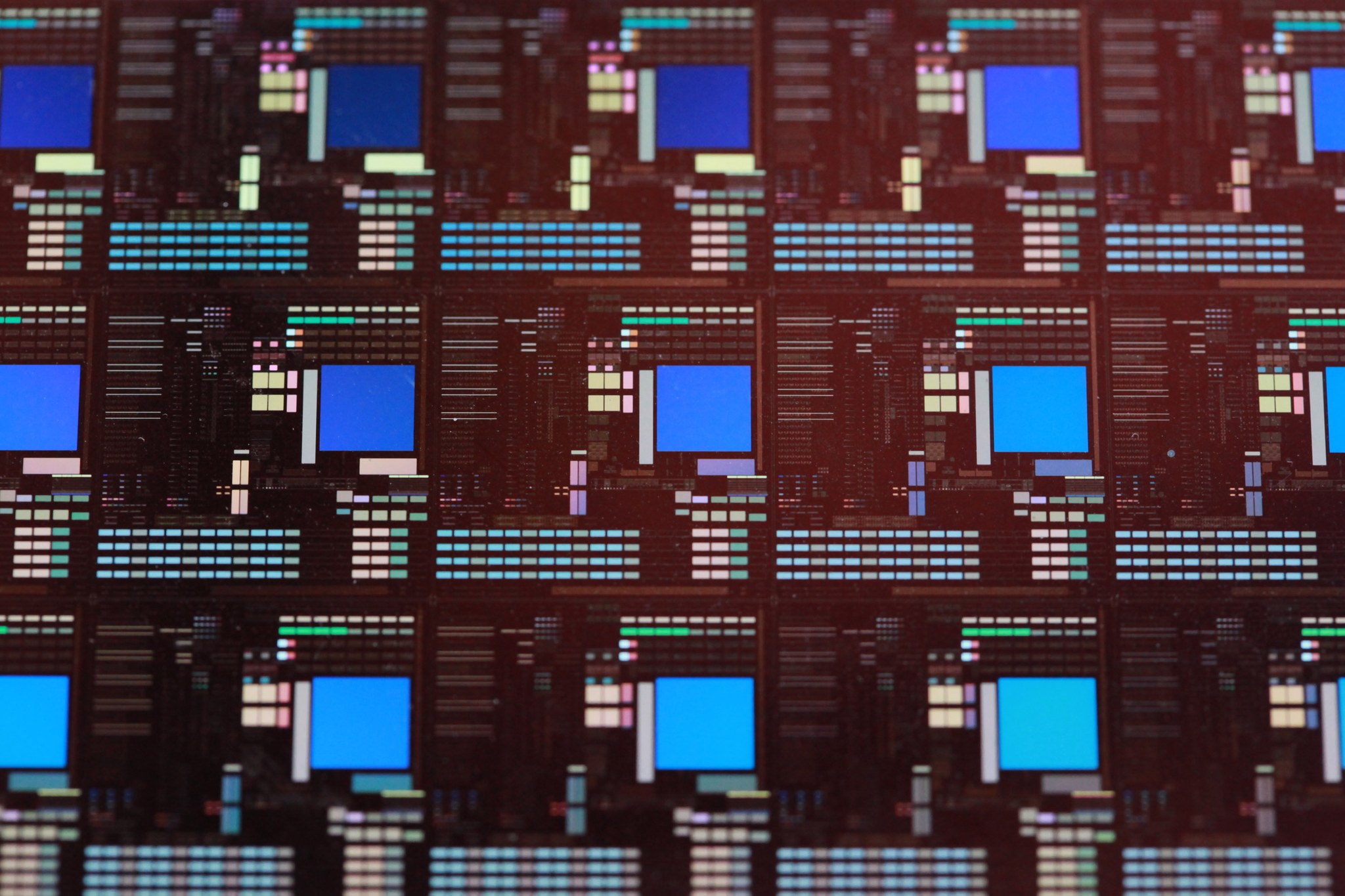
Cover image: individual dies on a 150-millimetre semiconductor wafer. Photo by Armin Kübelbeck, licensed under CC BY-SA 3.0, via Wikimedia Commons.