Tuesday, August 4, 2026. Two companies reported into this tape overnight and they could hardly be less alike. One writes software for governments and enterprises and trades on a multiple that has embarrassed a generation of value investors. The other builds excavators and gensets and has been public since before the Second World War. Palantir grew revenue 93 percent and raised its full-year guide by half a billion dollars. Caterpillar passed $20 billion of quarterly revenue for the first time in its history and lifted its own outlook. Both stocks are up double digits or close to it before the bell. The common thread running through both income statements is the same physical buildout: Palantir’s US commercial business rose 149 percent selling the software layer, and Caterpillar’s power generation business rose 29 percent selling the turbines and reciprocating engines that keep the buildings that run it energised. That is the story of this morning, and it matters more than the third consecutive session of falling oil.
Top Call: The AI Capex Cycle Is Now Visible on Income Statements That Have Nothing to Do With Chips
For most of the past two years the AI trade has been a semiconductor trade with a software option attached. Last week’s megacap reports began to complicate that, rewarding Microsoft and Amazon for naming the customers of their capacity while punishing Meta for spending without them. This morning takes the argument a layer further out. Caterpillar’s Power and Energy segment grew 17 percent to $8.2 billion, and inside it power generation, which is now predominantly data centre demand, grew 29 percent. Construction Industries grew 35 percent to $8.3 billion with North American construction demand up 50 percent. Operating margin expanded to 20.9 percent from 17.3 percent. Adjusted earnings came in at $8.17 against a street looking for $6.20, which is not a beat so much as a repricing of what the company’s earnings power actually is, and management responded by taking full-year revenue growth guidance to the mid-to-high teens from low double digits.
The read-through is uncomfortable for anyone who has been arguing that AI capital spending is a closed loop between five hyperscalers and three chip suppliers. It is not. It is landing in generators, in switchgear, in earthmoving, in the grid, and it is being paid for at margins that are expanding rather than compressing. That is the same conclusion the market reached about memory two weeks ago when Korean suppliers repriced violently, and it is the reason the storage complex is bid again this morning with Micron, SanDisk, Western Digital and Seagate all up around 5 percent pre-market.
Palantir supplies the other half of the proof. Revenue of $1.935 billion against consensus near $1.812 billion, US commercial revenue of $764 million up 149 percent, US government revenue of $809 million up 90 percent, GAAP net income of $1.062 billion at a 55 percent margin, adjusted operating margin of 62 percent and adjusted free cash flow of $1.220 billion at a 63 percent margin. Full-year revenue guidance went to $8.150 to $8.158 billion from $7.65 to $7.66 billion, which is roughly 82 percent growth for the year. The company closed a record 220 deals worth a million dollars or more.
Our view going into this print was that 80 percent growth would still be a deceleration and that the burden of proof sat with the company. It did not decelerate. It accelerated, and the acceleration came from the commercial side rather than from the war. That distinction is what we would emphasise this morning. The bear case on Palantir for months has been that its government line was a conflict trade that a ceasefire would unwind, and a 149 percent commercial growth rate against a 90 percent government growth rate substantially weakens that objection. The stock at roughly $146 pre-market is up about 16 percent and still below its high. The multiple remains the risk. The growth rate is no longer the risk.
Overnight and Pre-Market Developments
Equity futures are firmer with an unusual internal shape. Dow futures are up 623 points or 1.17 percent, Nasdaq 100 futures up 317.75 points or 1.10 percent, S&P 500 futures up only 0.31 percent and Russell 2000 futures up 0.51 percent. When both the Dow and the Nasdaq lead by more than a percent while the S&P adds a third of one, the move is being carried by a very small number of very large single-stock contributions rather than by breadth. Caterpillar alone explains a large share of the Dow’s gain given its share price weighting, and Palantir plus the memory complex explains most of the Nasdaq’s. The VIX at 15.59 is down 1.7 percent and remains untroubled.
| Name | Development | Our Take |
|---|---|---|
| Palantir | Revenue +93% to $1.935B, US commercial +149%, FY guide raised to $8.15B from $7.66B, +16% pre-market | Growth accelerated and the mix shifted toward commercial. The conflict-revenue objection is materially weaker this morning |
| Caterpillar | First ever $20B quarter at $20.5B, +24% y/y, adj EPS $8.17 vs $6.20, power gen +29%, FY guide raised | The most important non-tech AI datapoint of the quarter. Data centre demand is now an industrial revenue line with expanding margins |
| Memory and storage | Micron, SanDisk, Western Digital, Seagate each up around 5% pre-market; Micron +188% YTD, SanDisk +412% YTD | Same trade as Caterpillar expressed in silicon. Easing Iran risk also relieves helium supply concern across the storage chain |
| McDonald’s | EPS $3.38 vs $3.35, revenue $7.099B vs $7.199B expected, US comps +0.8% against +2.5% a year ago | The consumer read is the weak spot of the morning. Domestic guest counts fell. Skye Anderson named president of McDonald’s USA |
| Pfizer | EPS $0.77 vs $0.68, revenue $15.03B vs $14.42B, FY revenue low end raised to $60.5B | A clean beat with the mix improving. Non-COVID products contribute $1.5B more, COVID guidance cut to $4B from $5B |
| AstraZeneca and Bristol Myers | Reported talks on a merger valuing the combination near $400B; AstraZeneca fell as much as 7% on the news | Pharma’s answer to a patent cliff is scale. The share reaction says the market thinks AstraZeneca would be paying, not receiving |
Geopolitics: A Deal That Is Always One Day Away, and a Sea Lane That Is Still Being Shot At
Treasury Secretary Scott Bessent told CNBC that there is a chance of a deal today or tomorrow to open the Strait and move toward a more normalised position in the conflict. That single sentence is doing most of the work in the oil complex this morning, with Brent down 3 percent to $81.24 and WTI down close to 4 percent to $77.22 after Monday’s 7 percent collapse. President Trump has separately framed the current round as Iran’s last chance and, in a Truth Social post, called Iranian leaders unbelievably duplicitous after Tehran denied that direct negotiations were taking place at all. Iran’s position is that it is discussing a new shipping route with Oman and nothing more.
Two developments argue against taking the price action at face value. First, at approximately 2200 local time on August 3 an unnamed cargo vessel broadcast a distress call reporting it had been struck by a projectile roughly 20 nautical miles northeast of Khasab, on the Omani coastal corridor that has been treated as the neutral route through the strait. A near miss occurred in the same area about 24 hours earlier. Every previous kinetic attack in that stretch has been Iranian in origin. Second, observable transit traffic through Hormuz remains at a trickle, which is a physical fact that does not respond to press conferences. A negotiated reopening is worth a great deal to this market. A reopening that shipowners and their insurers decline to use is worth considerably less, and the gap between the two is where the residual oil risk sits.
There is a domestic political overlay as well. The President publicly attacked the oil majors this week, saying they made too much money and demanding price cuts, which arrives one session after Exxon and Chevron banked a combined $26.6 billion of conflict-period profit. Political pressure on refiners and producers is a margin risk for the energy complex that is separate from, and additive to, the price risk of a Hormuz reopening. European energy names traded down about 2 percent on Monday with Eni, TotalEnergies and Shell all lower.
Macro: A Four-Year High in Manufacturing Argues With the Cheap-Oil Relief Trade
Monday’s ISM Manufacturing print deserves more attention than it received, because it complicates the disinflation story the equity market is currently celebrating. The headline came in at 55.6 against 54.0 expected and 53.3 prior, the strongest reading in four years. Prices Paid eased to 71.1 from 73.0, which was roughly in line, but a print above 70 is not a disinflationary signal in any historical sense. It is a slightly less inflationary signal.
Put those two things together and the September policy argument changes shape rather than resolving. Since February the case for a hike has been an energy-driven inflation impulse, which is precisely the thing that has been unwinding for three sessions. But a manufacturing sector accelerating to a four-year high supplies a growth-driven case for the same hike, and that one does not care what Brent does. Markets price roughly 63 percent odds of a 25 basis point September hike, down from about 80 percent before the last decision, when Chair Kevin Warsh offered little forward guidance. We think that number is too low given Monday’s data, and we would note that the 30-year Treasury near 5.20 percent has spent the entire rally refusing to validate the relief story. The 10-year at 4.70 percent has come off an 18-month high but has not broken anything.
Today’s calendar is second tier and the labour data that matters comes later in the week. The June trade balance is expected at a deficit near $73 billion, JOLTS job openings at 7.44 million against 7.594 million prior, with factory orders and the IBD/TIPP optimism index alongside. Governor Lisa Cook, San Francisco’s Mary Daly and Vice Chair for Supervision Michelle Bowman all speak. ADP lands Thursday and the July employment report Friday, and after Monday’s ISM the payroll number carries more weight in September pricing than any oil headline will.
The dollar tells its own story. DXY sits at 99.98 after five consecutive down sessions, but USD/JPY has climbed back to roughly 157.55 from the 155.20 low printed during Friday’s first joint US and Japan intervention since 2011. Bank of Japan data suggest as much as $58.97 billion was deployed on Thursday. Recovering more than two thirds of an intervention move within two sessions is a poor advertisement for the operation, and it is a reminder that coordinated action can set a floor on speed but not on level.
Quick Take: The Earnings That Matter
Palantir (PLTR), reported after Monday’s close
| Metric | Consensus | Actual | Beat/Miss |
|---|---|---|---|
| Revenue | $1.812B | $1.935B, +93% y/y | Beat |
| EPS | $0.34 (adj) | $0.41 GAAP diluted | Beat |
| US commercial revenue | not guided | $764M, +149% y/y | Beat |
| Adjusted FCF | not guided | $1.220B, 63% margin | Beat |
| FY26 revenue guidance | $7.65-7.66B prior | $8.150-8.158B, ~82% growth | Raised |
Our take: This is the strongest quarter in the company’s history on every axis that matters, and the important detail is the composition rather than the headline. A 149 percent US commercial growth rate against 90 percent in government moves the centre of gravity of the business toward the part that is not exposed to a ceasefire. Free cash flow at a 63 percent margin means the growth is self-funded, which is the test last week’s megacap prints established as the market’s current standard. The valuation debate is unresolved and will stay unresolved. The operational debate is over for this quarter.
Caterpillar (CAT), reported pre-market
| Metric | Consensus | Actual | Beat/Miss |
|---|---|---|---|
| Revenue | below $20B | $20.5B, +24% y/y | Beat, first ever above $20B |
| Adjusted EPS | $6.20 | $8.17 | Large beat |
| Operating margin | n/a | 20.9% vs 17.3% a year ago | Beat |
| Power generation | n/a | +29%, mostly data centre | Beat |
| FY26 revenue growth | low double digits | mid-to-high teens | Raised |
Our take: A 32 percent earnings beat at a company this size is not a quarterly timing artefact, it is evidence the market has been modelling the wrong demand curve. North American construction up 50 percent and power generation up 29 percent describe an economy building physical AI infrastructure at a pace the industrial estimates had not caught up with. Watch margin durability rather than the top line from here, because the guidance raise implicitly assumes the data centre order book converts through the second half.
McDonald’s is the counterweight worth keeping in view. US comparable sales of plus 0.8 percent against plus 2.5 percent a year earlier, with declining guest counts and a revenue miss, is a low-income consumer signal arriving on the same morning as an industrial boom. Those two facts belong in the same paragraph because they describe an economy where capital spending is strong and household spending is not, and that combination historically resolves in favour of the capital spending for longer than people expect.
Tonight: Silicon and Rockets on the Same Evening
AMD reports after the close with a call at 5:00pm Eastern. The street is at roughly $11.3 billion of revenue and $1.61 of earnings per share against company guidance of $11.2 billion plus or minus $300 million, which would be 46 percent growth. The stock is up around 5 percent pre-market on the Palantir and memory readacross. This remains the only near-term test of whether AI inference has genuinely become a multi-vendor market or remains effectively single sourced, and the substance sits in the second-half commentary on the MI400 line and the Helios rack-scale platform that Microsoft has committed to Azure rather than in the June quarter itself.
SpaceX files its first quarterly report as a public company, with the call at 4:30pm Eastern. Consensus is near $6.9 billion of revenue for 68 percent growth, and the earnings estimate range spans a loss of $1.26 to a profit of $0.33 per share, which is an extraordinary dispersion that tells you the sell side does not yet know how to model the combined space, connectivity and AI entity created by the February integration of xAI and X. The shares priced at $135 on June 11 in the largest IPO ever at $85.7 billion raised and have since fallen more than 45 percent. The first major lock-up expiry follows on August 6. We would keep the operating question and the share supply question separate. Starlink is a genuinely strong business growing subscribers at triple digit rates, and it is about to meet the largest insider unlock this market has seen in years within 48 hours of its first public disclosure. A good print does not neutralise a supply event of that size.
Asia and Europe
Asia was mixed and the dispersion was informative. Korea rebounded 1.6 percent to 6,358.95, recovering roughly a third of Monday’s 5.1 percent decline, which supports our read that Monday’s fall was positioning rather than a change in the memory fundamentals. Japan’s Nikkei added 0.3 percent to 63,957.53, Australia’s ASX 200 gained 1.4 percent to 9,145.80 and the Shanghai Composite rose 0.3 percent to 3,822.28. Hong Kong was the outlier, with the Hang Seng down 0.6 percent to 25,852.92. The pattern favours markets levered to semiconductors and commodities and penalises the China property and consumer complex, which is unchanged from the past fortnight.
Europe is trading near record territory. The Stoxx 600 closed Monday up 0.5 percent at 652.09, just under the record 655.45 set on July 31, with the DAX up 1.59 percent and holding near its all-time high and the CAC 40 up 1.22 percent while the FTSE 100 slipped 0.1 percent on its energy weighting. Software led with SAP adding 4.4 percent, Deutsche Telekom rose 5 percent ahead of results and travel and leisure gained 2.1 percent on cheaper fuel. Energy fell 2 percent. AstraZeneca’s 6 to 7 percent decline on the Bristol Myers report was the single largest drag and the most interesting European story of the week.
Sector Spotlights
Semiconductors and AI infrastructure. The complex is bid across the board with Intel up 5 percent, Nvidia up 1 percent and the memory names up around 5 percent each. The distinguishing feature of this leg is that the buying is concentrated in the supply chain rather than in the buyers of compute, which is the same split that produced last week’s divergence between Microsoft and Meta. Suppliers with pricing power are winning. Spenders without named customers are not.
Energy. Three consecutive sessions of decline have taken Brent from the mid-90s to $81.24 and WTI to $77.22. The sector faces a genuine two-sided problem: a Hormuz reopening removes the scarcity premium, while political pressure on pricing threatens the margin. European majors led declines on Monday and the US complex should follow if the diplomatic headlines hold.
Healthcare. Pfizer’s beat and guidance raise, driven by oncology and cardiovascular products rather than COVID, is a reminder that the large-cap pharma earnings base is being rebuilt around non-pandemic franchises. The AstraZeneca and Bristol Myers talks point at the same underlying problem from the other direction, which is that scale is the industry’s preferred answer to expiring exclusivity. Expect more of this.
Consumer. McDonald’s decelerating US comps and falling guest counts is the clearest weak signal in the tape this morning and it is being drowned out by the industrial and AI headlines. It should not be.
Key Events Today and Ahead
| Time | Event | Why It Matters |
|---|---|---|
| Tue, 8:30am | June trade balance | Expected deficit near $73B. Second tier ahead of Friday’s payrolls |
| Tue, 10:00am | JOLTS job openings | Expected 7.44M against 7.594M prior. The first of the week’s three labour prints |
| Tue, 10:00am | Factory orders, IBD/TIPP | The factory orders detail matters more than usual after ISM at 55.6 |
| Tue, through the day | Cook, Daly and Bowman speak | First Fed commentary since ISM and since oil broke lower |
| Tue, 4:30pm | SpaceX, first public quarter | Revenue near $6.9B expected, EPS estimates span -$1.26 to +$0.33, lock-up opens Thursday |
| Tue, 5:00pm | AMD Q2 | ~$11.3B revenue, $1.61 EPS. MI400 and Helios second-half commentary is the whole print |
| Wed | SanDisk fiscal Q4, Disney, Shopify | The storage read straight into the memory inflation debate |
| Wed, 8:15am | ADP employment | Expected +65k after +98k |
| Thu | Constellation Energy, Airbnb | The AI power leg, reporting two days after Caterpillar quantified it |
| Thu, 6 Aug | SpaceX lock-up window opens | Up to 20% of restricted holdings, as much as 911.5 million shares |
| Fri, 8:30am | July employment report | With energy disinflating and manufacturing at a four-year high, payrolls now decide September |
| Sept 16-17 | Next FOMC | Hike odds at roughly 63%, in our view too low after Monday’s ISM |
Morning note, Tuesday August 4, 2026, written at 9:15am Eastern before the opening bell, so pre-market levels can and will move by the open and the 10:00am JOLTS release sits inside the first half hour of trading. Palantir reported after Monday’s close with revenue of $1.935 billion up 93 percent against consensus near $1.812 billion, US commercial revenue of $764 million up 149 percent, US government revenue of $809 million up 90 percent, GAAP net income attributable to common stockholders of $1.062 billion at a 55 percent margin and diluted earnings per share of $0.41, adjusted income from operations of $1.194 billion at a 62 percent margin, adjusted free cash flow of $1.220 billion at a 63 percent margin and a record 220 deals worth at least $1 million, and raised full-year 2026 revenue guidance to $8.150 to $8.158 billion from $7.65 to $7.66 billion with US commercial revenue guidance above $3.424 billion, trading around $145.90 pre-market for a gain near 16 percent. Caterpillar reported second-quarter sales and revenues of $20.5 billion, up 24 percent from $16.6 billion and the first quarter above $20 billion in company history, adjusted profit per share of $8.17 against $4.72 a year ago and analyst expectations of $6.20, operating profit margin of 20.9 percent against 17.3 percent, Construction Industries sales up 35 percent to $8.3 billion with North American construction demand up 50 percent and Power and Energy up 17 percent to $8.2 billion with power generation up 29 percent, and guided full-year revenue growth to the mid-to-high teens from low double digits, trading up roughly 9 to 10 percent. McDonald’s reported earnings per share of $3.38 against $3.35 expected on revenue of $7.099 billion against $7.199 billion expected, with US comparable sales up 0.8 percent against 2.5 percent a year earlier, global comparable sales up 1.3 percent and Skye Anderson named president of McDonald’s USA. Pfizer reported earnings per share of $0.77 against $0.68 expected on revenue of $15.03 billion against $14.42 billion expected, and raised the low end of full-year revenue guidance to $60.5 to $62.5 billion. S&P 500 futures are up 0.31 percent, Dow futures up 623 points or 1.17 percent, Nasdaq 100 futures up 317.75 points or 1.10 percent and Russell 2000 futures up 15.20 points or 0.51 percent, with the VIX at 15.59, gold at $4,136.30, bitcoin near $63,600 and the dollar index at 99.98. Brent traded 3 percent lower at $81.24 and WTI near 4 percent lower at $77.22 after Treasury Secretary Scott Bessent told CNBC there is a chance of a deal today or tomorrow to open the Strait, while President Trump described Iranian leaders as unbelievably duplicitous after Tehran denied direct talks and said it was only discussing a shipping route with Oman. An unnamed cargo vessel reported being struck by a projectile about 20 nautical miles northeast of Khasab at approximately 2200 on August 3, the second incident on the Omani coastal corridor in 24 hours, with Hormuz transit traffic still at a trickle. Monday’s ISM Manufacturing PMI printed 55.6 against 54.0 expected and 53.3 prior, a four-year high, with Prices Paid at 71.1 against 73.0 prior. Overnight the Kospi rose 1.6 percent to 6,358.95, the Nikkei rose 0.3 percent to 63,957.53, the ASX 200 rose 1.4 percent to 9,145.80, the Shanghai Composite rose 0.3 percent to 3,822.28 and the Hang Seng fell 0.6 percent to 25,852.92, while the Stoxx 600 closed Monday at 652.09 against a record 655.45 set on July 31. AMD reports at 5:00pm Eastern and SpaceX files its first public quarter at 4:30pm Eastern ahead of a lock-up window opening August 6. We read this morning as confirmation that AI capital spending has broadened into the industrial economy, with the important caveat that a manufacturing survey at a four-year high makes the September policy path harder rather than easier, and with the 30-year Treasury near 5.20 percent still declining to confirm the relief trade. For internal use only. Not investment advice.
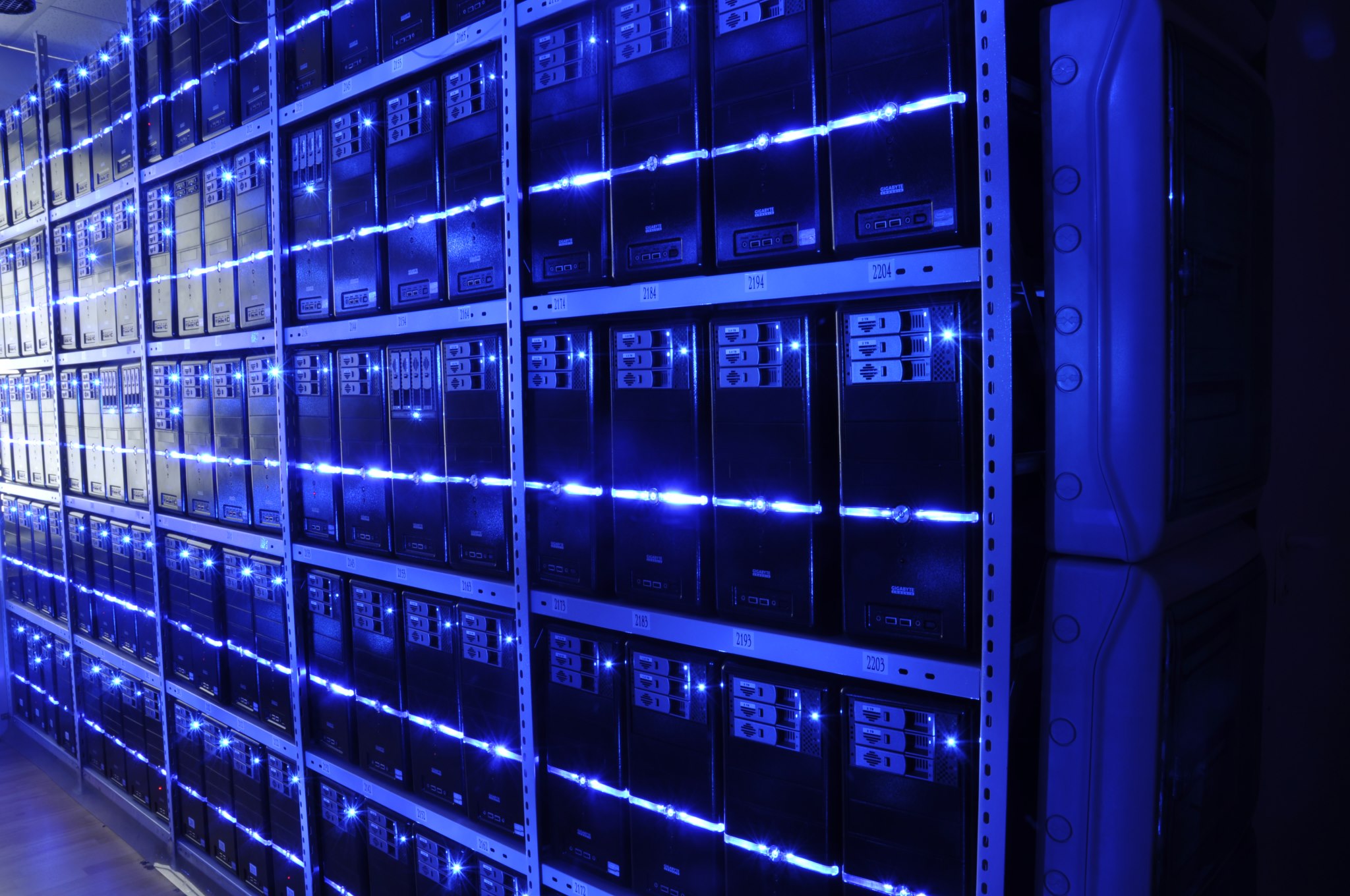
Cover image: server racks in a commercial data centre facility. Photograph by BalticServers.com, via Wikimedia Commons, licensed CC BY-SA 3.0.