Wednesday, August 5, 2026. Three companies levered to artificial intelligence reported after yesterday’s close, and all three beat. AMD beat on revenue and earnings and guided the September quarter above the street. SpaceX beat consensus revenue by a billion dollars in its first disclosure as a public company and lost a quarter of what analysts had penciled in. Arista beat and then guided the next quarter roughly twelve percent above where the street had it. Two of those three stocks are lower this morning and one is up fourteen percent. The sorting principle is not growth, because AMD grew its data centre business 107 percent and is down nine. The sorting principle is cash. Companies that collect money from the buildout are being paid for it. Companies that spend money on the buildout are being charged for it, and as of this morning that charge applies even when their revenue is compounding at triple digits.
Top Call: The Buildout Now Has a Payer and a Payee, and the Tape Only Wants to Own the Payee
Start with AMD, because the reaction looks wrong until you read the margin line. Revenue of $11.5 billion grew 50 percent year on year and 13 percent sequentially. Data centre revenue of $6.72 billion grew 107 percent and now accounts for 58 percent of the company. Adjusted earnings of $1.66 beat the $1.55 consensus. September quarter guidance of roughly $13 billion plus or minus $300 million implies 41 percent annual growth and another 13 percent sequentially. On any normal reading that is an excellent quarter from a company that has spent three years trying to prove it can be a genuine second source in accelerated compute. The stock is indicated down about nine percent near $481.
What broke it is that non-GAAP gross margin came in at 56 percent and was guided to roughly 56 percent again. AMD is now running something close to twenty points of gross margin below Nvidia, and every incremental dollar of Instinct revenue arrives at a mix that dilutes rather than levers the corporate margin. Investors will pay a very high multiple for growth that improves the margin structure. They will not pay that multiple for growth that merely holds it flat, particularly when the cash conversion is slowing behind it. Our read is that the demand question on AMD was answered decisively last night and the economics question was not. That is a materially better position than the company was in a year ago, but it is not what a stock priced for a trillion-dollar outcome needed to hear.
SpaceX is the cleaner illustration. Revenue of $7.8 billion grew 92 percent against a consensus near $6.8 billion. The net loss of $541 million compares with a consensus loss of $1.9 billion and with the $4.3 billion loss the company booked in the first quarter. On both lines this was one of the largest first-print beats the market has seen from a newly listed company of this size. The shares are down about eleven percent at $111.81, roughly seventeen percent below the $135 IPO price. The reason is a single number: capital expenditure of about $18.4 billion in the June quarter alone, which is more than twice the revenue the company generated in the same three months, driven by the artificial intelligence side of the business created by the February integration of xAI and X.
We wrote yesterday that a good print does not neutralise a supply event, and that the operating question and the share supply question should be kept separate. That is exactly what is playing out. The lock-up window opens tomorrow, August 6, releasing as much as twenty percent of restricted holdings and up to 911.5 million shares. Every holder considering selling into that window now has a headline capex figure to point at. The operating business inflected last night. The share count is about to. Those are two different facts and the second one is currently louder.
Then Arista. Revenue of $3.04 billion grew 38 percent against a $2.83 billion consensus, adjusted earnings of $1.02 beat the 88 cent estimate, and third-quarter guidance of roughly $3.3 billion in revenue and $1.06 to $1.08 in earnings sits far above the $2.95 billion and 92 cents the street carried. The stock is up around fourteen percent. Arista does not build data centres, does not buy accelerators, and does not carry the depreciation. It sells the switching fabric that connects other people’s capital spending, and it is being valued accordingly.
The rule that emerges from these three prints is the same one that split Microsoft and Amazon from Meta last week, and the same one that lifted both Palantir and Caterpillar on Monday. Get paid by the buildout. Do not fund it. What is new this week is the severity with which the market is applying it to companies whose top lines are still doubling.
Overnight and Pre-Market Developments
Tuesday’s session was the strongest of the year. The S&P 500 rose 1.79 percent to 7,737 for its first record high in two months, the Dow gained more than 900 points or 1.71 percent to close above 54,000 for the first time, and the Nasdaq Composite added 2.59 percent to 26,585. The Dow has added roughly 1,600 points across two sessions and the Nasdaq is up almost nine percent from its July 29 low. Palantir rose 29 percent, its best day in more than two years. Against that, this morning’s futures are almost polite: S&P and Dow contracts up about 0.4 percent and Nasdaq 100 futures up about 0.2 percent, with the VIX ticking back up to 16.78.
| Name | Development | Our Take |
|---|---|---|
| AMD | Rev $11.5B +50%, data centre $6.72B +107%, adj EPS $1.66 vs $1.55, Q3 guide ~$13B; down ~9% pre-market | Demand answered, economics not. A 56% gross margin guide against Nvidia’s structure is the entire reaction, not the growth |
| SpaceX | First public quarter: rev $7.8B +92% vs $6.8B est, net loss $541M vs $1.9B feared, capex ~$18.4B; down ~11% to $111.81 | A large double beat overwhelmed by a capex line twice the size of revenue, 48 hours before a lock-up on up to 911.5M shares |
| Arista Networks | Rev $3.04B +38% vs $2.83B, adj EPS $1.02 vs $0.88, Q3 guide $3.3B vs $2.95B street; up ~14% | The cleanest expression of the supplier trade. No accelerator cost, no depreciation, all of the volume |
| Eli Lilly | Adj EPS $8.38 vs $6.01, rev $22.97B vs $20.73B, volume +37%, ex-US rev +80%; FY raised to $85-87B | The largest large-cap pharma beat of the quarter. The international obesity market is inflecting, and that is the number that matters |
| Novo Nordisk | Q2 sales DKK 78.49B, +3% at constant currency; FY adjusted sales guided down 6% to flat, 9,000 roles being cut | Same category, opposite direction. This is no longer a share fight, it is one compounder and one restructuring |
| Disney | Adj EPS $2.06 +28% vs $1.86, rev $25.2B +7% vs $25.4B est, streaming rev +5.53B +11%, buyback to $9B, TikTok deal; up ~3% | Revenue missed and nobody cares because the profit mix improved. The TikTok licensing deal is the strategically interesting item |
| Uber | Revenue below estimates, adjusted earnings barely ahead; down ~4% despite Wayve winning London robotaxi approval | The autonomy headline is real and the quarter is not. The market correctly separated them |
| CVS Health | Beat and raised full-year profit outlook; up ~3% | Second consecutive quarter of the managed care and pharmacy combination working. Quietly one of the better tapes in healthcare |
Macro: A 44,000 Print Against a Four-Year High in Manufacturing
ADP reported private payrolls rose 44,000 in July against a 75,000 consensus, the slowest month since January, with June revised down to 95,000. Services added 47,000 and goods-producing industries lost 3,000. Education and health services contributed 36,000, which is to say that outside of the least cyclical category in the survey, private hiring in July was effectively zero.
Put that beside Monday’s ISM Manufacturing at 55.6, a four-year high, and you have a spread that cannot persist. Manufacturing surveys at multi-year highs alongside shrinking goods payrolls is either a survey that is running hot on sentiment or a payroll series that is about to catch up. Our view is that the September policy case has quietly changed character. Twenty-four hours ago it was possible to argue for a hike on domestic demand strength. This morning that argument is thinner, and the September case rests almost entirely on inflation, where prices paid at 71.1 remains genuinely uncomfortable. Friday’s July employment report, expected at 83,000 after 57,000, now carries more weight than it did yesterday.
Markets barely blinked at ADP, which we think understates the signal. The bond market did react: the ten-year is at 4.607 percent, the two-year is bid, and the thirty-year is easing back from a nineteen-year high. Swaps still put September at roughly 60 percent.
The Gold Tell
The single most informative price on the screen this morning is gold, up close to three percent through $4,245 and briefly higher, with silver up more than three percent alongside it. That is not supposed to happen on the day Washington says it may sign an agreement to reopen the world’s most important oil chokepoint. The textbook reaction to a war ending is gold lower and real yields higher.
Instead gold is ripping while the ten-year falls and the dollar sits flat at 99.85. That combination does not describe a geopolitical bid. It describes a rate bid layered on top of the debasement demand that has driven bullion all year, and it means the metal is trading the 44,000 payroll print rather than the Hormuz headline. When the equity tape and the gold tape disagree this sharply about the same morning’s data, we would generally take the metal seriously. It is not a comfortable signal to hold alongside record index closes.
Geopolitics: Priced, But Not Signed
President Trump said late Tuesday that a Hormuz agreement could come “tomorrow or the next day,” adding that a lot of progress had been made and that talks were moving along very nicely. Treasury Secretary Bessent had said Tuesday that a deal could land today or tomorrow. Qatar confirmed an interim proposal has been drafted, and reporting indicates Washington, Tehran and Muscat are closing on an interim agreement with the United States aiming for an announcement today.
Crude’s response tells you where positioning already sits. Brent lost more than ten percent across Monday and Tuesday, trading below $79 at one point, and this morning it is up 1.2 percent at $80.33 with WTI up 0.6 percent at $76.19. Oil is no longer falling on deal headlines because the deal is in the price. That creates an asymmetry worth naming plainly: if the agreement is signed today, the remaining downside in crude is modest, perhaps a few dollars. If the talks collapse, the move back up is not modest. Iran has continued to deny direct negotiations and describes the process as a discussion with Oman about a shipping route. We would not add to length in energy on a signature, and we would not be short volatility into a headline that has slipped twice already.
Quick Take: The Earnings That Matter
AMD (AMD), reported after Tuesday’s close
| Metric | Consensus | Actual | Beat/Miss |
|---|---|---|---|
| Revenue | ~$11.3B | $11.54B, +50% y/y | Beat |
| Adjusted EPS | $1.55 | $1.66 | Beat |
| Data centre revenue | not guided | $6.72B, +107% y/y | Beat, record |
| Non-GAAP gross margin | ~56% | 56% | In line |
| Q3 revenue guidance | ~$12.5B | ~$13B, +41% y/y | Raised |
Our Take: This is a strong quarter being sold on a margin technicality, and the technicality is real. Data centre at 58 percent of revenue growing 107 percent settles the question of whether AMD has a durable second-source position in accelerated compute. What it does not settle is whether that position ever earns a Nvidia-like return, and a flat 56 percent margin guide with slowing cash conversion says not yet. Gaming down 31 percent is noise. The margin is the thesis.
SpaceX (SPCX), first public quarter, reported after Tuesday’s close
| Metric | Consensus | Actual | Beat/Miss |
|---|---|---|---|
| Revenue | ~$6.8B | $7.8B, +92% y/y | Large beat |
| Net income | -$1.9B | -$541M | Large beat |
| Capital expenditure | not guided | ~$18.4B in the quarter | The problem |
| Share price vs $135 IPO | n/a | $111.81 pre-market, -11% | Below issue |
Our Take: On the operating lines this was the best possible first disclosure, and the loss narrowing from $4.3 billion in the March quarter to $541 million in June is a genuine inflection. It does not matter this week. A capex figure more than twice quarterly revenue, published 48 hours before a lock-up that can release up to 911.5 million shares, gives sellers both a reason and a window. We would revisit the operating case after the supply event clears rather than in front of it.
Eli Lilly (LLY), reported pre-market
| Metric | Consensus | Actual | Beat/Miss |
|---|---|---|---|
| Revenue | $20.73B | $22.97B | Beat |
| Adjusted EPS | $6.01 | $8.38 | Large beat |
| Volume growth | not guided | +37%, Mounjaro and Zepbound led | Beat |
| International revenue | not guided | $8.6B, +80%, volume +113% | Beat |
| FY26 revenue guidance | $82-85B | $85-87B | Raised |
Our Take: A $2.37 earnings beat on a $6.01 base is not a beat, it is evidence the model was wrong. The line to focus on is international, where revenue rose 80 percent on 113 percent volume growth, because it says the obesity franchise is now scaling outside the United States at a pace that domestic-only models have systematically underestimated. Set against Novo guiding full-year sales to down six percent to flat while cutting 9,000 roles, the divergence inside this category has stopped being cyclical.
Disney (DIS), fiscal Q3, reported pre-market
| Metric | Consensus | Actual | Beat/Miss |
|---|---|---|---|
| Revenue | $25.4B | $25.2B, +7% y/y | Miss |
| Adjusted EPS | $1.86 | $2.06, +28% y/y | Beat |
| Entertainment streaming revenue | not guided | $5.53B, +11% | Beat |
| Disney+ and Hulu profit | not guided | $712M | Beat |
| FY26 buyback target | $8B | at least $9B | Raised |
Our Take: A revenue miss with a 28 percent earnings gain is the shape of a company finally converting scale into profit rather than buying it. Streaming profitability of $712 million and a buyback lifted to $9 billion, partly funded by the $1.2 billion A+E sale to Hearst, are the substance. The TikTok content arrangement is the item worth watching: Disney has chosen to license Marvel, Pixar, Star Wars and FX characters onto the largest short-form surface in the world rather than compete with it, which is a meaningful strategic reversal and a cheap distribution experiment.
Tonight and Tomorrow
SanDisk reports fiscal fourth-quarter results with the street near $8.24 to $8.39 billion of revenue and earnings around $33 to $34 per share, against 29 cents on $1.90 billion a year ago. Western Digital reports alongside it. This is the most consequential print of the session for the memory inflation debate that has driven Korea and the storage complex all quarter. SanDisk is up more than 420 percent this year and fell 47 percent in July, which is a stock whose holders have no consensus about what it is worth. NAND pricing commentary and any long-term supply agreements will move Samsung, SK Hynix, Micron and Seagate tomorrow morning regardless of what SanDisk itself does.
Shopify, AppLovin and McKesson also report today. Tomorrow brings Constellation Energy and Airbnb, and the SpaceX lock-up window opens.
Asia and Europe
Asia traded the American semiconductor rally hard. The Nikkei 225 jumped 3.66 percent to 66,300 with the Topix up 2.13 percent to 4,046, and Korea’s Kospi rose roughly 3.8 percent to 6,598, briefly reclaiming 6,600, with Samsung Electronics up four to five percent and SK Hynix up six to seven percent. SoftBank added nine percent and Kioxia seven. The catalysts cited locally were the High Bandwidth Flash standard and advanced QLC 3D NAND progress, which is to say the region is trading the same supplier logic that lifted Arista overnight.
China and Hong Kong lagged that enthusiasm. The Hang Seng added just 0.2 percent to 25,915 with the Hang Seng Tech index up one percent on turnover of HK$278 billion, and the CSI 300 rose about 1.2 percent. The pattern of the past fortnight holds: markets levered to memory and semiconductor capital equipment outperform, and the China consumer and property complex does not participate.
Europe is at records. The Stoxx 600 closed Tuesday up 0.7 percent at an all-time high of 656.86 and is up ten percent this year, with the DAX around 26,254 and up 0.2 percent, the FTSE 100 up 0.45 percent near 10,928 and the CAC 40 roughly unchanged. The composition of Europe’s leadership is worth noting for anyone still treating the region as a value market: the five best-performing European stocks of 2026 are all semiconductor-related, led by Soitec up 371 percent and AT&S up 330 percent.
Sector Spotlights
Semiconductors and AI infrastructure. The complex is not moving as one this morning and that is the point. Networking and memory are bid, accelerator vendors are not, and the differentiator is where each company sits relative to the capital spending. Arista up fourteen percent and AMD down nine on the same night is a distinction the market was not making three months ago.
Healthcare. Lilly, Novo and CVS in one session produced the widest dispersion of the quarter. Lilly raised full-year revenue guidance by three billion dollars, Novo guided to a full-year sales decline while restructuring, and CVS raised its profit outlook. Obesity remains the single largest earnings swing factor in the sector and it is now clearly a one-company story on the growth side.
Energy. Crude bouncing 1.2 percent on the morning a Hormuz agreement is supposed to be announced tells you the trade is complete. After a ten percent two-day decline, the risk in energy has flipped from headline risk to positioning risk. Refiners and shippers are the more interesting expression of a reopening than the majors.
Media and consumer. Disney’s streaming profitability and the TikTok deal sit against Uber’s revenue shortfall and McDonald’s soft comparable sales from Monday. The consumer datapoints continue to look weaker than the index level, and the ADP print reinforces that read rather than contradicting it.
Key Events Today and Ahead
| Time | Event | Why It Matters |
|---|---|---|
| Wed, 8:15am | ADP employment (released) | +44k against +75k expected, slowest since January, June revised to +95k |
| Wed, 9:45am | S&P Global services PMI | The services counterpart to Monday’s 55.6 manufacturing print |
| Wed, 10:00am | ISM Services | Prices paid is the component that matters for September, not the headline |
| Wed, 10:30am | EIA crude inventories | First inventory read since the two-day ten percent decline in Brent |
| Wed, after close | SanDisk fiscal Q4, Western Digital | ~$8.3B revenue expected. The NAND pricing read into Korea and the whole storage complex |
| Wed | Shopify, AppLovin, McKesson | Digital commerce and healthcare distribution round out the session |
| Thu, 6 Aug | SpaceX lock-up window opens | Up to 20% of restricted holdings, as much as 911.5 million shares |
| Thu, 6 Aug | Constellation Energy, Airbnb | The AI power leg, three days after Caterpillar quantified the demand |
| Fri, 8:30am | July employment report | Expected +83k after +57k. After a 44k ADP print this is the whole week |
| Sept 16-17 | Next FOMC | Hike odds near 60%. The case is now an inflation case rather than a growth case |
Morning note, Wednesday August 5, 2026, written at 9:15am Eastern before the opening bell, so pre-market levels can and will move by the open and the 10:00am ISM Services release sits inside the first half hour of trading. AMD reported second-quarter revenue of $11.5 billion, up 50 percent year on year and 13 percent sequentially, non-GAAP gross margin of 56 percent, operating income of $3.1 billion, net income of $2.8 billion and diluted earnings per share of $1.66 against a $1.55 consensus, with data centre revenue of $6.72 billion up 107 percent and representing 58 percent of company revenue, client and gaming revenue of $3.8 billion with client up 23 percent and gaming down 31 percent, and third-quarter guidance of approximately $13 billion plus or minus $300 million with non-GAAP gross margin of about 56 percent; shares fell 8.94 percent after hours to $472.20 and are indicated around $481 for a decline near 7 to 9 percent. SpaceX reported its first quarter as a public company with revenue of $7.8 billion, up 92 percent against consensus near $6.8 billion, a net loss of $541 million against a consensus loss of $1.9 billion and a $4.3 billion loss in the March quarter, and capital expenditure of approximately $18.4 billion; shares fell roughly 7 percent post-market and are indicated down about 11 percent at $111.81 against the $135 IPO price, with the first lock-up window opening August 6 for up to 20 percent of restricted holdings and as much as 911.5 million shares. Arista Networks reported revenue of $3.04 billion up 38 percent against $2.83 billion expected and adjusted earnings of $1.02 against $0.88, and guided third-quarter revenue to approximately $3.3 billion and earnings to $1.06 to $1.08 against street estimates of $2.95 billion and $0.92; shares rose more than 11 percent late and are indicated up as much as 14 percent. Eli Lilly reported adjusted earnings per share of $8.38 against $6.01 expected on revenue of $22.97 billion against $20.73 billion, with volume up 37 percent led by Mounjaro and Zepbound and revenue outside the United States up 80 percent to $8.6 billion on 113 percent volume growth, and raised full-year 2026 revenue guidance to $85 to $87 billion from $82 to $85 billion; shares up about 5 percent. Novo Nordisk reported second-quarter sales of 78.49 billion Danish kroner, or $12.09 billion, up 3 percent at constant exchange rates and 7 percent on an adjusted basis, and guided full-year adjusted sales and adjusted operating profit to down 6 percent to flat at constant exchange rates, with roughly 9,000 roles being cut under its new chief executive. Disney reported fiscal third-quarter net income of $2.63 billion on revenue of $25.2 billion, up 7 percent but below the $25.4 billion expected, with adjusted earnings per share of $2.06 up 28 percent against $1.86 expected, entertainment direct-to-consumer revenue up 11 percent to $5.53 billion, combined Disney+ and Hulu operating profit of $712 million, a $100 million tariff refund, the sale of its 50 percent A+E Global Media stake to Hearst for roughly $1.2 billion in cash, a fiscal 2026 buyback target raised to at least $9 billion from $8 billion, Toy Story 5 past $1 billion at the global box office and a new TikTok content licensing arrangement covering Marvel, Pixar, Star Wars and FX; shares up about 3 percent. CVS Health beat and raised its profit outlook and is up about 3 percent, while Uber missed on revenue with adjusted earnings barely ahead and is down about 4 percent despite autonomy partner Wayve receiving London approval for supervised robotaxi operation. ADP reported private payrolls up 44,000 in July against 75,000 expected, the slowest since January, with June revised down to 95,000, services up 47,000, goods-producing down 3,000 and education and health services up 36,000; Friday’s July employment report is expected at 83,000 after 57,000. On Tuesday the S&P 500 rose 1.79 percent to 7,737 for a record, the Dow rose 1.71 percent and more than 900 points to close above 54,000 for the first time and the Nasdaq Composite rose 2.59 percent to 26,585, with Palantir up 29 percent. This morning S&P 500 and Dow futures are up about 0.4 percent and Nasdaq 100 futures about 0.2 percent, with the VIX at 16.78, the ten-year Treasury at 4.607 percent, the dollar index at 99.85, gold near $4,245.80 and up close to 3 percent, silver up 3.3 percent at $62.05, bitcoin near $64,300 and ether near $1,874. Brent trades 1.2 percent higher at $80.33 and WTI 0.6 percent higher at $76.19 after a two-session decline of more than 10 percent, with President Trump saying a Strait of Hormuz agreement could come “tomorrow or the next day,” Treasury Secretary Bessent having said Tuesday it could come today or tomorrow, Qatar confirming an interim proposal has been drafted and Washington reportedly aiming for an announcement today, while Tehran continues to deny direct negotiations. Overnight the Nikkei 225 rose 3.66 percent to 66,300 with the Topix up 2.13 percent to 4,046, the Kospi rose roughly 3.8 percent to 6,598 with Samsung up 4 to 5 percent, SK Hynix up 6 to 7 percent, SoftBank up 9 percent and Kioxia up 7 percent, the Hang Seng rose 0.2 percent to 25,915 with the Hang Seng Tech index up 1 percent, and the CSI 300 rose about 1.2 percent; the Stoxx 600 closed Tuesday at a record 656.86, up 0.7 percent and up 10 percent this year, with the DAX near 26,254 up 0.2 percent, the FTSE 100 up 0.45 percent near 10,928 and the CAC 40 roughly flat. SanDisk and Western Digital report after today’s close with SanDisk consensus near $8.24 to $8.39 billion of revenue. We read this morning as the AI trade completing its separation into payers and payees, with the important caveat that a 44,000 ADP print and a 3 percent move in gold on the morning a war is meant to end are both arguing that the macro backdrop is softer than a record equity close implies. For internal use only. Not investment advice.
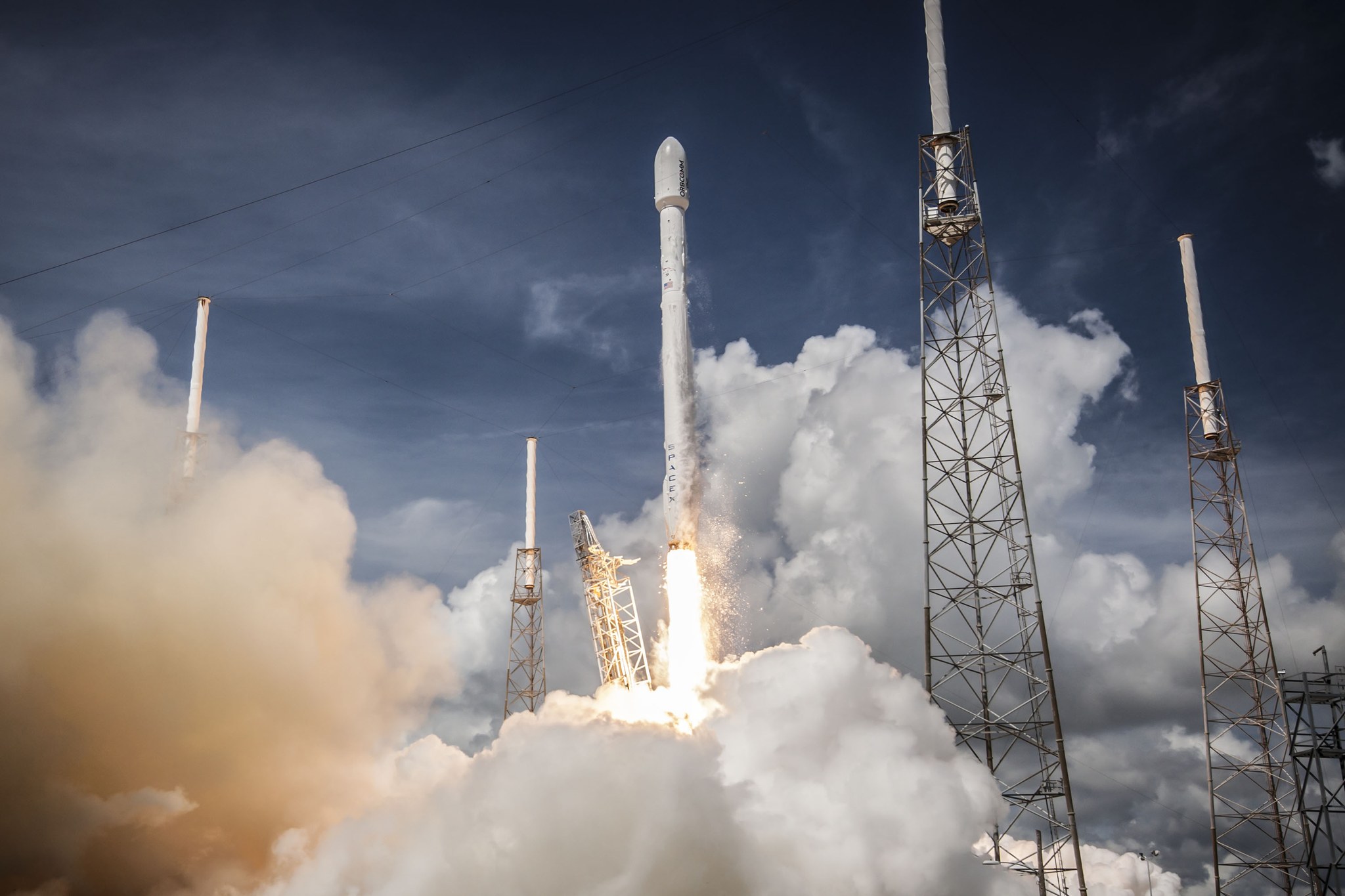
Cover image: a SpaceX Falcon 9 lifting off from Cape Canaveral. Photograph by SpaceX, via Wikimedia Commons, released under CC0 1.0.