Wednesday, September 23, 2026, written at 9:25 a.m. Eastern, thirty five minutes before the open. Futures and pre-market levels below are indicative and can move before the bell. Tokyo is shut for a fourth consecutive session for the autumnal equinox and reopens tomorrow, so Asia has now traded four days without its largest cash market.
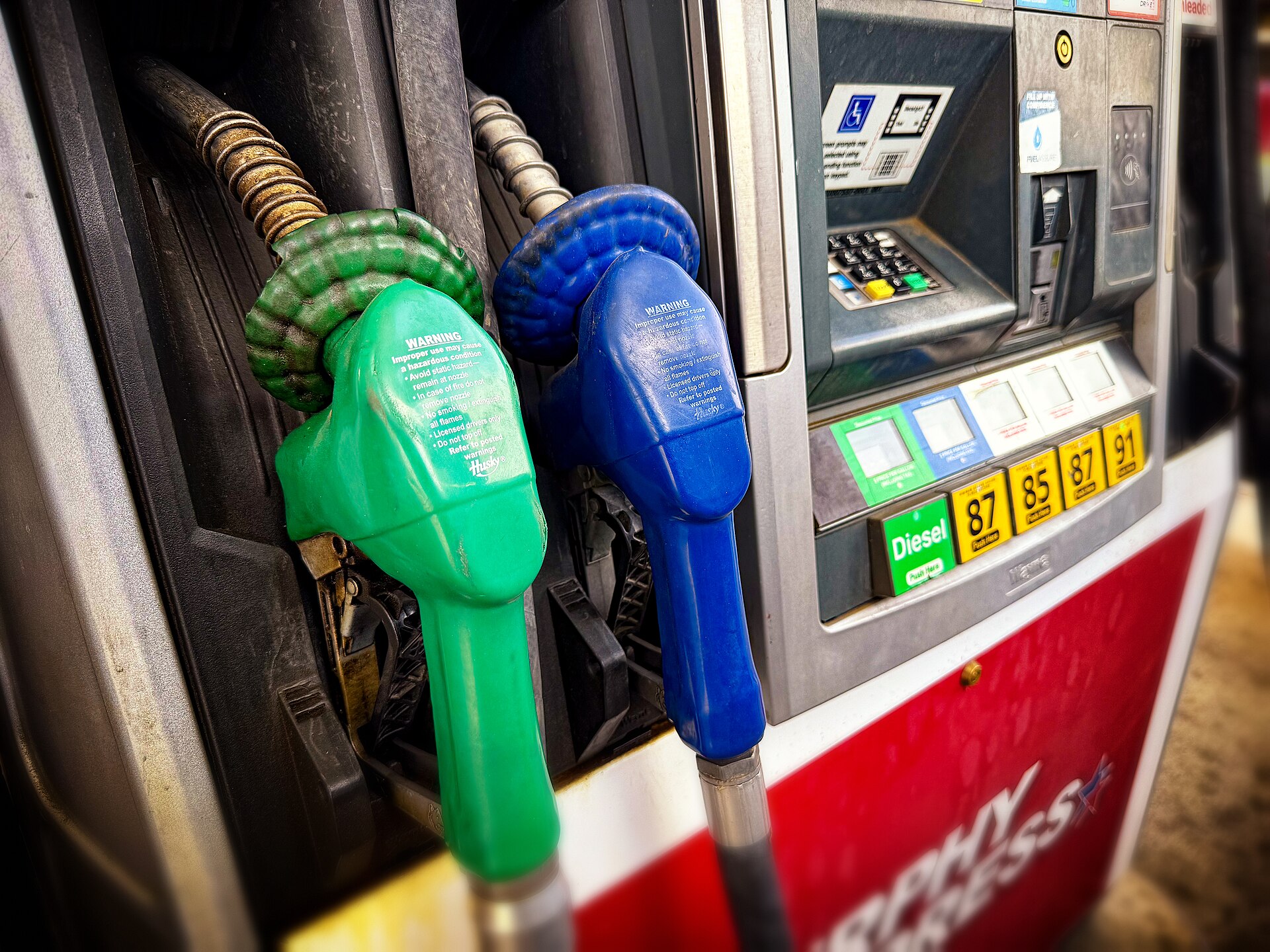
The President of the United States endorsed a ban on American diesel exports yesterday. His words were “I’ve said let’s not send out the diesel,” and “I’ve called for it within my people.” Treasury Secretary Bessent confirmed the administration is studying it, saying they are examining whether it is feasible in terms of overall refining capacity and whether a full or partial ban would work. The national average price of diesel printed a record $6.52 a gallon. On Friday it was $6.29. That is twenty three cents in four days.
In the same four days Brent fell to $98.99 for a sixth consecutive decline and its first close under a hundred dollars since early September, helped by Saudi Arabia restarting the East-West pipeline it shut on September 13 and by the first mediated contact between American and Iranian officials since July. Crude down six days, product up twenty three cents. This desk has argued since September 19 that the binding constraint in this energy shock is refining rather than extraction, and that only the product leg reaches the inflation print the Committee is hiking against. We no longer need to argue it. The White House has now proposed a policy that only makes sense if the argument is true.
It is also the wrong policy, and the reason is in the data rather than in the politics. The United States is currently producing more diesel than at any point since 2019 and the price is still a record. That combination rules out a domestic production problem and leaves a global product shortage priced in a globally traded market. An export ban does not add a barrel of refining capacity. What it does is reallocate American barrels from the seaborne market into domestic tanks, which lowers the domestic price at the margin and raises the international crack, which then pulls barrels back out through whatever channel remains open and reduces the incentive for a Gulf Coast refiner to run flat out in the first place. The American Petroleum Institute made the second half of that point yesterday, saying restrictions would compound the problem and that the answer is more supply and more flexibility. On this one they are right and the politics are wrong.
The timing makes it sharper. Half of Russia’s six largest diesel producing refineries have cut or halted output this month under Ukrainian drone attack. The Moscow refinery at Kapotnya stopped processing after the September 20 barrage with repairs measured in weeks, and the Kuibyshev plant in Samara was still burning yesterday. So the two largest pools of marginal distillate available to the seaborne market, Russian and American, are being withdrawn in the same fortnight, one by drones and one by executive order. ARA inventories sit roughly sixteen percent below their five year average and American distillate cover is the thinnest for the date since the early 1980s. Our position is unchanged in direction and firmer in conviction: own the crack, not the barrel, and understand that the crack is now a political variable with an asymmetric tail rather than a pure inventory trade.
The Tape: Quiet Futures Into a Loud Two Days
Futures are giving a little back. S&P contracts are 7,821.75, down 0.13%, Dow futures are 52,107 and down 0.33%, Nasdaq 100 futures are 30,953 and down 0.24%, and the Russell is again the worst of the four at 2,898.40 and down 0.54%. Yesterday the Nasdaq Composite closed at a second consecutive record, 27,244, up about 0.45%, while the S&P finished effectively unchanged and the Dow fell 185 points to 51,864. That is a third session in which one index makes a record and the other two do not participate, which is dispersion rather than a bull market, and it is the same internal shape we flagged on Friday.
The VIX at 14.29 is lower again. We buried the volatility call last week and we are not reviving it, but the observation is worth repeating in a different form: a fourteen handle into a state visit tomorrow, flash purchasing managers surveys this morning, a five year auction this afternoon and an active shuttle negotiation with Iran is a market that has decided every scheduled event resolves quietly. It has been right for six sessions running.
Two names in yesterday’s decliner list deserve a mention without a theory attached. Charles Schwab fell 6.1% and LPL Financial fell 7.5%, the largest moves in the index on a day the front end sat at a cycle high. Retail brokerage economics improve with a higher front end, so a six to seven percent drop in both on the same afternoon is either a flow event or something idiosyncratic we have not seen reported. We flag it rather than explain it.
Rates and the Dollar: The Fifth Session of the Same Mechanism
The ten year added about three basis points to 4.98% yesterday, the two year is holding 4.76% at the top of its cycle range and the thirty year sits near 5.30%. The dollar index is at 100.85, its highest in two months, and gold has fallen a third consecutive session to roughly $4,315, down a percent. Bitcoin is $85,457, down a percent, after $86,020 on Monday.
That is the reflexivity we flagged on the day of the hike, now in its fifth session and operating cleanly. Kevin Warsh said he would be hard pressed to describe financial conditions as restrictive and named them as the Committee’s evidence. Equities have eased them on Thursday, Friday, Monday and Tuesday. Goolsbee and Musalem have each said in the last three sessions that the Committee is not finished. The market has responded by bidding the dollar to a two month high and selling gold, which is the textbook expression of higher for longer arriving in the currency before it arrives in the equity multiple. The equity market is still pricing the rally. The dollar is pricing the bill for it.
Flash purchasing managers surveys land at 9:45 this morning, with manufacturing expected to ease to 53.5 from 53.9 and services to 56.0 from 56.5. These are the first survey readings that fully cover the diesel spike, and the line to watch is prices paid rather than the headline. Philadelphia’s prices received index jumped fourteen points last week to its highest since April. If the composite shows the same thing while output holds, the October meeting stops being a coin toss. A five year auction follows this afternoon.
Energy: What the Ban Would and Would Not Do
Take the two legs separately, because they are now moving in opposite directions fast enough that averaging them destroys the information.
The crude leg is genuinely easing and we concede it without reservation. Saudi Arabia restarted the East-West pipeline on Tuesday after a drone strike shut it on September 13, is loading a first cargo at Yanbu and is working the pumping rate back toward four million barrels a day, though a full restoration is still described as weeks away. Hormuz transits have been at a six month high with the main lanes clear of mines. American and Iranian delegations held mediated talks at the General Assembly, the first contact since the interim ceasefire collapsed in July, and Tehran repeated that it could reopen the strait within seven days if Washington lifts the naval blockade, unfreezes assets and stops striking allied forces. Brent at $98.99 is down 0.3% and lower for a sixth day. WTI’s November contract is $91.05, up 0.6%, after trading near $89.8 in the Asian session.
The product leg is going the other way and is now a political object. Diesel is at a record $6.52 with American refineries already running hard, distillate inventories about thirteen percent below their five year seasonal average as of September 11 and the Energy Information Administration forecasting stocks below the five year low through the end of 2026 and most of 2027. The crack closed at a record $107.72 on September 10 and printed $118.62 on September 14. Nothing in the last week has changed any of that. What changed is that Washington is now proposing to manage the symptom.
The honest two sided read on a ban is this. Domestically it would work, at least at first, because pulling roughly a million barrels a day of exports into the American system would build inventory cover quickly and take something off the pump price before the midterms. Internationally it would be inflationary for everyone else and eventually for the United States too, because the global crack would widen, European and Latin American buyers would bid harder for the shrinking non-American pool, and American refiners facing a capped domestic price and no export outlet would trim runs. You would also invite retaliation in a market where the United States is a net beneficiary of open product trade. Our expectation is a partial or conditional measure rather than a full ban, because Bessent’s language about a full or partial ban is the language of an administration looking for the smallest thing that can be announced. For positioning, the relevant point is not the direction of the crack but its distribution. A trade that was a physical shortage is now a physical shortage plus headline risk in both directions.
Corporate: Error Correction Lands on a General Purpose Processor
IonQ is up about 12.6% before the open at $45.87 and it has dragged the whole category, with Infleqtion up over six percent and Rigetti and D-Wave both up over five. The announcement, made after Tuesday’s close, is the first end to end real time quantum error correction decoder to run on a single off the shelf central processing unit. IonQ tested a dual decoder system on benchmark circuits simulating up to 408 logical qubits and more than 31.5 million quantum operations, and under typical noise conditions it added as little as 0.02% in extra run time. Separately the company said it will put a Superion 256 system into Nvidia’s Accelerated Quantum Research Center, linked to a GB200 NVL72 over NVQLink and orchestrated through CUDA-Q, with installation next year and first customer deliveries in 2027.
The first half matters more than the second. Real time decoding has been the bottleneck that forces a quantum machine to pause while its errors are fixed, and the working assumption in the field was that solving it would require dedicated silicon. It did not. It required a commodity processor. That is the third datapoint in four sessions pointing at the same layer, after the agentic workload argument that re-rated the CPU complex on Monday and AMD notifying channel partners of a ten percent fourth quarter price increase in the same session. We said on Monday that we would own the direction and size it off pricing data rather than download counts. This is a better piece of evidence than the downloads were.
What we would not do is pay yesterday’s multiple for it. A 408 logical qubit benchmark is a simulation, not a machine, the NVAQC install is next year and customer deliveries are 2027, and the revenue line that would justify a twelve percent move does not exist yet. The theme is investable at the compute layer. The pure play is a 2027 story being priced in 2026.
Elsewhere on the AI page, the supply side of this trade is about to change character and almost nobody is marking it. Anthropic is reported to be targeting an October listing at two trillion dollars or more against a roughly $965bn private mark in May and an annualised revenue run rate above sixty five billion by the end of July. OpenAI is raising at $1.2 trillion and has ruled out a 2026 listing. Add SpaceX at two trillion and the three of them carry more value than every American initial public offering between 1980 and 2025 combined. That is the largest new issue supply in the history of public equity markets arriving in the same quarter the front end sits at a cycle high and the discount rate is still rising. The risk to the AI trade that we would actually underwrite is not a demand disappointment. It is that the float goes up faster than the buyer base.
In Europe, Arcadis rejected acquisition proposals from WSP Global on strategic and integration grounds, Iberdrola is selling 49% of East Anglia Two for roughly five billion euros, Glencore signed a one billion dollar battery recycling agreement with Nth Cycle, Shell completed its $840m Gulf of Mexico divestment to Talos, Exor posted a first half loss alongside a five hundred million euro buyback, and Diageo hired WPP’s chief financial officer. Banking executives also told the press they would reconsider British operations if taxes rise again, which is worth a note five weeks before an October 28 budget that already has an eighteen billion pound August borrowing overshoot behind it.
Earnings: Nothing That Matters Printed, and That Is the Read
There is no print on today’s tape from the part of the market that is driving it. No accelerator, memory, optical, power or launch name reported. Twelve companies are scheduled and the two that moved are a steel processor and a restaurant chain. When a fifty trillion dollar equity market is being led by roughly twenty names and none of them reports for another week, the daily earnings docket stops being information and the calendar becomes the story.
| Company | Consensus | Actual | Read |
|---|---|---|---|
| Worthington Enterprises | $0.75 EPS, $331.3m | $0.82 EPS, $343.9m | Beat both, +15.9% pre-market |
| Cracker Barrel (FQ4) | $0.26 EPS, $845m | $0.99 EPS, $849.3m (-2.2%) | Large beat, +8.3% |
| KB Home (Tue, after close) | $0.89 EPS | $1.05 EPS, $1.30bn (-20%) | EPS beat, guidance miss |
Our take on KB Home, which is the only one of the three that tells you anything macro. Revenue fell twenty percent, deliveries fell nineteen percent to 2,732 and net orders fell twelve percent to 2,604, but earnings per share beat by sixteen cents and the backlog rose two percent to 4,398 homes and three percent to $2.05bn, its first increase in four years. The mechanism is the shift back to built to order, now about three quarters of deliveries, which lifted the housing gross margin sequentially. Read plainly, the builder has stopped buying volume with price and started protecting margin, and the market rewarded the margin. Full year sales guidance still came in light. This is the fifth consecutive week in which the rate sensitive economy underneath the artificial intelligence buildout has missed on volume, after Lennar, Nucor, Steel Dynamics and Fluence, and it remains the cleanest available evidence that a five percent long end is doing real work somewhere even while the Nasdaq makes records.
The substance is tomorrow and next week. Jabil reports before the open on Thursday with roughly $4.06 expected on about $9.6bn, carrying approximately $13.6bn of artificial intelligence revenue in fiscal 2026 against $9bn a year earlier and a third hyperscale customer won last quarter. That is the first genuine read on the buildout since Oracle. Micron follows on September 30 into sub ten day memory inventories and a labour dispute that hardened on Monday, when a second mediation failed and the Taoyuan union moved a formal strike vote to early October. Roughly ten thousand union members across two sites, about eighty percent of those polled supporting action, and a company that has said it cannot commit to anything before its October 9 board meeting. Micron has scheduled its confrontation for the week after it prints, at its largest DRAM and high bandwidth memory base, in the tightest memory market in a decade.
Asia and Europe
Korea did the thing we said it would not do. The Kospi closed at 7,080.92, up 0.9%, taking out Monday’s failed intraday high and holding well above seven thousand for the first time. Yesterday we wrote that the region which manufactures the entire artificial intelligence thesis would not hold the gap New York had paid for. It held it and extended it on the following session. We mark that against us below.
Hong Kong went the other way, closing at 24,821.84 and down 1.1%, with Shanghai at 3,936.52 and down 0.4%. Chinese equities are selling into a state visit that begins today. That is the second consecutive session in which the market with the most direct exposure to a tariff framework has declined to price optimism about it, and when the meeting is in Washington and the leverage is Chinese, Hong Kong’s read is the one we would weight.
Tokyo is shut a fourth day. The yen is weaker again at 157.82 against 157.39, which is now five sessions in which the currency has failed to strengthen after a Bank of Japan hike to 1.25%. The carry structure that funds a large part of the global artificial intelligence capital stack remains intact and remains the least discussed fact in funding markets.
Europe closed effectively flat on Tuesday, with the Euro Stoxx 50 up 0.08% at 6,323, the DAX up 0.10% at 25,600, the CAC up 0.20% at 8,155 and the FTSE down 0.29% at 10,708. This morning the DAX is 25,473 and down 0.4%, the CAC is 8,147 and the FTSE is 10,712. A region with no offset to an energy line that is now setting records in the product rather than the crude is doing exactly what you would expect it to do, which is nothing.
Geopolitics
The Iran war reaches day two hundred and seven with the fire pause in its thirteenth day, and yesterday produced the first real diplomatic movement of the conflict. Steve Witkoff and Jared Kushner engaged with Foreign Minister Araghchi through mediators on the sidelines of the General Assembly. The President initially described a three hour meeting and the White House later clarified that mediators shuttled between the delegations rather than the parties sitting together, while Tehran downplayed the encounter and said it had maintained its negotiating position. Witkoff called the talks lengthy. Both sides used the word momentum.
The terms are where the caution belongs. Iran wants the naval blockade lifted, its frozen assets released and operations against its regional partners ended, and only then will it reopen Hormuz within seven days. The President’s own General Assembly speech framed the choice as a deal that allows Iran to rebuild or moving to annihilate the Islamic Republic, and the Iranian military called the threat evidence of strategic weakness. So the gap is unchanged and the channel is new. That is worth something and it is worth less than a sixth consecutive down day in Brent implies.
Xi Jinping’s state visit runs today through Friday, with the bilateral meeting and the state dinner tomorrow. Tariffs are the main agenda item, with a framework covering roughly thirty billion dollars of products on each side under consultation, alongside rare earths, artificial intelligence and Taiwan, and the truce agreed last October expires in November. China controls about seventy percent of global rare earth mining and roughly ninety percent of processing, which is the entire reason the meeting is happening in Washington rather than Beijing. Jensen Huang, Sam Altman, Jeff Bezos, Elon Musk, Tim Cook, Sundar Pichai and Cristiano Amon are all expected at the dinner. The guest list tells you what the two governments think this meeting is about, and it is not soybeans.
Key Events Today and This Week
| When | Event | What matters |
|---|---|---|
| Wed, 7:00am | MBA mortgage applications | Already out and lower, a five handle long end at work |
| Wed, 9:45am | Flash PMIs | Mfg 53.5e from 53.9, services 56.0e from 56.5. Watch prices paid |
| Wed, 10:30am | EIA petroleum status | Distillate cover, the number the export ban is aimed at |
| Wed, 1:00pm | 5-year note auction | Demand for duration with the front end pinned |
| Wed, all day | Xi arrives in Washington | State visit runs to Friday |
| Thu 24 | Trump and Xi meet, state dinner | Tariffs, rare earths, AI. Truce expires in November |
| Thu, pre-open | Jabil | ~$4.06 on ~$9.6bn, $13.6bn of AI revenue in FY26 |
| Thu, after close | Accenture, Costco | Tech budgets and the six dollar diesel consumer |
| Fri, 8:30am | Core PCE | The number Musalem cited at 3.7% for July |
| Sep 30 | Micron | Memory demand into a strike vote dated for early October |
Accountability
The Korean call is marked against us and it is the clearest miss of the week. On Tuesday we led with the observation that Korea opened up 2.20% and closed up 0.15%, and argued that the region which manufactures the thesis would not hold the gap New York had paid for. Seoul closed up 0.9% at 7,080.92 yesterday, above the level it had failed at, and it did so without help from a strong American session. One session of fade is not a signal and we should have waited for the second before writing it as one. The demand read from the customs file stands. The tape reading we hung on it does not.
The peace trade call is now six sessions against us and we are conceding the crude leg entirely rather than narrowing it again. We declined it on September 21 with Brent near $100.50 on the grounds that it was priced off an unscheduled meeting between two governments exchanging threats. The meeting has now happened, through mediators, and Brent is $98.99 and lower for a sixth day. We were right that the meeting was not scheduled and wrong about what that was worth, and the correct lesson is that a physical market does not need a signed document to reprice when the pipeline restarts and the mines are cleared. What we keep is the product leg, which has done the opposite of everything the crude leg has done, and which is the only leg that reaches the inflation print.
The distillate thesis is working and today it was confirmed by the most expensive possible source, which is the White House proposing to legislate against it. Pump diesel at a record $6.52 against $6.29 on Friday, with American refineries running at their highest diesel output since 2019, is the shortage arriving at the consumer. We would note for the record that we spent nine sessions earlier this month analysing crude flat price while this was happening, which we marked on September 19 and which stands as the heaviest error of the month.
The reflexivity call is working in its fifth session and has now shown up in the currency. Dollar at a two month high, gold down a third day, ten year at 4.98% and the two year pinned at 4.76%, while equities made another record. That is the mechanism as described.