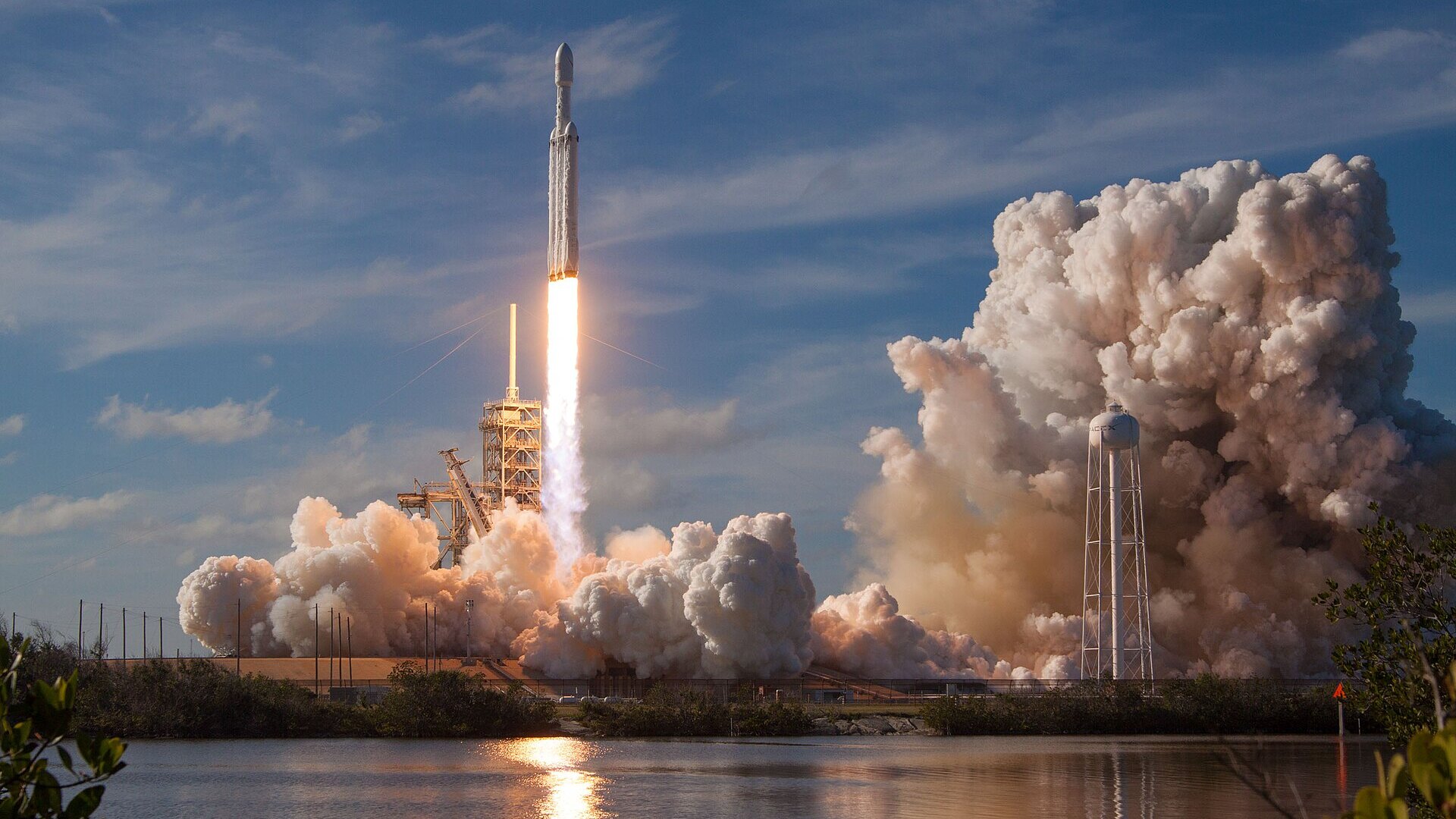
Wednesday, October 21, 2026, written at 9:15 a.m. Eastern, fifteen minutes before the open. Every future, yield, currency and commodity level in this note carries that stamp, and the European and Asian figures are intraday or local closes rather than settled American marks. There is no first tier American data release today. The Treasury reopens $13bn of twenty year paper at 1:00 p.m. Meta, Tesla, IBM and Texas Instruments all report after the close, which makes this the single densest evening of the quarter for the argument this desk has been running since the first week of October.
Top Call: The Demand Question Got Answered. The Funding Question Got Worse.
SpaceX reported $14.58bn of revenue last night, up 161% year on year against a consensus near $12.86bn, with net income of $4.4bn and $0.35 a share. The Super Intelligence segment, which leases computing capacity to Anthropic, Google, Grok and X, produced $7.56bn against $2.56bn in the second quarter and is now the largest business in the company. Connectivity rose 69% to $5.25bn with operating income close to doubling at $2.37bn. Space revenue grew 6% to $1.77bn. The stock is up roughly 8% pre-market and Nasdaq 100 futures are up 0.62% on the back of it.
Take the first half of that seriously, because it is the strongest piece of evidence anyone has produced for the bull case in a month. For three weeks the dominant worry has been that artificial intelligence spending is a capital story in search of a revenue line. Here is a revenue line, $7.56bn of it, growing at a rate that nobody modelled, at a company most of the street still classifies as a launch provider. That is contracted demand for compute, invoiced and collected, not a pipeline number. On its own it is a direct rebuttal to the DeepSeek efficiency argument we wrote up on Monday.
Now take the second half. Third quarter capital spending was $19.6bn against $14.6bn of revenue, and management guided fourth quarter capital spending to a range of $35bn to $40bn. That is roughly double what the company just spent in a single step. Sell side capital spending projections now run from about $70bn this year to $197bn in fiscal 2028, with debt modelled to rise from $50.7bn in 2025 to around $350bn by 2029. Our read is that the quarter resolved the demand debate and sharpened the funding debate in the same document, and the market is currently paying attention to one of those.
The Capex Guide Is the Number, Not the Beat
We want to sit on the $35bn to $40bn for a moment because it is the most consequential disclosure of the week and it is being reported as a footnote.
A company that generated $2.79bn of operating income in a quarter is telling you it intends to spend somewhere between twelve and fourteen times that amount in the next ninety days. The gap gets funded externally. Yesterday S&P Global’s head of digital infrastructure said the largest technology companies almost certainly carry more artificial intelligence debt than the agency can see, naming guarantees and long dated purchase commitments that never appear as debt in a filing. SpaceX is one of the six names in the $7tn figure S&P used. Less than twenty four hours later it raised its quarterly capital ask by roughly $18bn without publishing a financing plan alongside it.
This is the part where our framework and the tape disagree, so we will state the disagreement plainly rather than hide it. Our view since October 7 has been that the binding constraint in this cycle is the cost of capital rather than the level of demand, and the market has spent this morning rewarding exactly the kind of spending plan that framework says is getting more expensive to carry. One of two things is true. Either the revenue growth is fast enough that a 10% cost of capital no longer matters, which is a defensible position when a segment nearly triples in a quarter, or the market is pricing the revenue and deferring the financing question to the next funding round. We think it is mostly the second, and the reason we think so is that the equity moved 8% overnight while nothing visible happened to the credit.
There is a cleaner version of the test available tonight. Meta has guided 2026 capital spending to $130bn to $145bn with street estimates near $193bn for 2027. Tesla, IBM and Texas Instruments report alongside it. We pre-committed on Monday to marking whether any of Meta, Tesla or IBM softens capital expenditure language. SpaceX has now pre-answered the question in the opposite direction at maximum volume, which raises rather than lowers the information content of what Meta says, because a hyperscaler with a public balance sheet and a real free cash flow line faces a constraint a privately financed launch company does not.
The Merger Headline Is a Governance Event, Not a Synergy Story
On the call Musk confirmed that Tesla and SpaceX have each formed special committees of independent directors to study a merger, that he is not participating because he is a conflicted party, and that calling a deal a certainty would be overstating it. A combination would be the largest corporate tie up ever attempted, somewhere around $3.5tn.
The framing we would resist is the one that treats this as an industrial logic question about shared chip and autonomy work. The relevant detail is procedural. Tesla would need approval from 50% of all shares outstanding rather than a simple majority of votes cast, which is a much higher bar than it sounds, and the proxy filed on October 19 sets the annual meeting for December 3 with no merger item on it. So any vote is a later meeting, and between now and then two separate shareholder bases get to decide whether they want each other’s capital intensity.
That is the actual content. SpaceX is about to spend $35bn to $40bn in a quarter. Tesla generates automotive free cash flow. A merger is, among other things, a funding structure, and it arrives in the same week a rating agency said it cannot see all the obligations in this complex. We are not taking a view on whether it happens. We are noting that it would convert an external financing problem into an internal one, and that the market should price it as such rather than as a story about rockets and cars.
Ken Griffin Named the Risk, and His Version Is Better Than the Usual One
Speaking at Citadel’s conference yesterday, Ken Griffin said investors are almost certainly in an artificial intelligence bubble, while making clear he remains a believer and that the survivors of bubbles tend to lead markets for decades. The useful part was not the word bubble. It was the mechanism he described.
Griffin’s concern is corporations scrutinising their artificial intelligence invoices, including from Anthropic and OpenAI, and struggling to identify clear productivity gains. Separately he compared graphics processors to airline seats, assets that still earn something when sold cheaply, and warned that a glut could send pricing into freefall. That is a far more specific claim than the generic bubble call, and it happens to be the one thing that would break the SpaceX print. If leased compute is a commodity with airline economics, then $7.56bn of segment revenue growing at this rate tells you about volume and tells you nothing durable about price. Nobody has produced the pricing disclosure that would settle it, and we would put a high value on any hyperscaler that provides one tonight.
Two positioning data points sit underneath this. Goldman’s risk appetite indicator turned negative for the first time since March, and hedge funds recorded their largest net selling of global technology over a two week stretch on record. That combination plus a 0.62% bid in Nasdaq futures is a market where the fast money has already reduced and the headline is being bought by whoever is left.
Earnings: Good Quarters, Punished Outlooks
The pattern across this morning’s tape is consistent enough to be a conclusion rather than an anecdote. Companies are beating on the quarter and being marked down on the guide.
| Company | Consensus | Actual | Read |
|---|---|---|---|
| SpaceX | $12.86bn rev | $14.58bn, $0.35 EPS, $4.4bn net | Blowout, Q4 capex $35-40bn |
| Netflix | $12.87bn rev | $12.874bn, $0.87 EPS | Beat, Q4 guide and ad target cut |
| Super Micro | FQ1 $17.0bn est | Raised to $18.5-19.5bn | The cleanest AI read of the day |
| Intuitive Surgical | $2.65 adj EPS | $3.00 adj, $3.05bn rev | Beat, down 7.5% on pricing plan |
| Capital One | $4.83 prior-year | $5.61, $3.5bn net income | Clean beat, credit still fine |
Super Micro is the print that deserves more attention than it will get. The company raised its fiscal first quarter revenue range to $18.5bn to $19.5bn and the shares are up about 13%. This is a business that cut the same quarter’s guidance a year ago on delivery slippage, so a raise here is a statement about component availability and customer schedules rather than about bookings. Read alongside the Nvidia reporting that ByteDance, Alibaba and Tencent have ordered more than three million Blackwell parts worth roughly $35bn, against capacity that may let Nvidia fill only 5% to 10% of it, the message is that the bottleneck in this complex is still supply. Micron is up about 2% pre-market after a 16% drawdown this month, and the Kospi closed up 3.3% at 5,735.66 with a sidecar triggered. Korean memory recovered most of yesterday’s 3.73% loss in a single session, which is the third 3% move in four days and tells you the holders there are mechanical rather than analytical.
Netflix is the counterexample and the better illustration of the regime. Revenue of $12.874bn grew 12% and matched, earnings of $0.87 beat, and the stock is down about 6%. The fourth quarter guide of $13.442bn and $0.67 sits below $13.517bn and $0.73, and the company cut its 2026 advertising target to $2.7bn from $3bn, blaming a slower rollout of advertising product capabilities. That last item is the problem. Advertising was the growth story that justified the multiple after subscriber disclosure ended, and a 10% cut to the target in the same month the company let go roughly 1,000 people and replaced its content chief is three pieces of the same picture. Our take is that this is a thesis change rather than a quarter, and the thesis it changes is the one about Netflix being a technology company with an advertising option attached.
Intuitive Surgical beat at $3.00 adjusted against $2.65 on $3.05bn of revenue, placed 546 da Vinci systems with systems revenue up 30%, took a $450m pre-tax antitrust settlement charge that cut the reported figure to $1.49, and is down about 7.5%. The mark down is not about the charge. Management announced it will deliberately reduce instrument and accessory revenue per procedure by 3% to 5% to drive adoption in high volume benign procedures. That is a company trading price for units on purpose, and holders who owned it for pricing power are reading the memo correctly.
Capital One earned $5.61 a share on $3.5bn of net income against $4.83 a year ago and is up about 3%. AT&T beat on both lines and is down roughly 3.5%, which is the purest expression of the morning. In Europe, Carrefour fell 14% to 15% after cutting its 2026 targets.
Energy: The Talks Are Not Working and the Premium Is Rebuilding
Brent trades at $110.13, up 1.2%, within a $109.27 to $110.75 range. WTI is up 1.4% near $99.20, with the apparent gap to Tuesday’s $101.79 reflecting the November contract expiring rather than a price collapse. Brent settled 0.69% lower at $108.79 yesterday after touching a five month high of $111.99.
Tuesday’s dip came from reports of mediation, with Iran’s president discussing possible channels with Pakistan’s army chief. This morning Iran said there is little reason to expect progress now, and the premium is rebuilding. Kpler still counts at least eighteen vessels attacked in two weeks, mine strikes near the Strait of Hormuz continue, and Houthi claims against Saudi energy infrastructure remain live. Dutch TTF gas is up 4% toward EUR 90 per megawatt hour.
Our framing is unchanged and it survived a round trip this week, which is worth something. A 2027 crude surplus sits underneath a present distillate and freight shortage, so headline Brent responds to diplomacy while gas and diesel respond to the actual chokepoint. The fact that European gas keeps climbing through a day when crude settled lower is the tell. Weekly EIA inventories are due this afternoon with the market looking for a draw of about 1.2m barrels.
Europe: France Is Now Paying 2002 Prices for Its Own Politics
The French ten year rose about seven basis points to 5.00%, the highest since July 2002, and the spread over Germany widened to roughly 158 basis points from about 153 at the previous close. That is a fresh post euro crisis extreme on consecutive days. Equities are not trading it the same way, with the CAC 40 up 0.4%, the Stoxx 600 up about 0.5% and the DAX up modestly, helped by EssilorLuxottica.
The divergence is the point. Curfews are in force in parts of Paris, Lille and Nice after a weekend of rioting, Prime Minister Lecornu has so far declined a blanket Paris curfew in favour of localised measures, and unions have called a national day of action for November 5. Moody’s reviews France on Friday and the ECB meets on October 29. Bond investors are pricing a fiscal path that a strike calendar and a rating review can make worse. Equity investors are pricing earnings from companies that mostly sell outside France. Both can be right for a while, and the thing that would force them to converge is a bank funding cost, which is why we keep watching the French lenders rather than the index.
The United Kingdom delivered the morning’s genuine data surprise. September inflation rose to 3.5% from 3.1%, above the 3.4% expected, with core at 2.8% from 2.6% and motor fuel inflation at its highest since August 2022. Markets now price a November 5 Bank of England hike at 98%. That is a central bank tightening into an autumn budget on October 28, which is an uncomfortable sequence, and the two year gilt at about 4.93% is barely moving because the hike is already in the price. Japan reported September exports up 16.7% year on year, which helped the Nikkei to 64,621.24 and up 0.9%.
Also On The Tape
- SpaceX agreed to buy Grain Management’s 800 MHz spectrum licences to improve indoor Starlink Mobile service, subject to FCC approval, at a price the Wall Street Journal puts near $8bn
- Musk said on X that he intends to offer SpaceX stock to every child in America next year, which on roughly 72m minors implies something close to $10.5bn, with his own shares locked up until 2027
- Nvidia is reported to have received orders from ByteDance, Alibaba and Tencent for more than three million Blackwell parts worth about $35bn, with capacity to fill only a small fraction before 2027
- Hong Kong closed down 0.9% at 23,651.87 and the Shanghai Composite fell 0.6% to 3,713.03, so the Asian rebound was a Korea and Japan event rather than a China one
- Salesforce confirmed the Braze acquisition at $47.50 a share for about $5.66bn of enterprise value, a premium near 58%
- Stord acquired AMS Fulfillment, a third party logistics provider handling more than 10m orders a year
- Goldman Sachs risk appetite turned negative for the first time since March, with record hedge fund net selling of global technology across two weeks
- Russia has proposed a three way summit involving the United States and China, while South Korea is withdrawing further embassy staff from Ukraine over a dispute about North Korean prisoners of war
- A United States congressional committee chair described Chinese coast guard patrols east of Taiwan as highly destabilising, and Defence Secretary Hegseth held an unannounced meeting with Prime Minister Netanyahu
- Fed pricing for October 28 sits near 86.5% for no change against about 12.5% for a hike, with December still close to 91%
The Record
Three items, and the first one is a miss on our own framing rather than our numbers.
Yesterday we previewed SpaceX and wrote that the central tension was subscriber growth against falling revenue per user, and that the answer would decide whether Starlink is a scaling network or a discounting one. The composition came out the other way round. Subscribers added were 1.6m against roughly 2.29m expected, and monthly revenue per user rose 5% sequentially to $69. So the business is pricing better and acquiring slower, which is the opposite of the failure mode we flagged. We also carried a consensus of $12.89bn and $0.15 adjusted, against $14.58bn and $0.35 delivered. We were not wrong to call it the most informative print of the week. We were wrong about which line would carry the information, and the line that carried it, the Super Intelligence segment at $7.56bn, was one we did not write about at all.
The Volta secondary test stays open with two days left in its stated window. We said the loan should trade at or below its 95 cent issue price through its first week of secondary trading, and that a print above 96 would mean we overstated how expensive this funding has become. There are still no reliable quotes. If none appear by Friday we mark it unresolved rather than claim it.
Wednesday’s capital expenditure test resolves tonight and we are leaving it exactly as written, with one addition. If the efficiency argument has any purchase on real plans, at least one of Meta, Tesla or IBM should soften its capital expenditure language rather than raise it, and we will also mark whether any of the three quantifies off balance sheet commitments tied to compute. The addition is this. SpaceX has already answered in the opposite direction by nearly doubling a quarterly capital plan, and we should say in advance that if Meta raises as well, the honest conclusion is that our cost of capital frame has not yet changed anybody’s behaviour, only their funding spread.
Key Events Today
- 7:00 a.m. MBA weekly mortgage applications
- 10:30 a.m. EIA weekly crude inventories, consensus a draw of about 1.2m barrels
- 1:00 p.m. Treasury reopens $13bn of twenty year bonds, when issued near 5.485%
- After the close Meta, Tesla, IBM and Texas Instruments, the first direct read on whether a doubled cost of capital changes a capital plan
- Also reporting Lam Research, Thermo Fisher, Danaher, Abbott, Philip Morris, CME and NextEra
- Friday Moody’s review of France
- Watching Hormuz and Bab al-Mandeb shipping, any secondary quote on the Volta loan, Korean memory after a 3.3% bounce, and whether anyone discloses pricing on leased compute