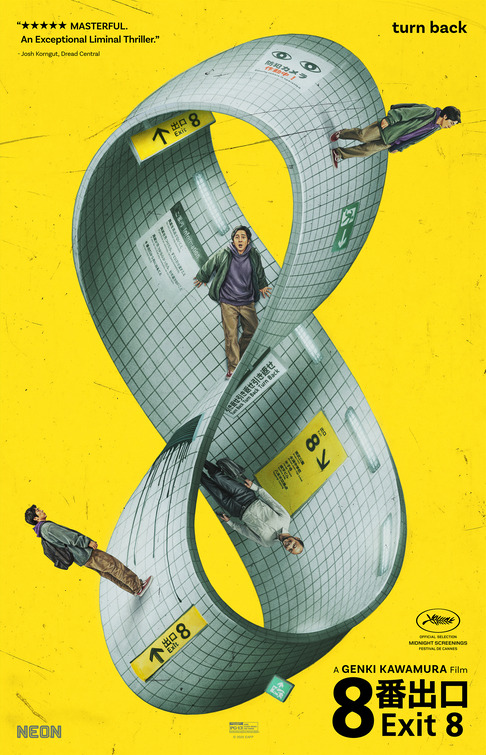
Let me be upfront: I watched the narrated version of Exit 8 without having played the original video game it is based on. That context gap almost certainly matters, and I suspect the experience lands differently for those who came in already fluent in the game’s logic and language. For the uninitiated, the film is a genuinely disorienting puzzle that never fully decides whether it wants to be solved.
The core experience the film captures is legible enough: a man trapped in a looping underground passage, forced to identify anomalies in order to progress, gradually unravelling under the weight of repetition and confusion. The psychological texture of that premise, the way choice becomes paralysing when the rules keep shifting beneath you, comes through. And the arrival of the unexpected child as an anchor point, the thing that finally orients the man enough to move forward, carries a quiet emotional logic even when the film refuses to make it explicit. Whether that child is his son, a memory, a projection of a future he is afraid to want, the film never specifies, and the ambiguity feels less like intentional mystery and more like an incomplete sentence.
The three-part structure is where the film loses me most completely. The middle aged man who navigates his own path to a middle exit that leads nowhere, the school girl whose presence seems tied to the anomaly framework but whose role never coheres: these feel less like deliberate layers of meaning and more like connective tissue searching for something to connect. A film is entitled to its mysteries. What it is not entitled to is mysteries that feel unearned, where the withholding of explanation reads as a substitute for meaning rather than a deepening of it.
What saves the film from being a complete frustration is that something does come through, faintly but genuinely. The confusion of a man at a crossroads, the struggle to make a choice when every path looks identical, the idea that sometimes an unexpected presence from outside your own logic is what finally moves you forward: these are real human experiences rendered in an unusual formal language. The film reaches for something. The hand just doesn’t quite close around it.
Perhaps the game would have helped. Perhaps the grammar of the source material would have given the film’s stranger choices a foundation they currently lack. As a standalone cinematic experience for a first-time viewer, Exit 8 is more bewildering than illuminating, a film that mistakes unresolved questions for profound ones, and trusts its atmosphere to carry more weight than it ultimately can.