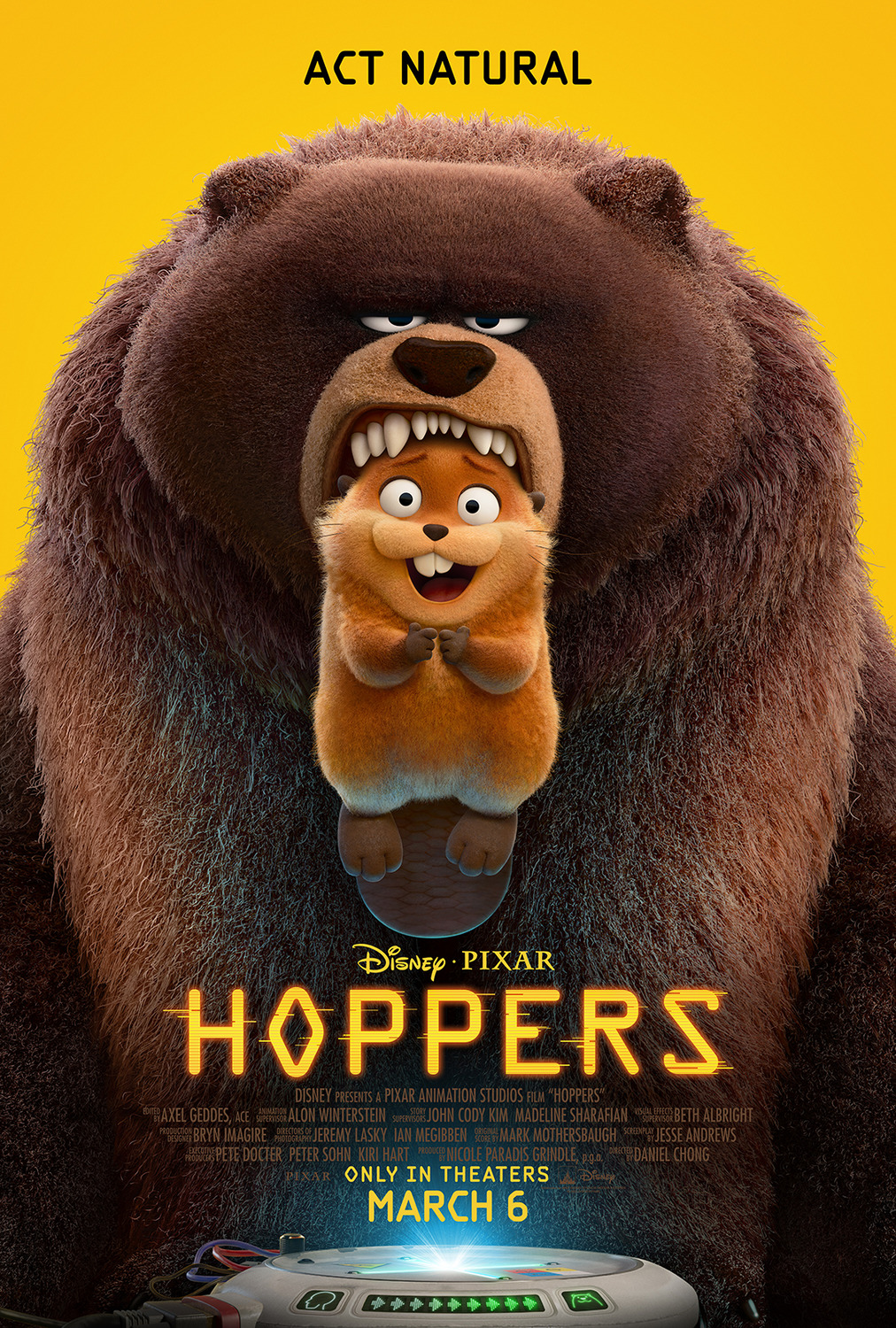
Among the best animations I have seen in recent memory, Hoppers belongs in the same conversation as The Wild Robot, films that earn their emotional moments rather than manufacturing them, and carry a meaning that feels genuinely relevant to the world outside the theatre. Pixar has had an uneven stretch in recent years, but this is a full, confident return to form.
What immediately separates Hoppers from the crowded field of environmentally conscious animated films is its central conceit. Rather than simply documenting the damage humans do to natural habitats and asking the audience to feel bad about it, the film uses its hopping technology, the ability to transfer a human consciousness into a robotic animal body, to collapse the distance between observer and observed entirely. Mabel doesn’t study the animals. She becomes one of them, moves through their world at their eye level, earns their trust and loses it and earns it again. The mind-bending premise has obvious shades of Avatar, but Hoppers is looser, funnier and far less self-serious about its own message. It has something to say and it says it while also being genuinely, repeatedly hilarious.
The story follows the classic people-against-power structure, but it earns that structure by escalating it with real imagination. What begins as Mabel and the animals pushing back against Mayor Jerry’s highway construction through their habitat steadily transforms into something far larger: the butterfly, the insect queen, driven to an extremity of resentment toward the human race, wants to burn it all down entirely. The film’s willingness to take the animals’ grievance seriously, to follow it to its logical and terrifying conclusion, is what gives the eventual resolution its weight. When Mabel and Mayor Jerry end up working together alongside the animals to save the world using the very water reservoir originally built for the beaver habitat, it doesn’t feel like a convenient plot device. It feels earned by everything that preceded it.
The final act, with animals that once hurt Mabel arriving to help her anyway, is genuinely warm in a way that doesn’t feel manipulated. The whole film has been building toward the argument that the only path forward is collective. Every advantage, every resource, every unlikely alliance matters. The timely theme is that the only path to salvation is for everyone to work with everyone else, and while that could easily collapse into hollow sentiment, Hoppers structures its story carefully enough that the message lands as something lived rather than declared.
The conversations throughout are where the film quietly excels. There’s a warmth and a wit to the dialogue that makes even the smaller exchanges linger. One line in particular: “trust is like a dam, you just need to patch it up”, lands with the kind of unpretentious simplicity that only works when a film has genuinely earned the emotional context around it.
And then there is Mayor Jerry himself, voiced by Jon Hamm with the perfect register of slick confidence slowly unravelling into genuine feeling. Watching a character who begins as a man who cares nothing for nature or animals end the film as someone transformed by the experience of fighting alongside them is one of the more satisfying character arcs in recent Pixar output. It doesn’t announce its emotional beats. It just lets them accumulate.
Hoppers will make you laugh, pull something warm out of your chest, and leave you with the quiet conviction that cooperation across difference isn’t naive idealism but the only practical option any of us actually have.