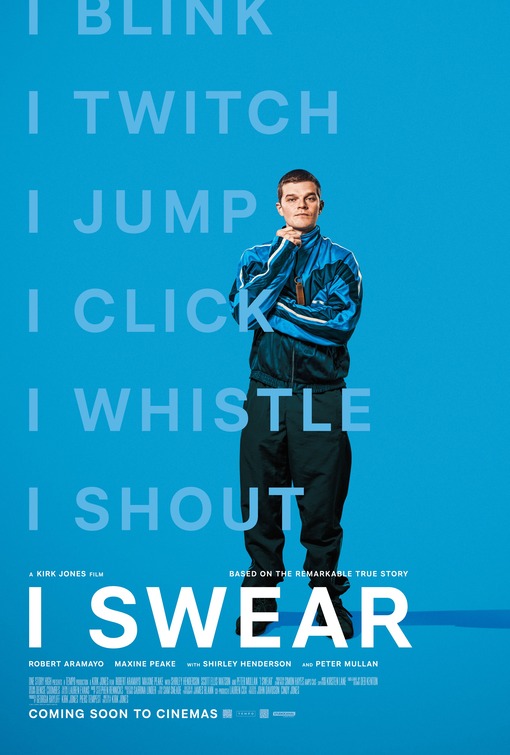
The first thing to establish is that Robert Aramayo’s performance as John Davidson is one of the finest pieces of acting you will see this decade. Portraying Tourette syndrome with the kind of specificity and physical commitment this role demands, the involuntary tics, the uncontrollable vocalizations, the swearing that erupts without consent or warning, is a minefield of potential misstep. Aramayo navigates it without a single false note. The performance never tips into caricature, never reaches for sympathy through manipulation, and never lets you forget that behind every tic is a person who is fully aware of what is happening and entirely unable to stop it. It is spotless work in a role that would expose any weakness in a lesser actor immediately.
The film’s first half is difficult in all the right ways. John is diagnosed at fifteen and the world responds the way the world tends to respond to things it doesn’t understand: with mockery, with avoidance, with the particular cruelty that adolescents specialize in. His condition costs him opportunities that should have been his and fractures his family in ways that a diagnosis alone cannot repair. The involuntary swearing provides moments that are genuinely, uncomfortably funny. The film is honest enough to let you laugh and then honest enough to show you the damage underneath the joke. His attempted suicide sits at the far end of this section and lands with appropriate weight, the inevitable destination of a young man who has absorbed years of the message that his presence is a problem.
The transition into the second half is the film’s one meaningful weakness. The time leap between adolescence and adulthood is too abrupt; it jumps from a broken family, a suicide attempt, and a world defined by ignorance, into a smaller community where understanding has somehow already partially arrived. The connective tissue is missing, and the tonal shift feels slightly earned by editing rather than by drama. It does not undermine what follows, but it does create a seam in what is otherwise a seamlessly constructed emotional journey.
What follows is Dottie, and Dottie is everything. The mother of a school friend who takes John in with a completeness and a warmth that asks nothing in return: no apology for words he didn’t choose, no performance of normalcy to make her comfortable. Her promise to look after each other is the moral center of the entire film, the moment where John’s life pivots from survival to something that might actually resemble living. That she is dealing with her own cancer diagnosis while extending this grace to him makes her neither a saint nor a martyr but simply a person who has decided that kindness costs less than people imagine. Their relationship is the warmest thing in the film and possibly the warmest thing in any film this year.
Tommy completes the picture: a man who defends John in court, advocates for him practically, and delivers the advice that changes the trajectory of everything. Stop surviving the disease in private and start educating people about it in public. The shift from victim to educator is handled without triumphalism, which is the right call. John does not conquer Tourette syndrome. He learns to bring other people inside his experience of it, and that act of education is its own form of dignity.
The honorary badge from the Queen arrives as recognition, and the film is clear-eyed enough to frame it as meaningful but insufficient, the kind of institutional acknowledgment that arrives after a lifetime of work that the institution largely ignored. But it is not the ending, and the film is wiser than to close there.
The real ending is quieter and more profound. A researcher invites John to participate in a neural control study aimed at reducing his tics in public settings, and for the first time, John walks into a library. A library. A place he had always avoided, a space defined by the silence his condition could never guarantee him. That single image carries more emotional weight than any award ceremony could. John had lived his entire life under the understanding that there was no cure, no meaningful intervention, no realistic prospect of the world becoming more navigable. The research changes that calculus. It does not promise a cure. It promises something rarer and more honest: the possibility of mitigation, of reclaimed spaces, of a future that is not simply a continuation of everything that came before.
I Swear is warm, real, and genuinely educational without ever feeling like a lesson. It earns every one of its emotional beats and wastes almost none of its considerable running time. Mostly, it makes the case that understanding is not a complicated thing to extend to another person; it just requires someone willing to go first.