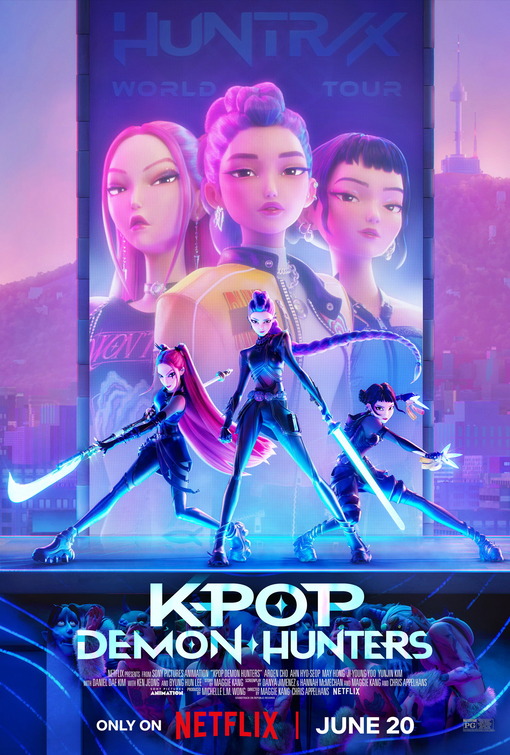
I am not a K-pop devotee. But KPop Demon Hunters does something genuinely clever. It doesn’t require you to be one. The film is so well integrated into the K-pop world that even a casual viewer feels the fandom energy, the rivalry stakes, and the parasocial pull without needing any prior investment. The genre blending works because it never feels like a marketing exercise dressed as a film. It feels like a story that happened to live inside this world naturally.
The setup is rooted in Korean mythology with real care and specificity. Ancient demons feed on human souls to empower their ruler Gwi-Ma, and across generations three women always emerge as demon hunters, using their voices to create the Honmoon: a golden barrier that seals the demons away. In the present day, those three women are Rumi, Mira and Zoey, better known to the world as Huntrix, a globally renowned K-pop girl group. Their music isn’t just performance. It is literally the mechanism by which the human world stays protected. That’s a genuinely elegant piece of worldbuilding. The idea that collective emotional energy, funnelled through song and fandom, is the thing standing between humanity and annihilation. It’s not subtle, but it earns its grandiosity.
What the film gets spectacularly right is how the songs function within the story. They are not decorative. Each musical moment conveys the precise emotional state of the characters at that point in the narrative, the desperation, the grief, the defiance, the tentative hope, so that the soundtrack and the story feel genuinely inseparable rather than stitched together. “Golden” in particular is exceptional, the kind of song that works both as a standalone piece of music and as an emotional climax for everything the film has been building toward.
The emotional core of the film rests entirely on Rumi, and it holds. Rumi has been hiding the fact that she is half-demon from the rest of the group, at the behest of their former master, and the shame of an identity she didn’t choose and was told to conceal is what the whole film is quietly about. When she finally confronts her inner demon, not just literally but in the fuller sense of accepting what she is and what she has been hiding, the moment lands with real weight. That reckoning is what wakes the other two members up, strips away the fractures between them, and allows all three to complete the Golden Honmoon together. The final barrier is built not just from their vocal power but from their honesty with each other, which is a genuinely moving idea.
The film probes shame in a fairly complex way: Rumi must become free of her hidden shame, but the Jinu subplot also suggests someone might have a legitimate reason to feel shame, a distinction most animated films wouldn’t bother to make. Jinu sold his soul for a beautiful voice to rescue his family from poverty and has been haunted by the consequences ever since. His arc mirrors Rumi’s in structure but diverges in crucial ways, and the film is wise enough to honour that difference rather than collapsing both journeys into the same tidy resolution.
The real-world resonance is hard to miss. The idea that the people most likely to drain your energy and erode your sense of self will disguise themselves as exactly what you find most attractive is not just good supernatural plotting.
KPop Demon Hunters is one of the best animated films of 2025, and easily the most culturally alive one. It fires when it needs to fire, moves when it needs to move, and leaves you humming something you didn’t expect to love.