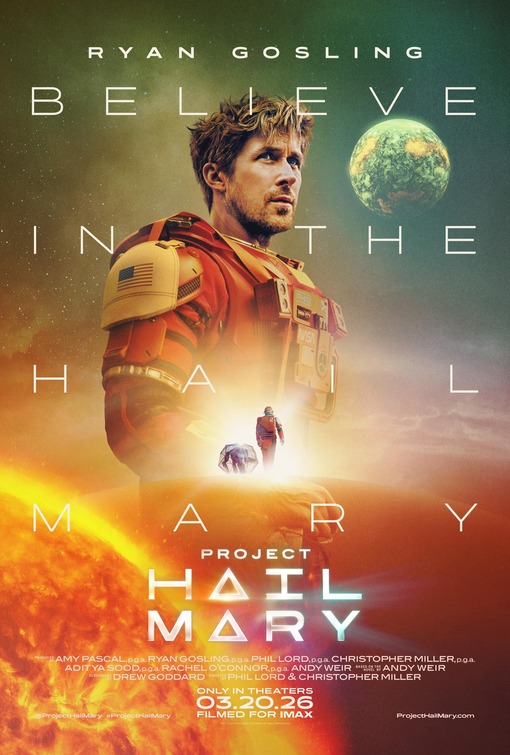
Before walking in, I had the same question anyone would: what exactly fills two and a half hours of a man alone in space? The premise sounds deceptively simple. A guy wakes up with no memory, figures out he is on a mission to save Earth, solves some science problems. That’s the movie. Except it is absolutely not, and the gap between that summary and what Project Hail Mary actually is constitutes most of the film’s achievement.
The structural choice is what elevates everything else. The film is not told linearly: it overlaps past and present in a way that is purposeful rather than decorative. Each flashback arrives because the present moment demands it, because Grace needs a memory or a piece of understanding that only the past can supply. Time becomes a non-entity. Life plays out moment by moment rather than in a linear flow. The result is that a film which could easily feel like a series of isolated problem-solving sequences accumulates genuine emotional weight, because you are learning who this man is at exactly the pace the story needs you to learn it. The two and a half hours passes without friction.
Ryan Gosling carries an extraordinary amount of the film alone, and the performance works because he understands that Grace is not a hero type. He is a science teacher who didn’t particularly want this mission and was sent anyway. The wit and the physical comedy ground him in something recognizable and warm. The jokes land not because the film is trying to be funny but because Gosling finds the genuine absurdity in a man waking up alone in deep space with barely functioning limbs and no idea who he is. What lands most is the feeling, that old, almost unfashionable idea that people might come together, across distances and differences, to solve something bigger than themselves.
That feeling is Rocky. The relationship between Grace and the spider-like rock alien he encounters is the film’s entire emotional center, and it is handled with patience and real imagination. The process of two creatures from completely different worlds building a shared language, literally constructing communication from scratch using mathematics and musical tones, is rendered with enough specificity that the friendship feels genuinely earned rather than narratively convenient. Their skills compensate each other perfectly: what Grace cannot do, Rocky can, and vice versa, and the film understands that this mutual dependency is the foundation of any real relationship rather than a narrative convenience. The closest comparison is The Wild Robot: two creatures from different worlds, building something between them that neither could have built alone, and ultimately giving everything to protect the other.
The moment Grace learns that the astrophage leaking from his ship will eventually kill Rocky and chooses to turn back rather than return to Earth is the film’s emotional climax, and it works completely. It is not presented as a grand sacrifice. It is presented as the only thing a person who has genuinely loved someone could do. The irony that the man who didn’t want to go to space in the first place now finds more meaning there than he ever found on Earth, and chooses to spend his life teaching children on an alien world, is the film’s final and most affecting note.
It is a story that really shows what it means to be human, to make mistakes and most importantly to overcome them together. There is not a great deal to excavate beneath the surface. This is not a film that rewards philosophical dissection or demands a second watch to reveal hidden layers. What it does instead is rarer in a blockbuster context: it makes you feel genuinely warm about the universe, about the possibility of connection across impossible distance, and about the specific pleasure of watching two very different minds work a problem together.
Sometimes that is exactly enough.