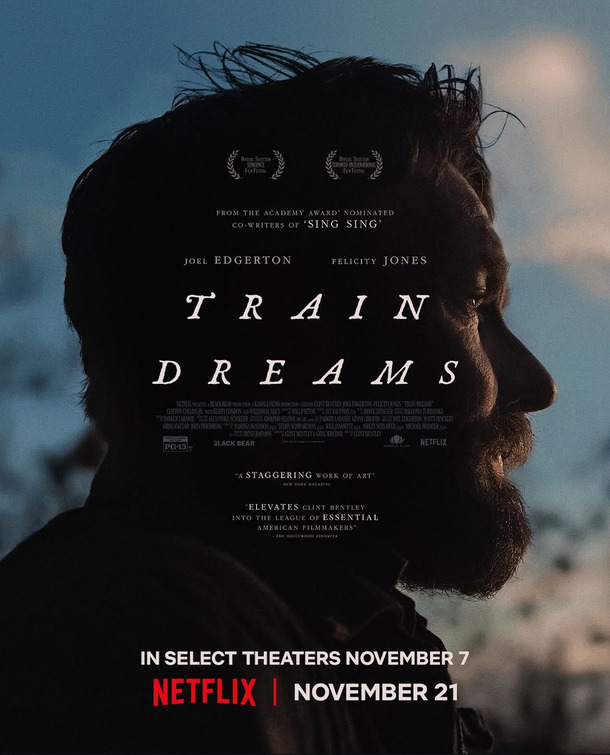
There is a particular kind of American sadness that Train Dreams understands completely: the sadness of a man who was never given the language to process what happened to him, and so carries it quietly across decades, showing up for work, building things, waiting. Director Clint Bentley’s adaptation of Denis Johnson’s novella is not a film that announces its emotional intentions. It accumulates them, the way a life does, one season at a time.
The title is worth sitting with. The “Train Dreams” of the title are not quite dreams in the aspirational sense. They are closer to a structural force: the railroads and logging operations that pulled men like Robert Grainier away from their families and their land as a matter of economic necessity, the industry that was both his livelihood and the invisible architecture of his loss. The train doesn’t ask permission. It arrives, it takes what it needs, and it moves on. Robert’s life unfolds in the space that machinery leaves behind.
The film divides cleanly into two halves, and the division is a wildfire. In the first half, Robert builds something: a wife, a daughter, a routine, a set of relationships forged by campfire conversation and shared physical labour. The talk among the loggers is the film’s intellectual and moral centre. The idea that the moment you lay a hand on a tree it becomes something adversarial, something that pushes back, that the natural world does not simply yield to human ambition but enters into a kind of combat with it, is planted early and grows through everything that follows. These are men who spend their lives dismantling wilderness and cannot help but think about what that means. The interconnectivity of even the smallest things hums beneath every conversation, the sense that nothing exists in isolation and that every act of severance carries consequence.
The wildfire takes his family. The second half of the film is grief rendered at the exact pace grief actually moves, which is to say, slowly, nonlinearly, and without resolution. Robert waits. He rebuilds the house on the same ground where everything burned, which is either an act of devotion or an act of refusal to accept reality, and the film is honest enough not to decide which. The stray dogs become company of a kind. He hears his wife and daughter return sometimes, senses their presence in the house, and keeps very still so as not to frighten them away. The film does not frame these moments as delusion. It frames them as the only form of contact still available to him, and holds them with complete tenderness.
The slow pace works here in a way it does not always work in films that adopt it as an aesthetic choice rather than an emotional necessity. Train Dreams earns its stillness because the stillness is Robert’s condition. He is a man suspended between a past he cannot retrieve and a future he never particularly wanted. The pacing does not ask for your patience; it asks you to feel what that suspension actually feels like from the inside.
The train runs through the film as a quiet recurring motif, appearing at intervals that feel less like directorial punctuation and more like reminders that the world kept moving while Robert stood still. It represents everything that passed him by, every current of history and modernity that flowed around him without carrying him with it. When he finally boards a train to the city late in the film and witnesses for the first time the scale of the world he has been living on the edges of, and then, in the film’s most quietly transcendent moment, rises into the air for the first time, something releases. The man who spent his life cutting down trees, watching fires take what he loved, waiting for ghosts that never quite fully arrived, finally feels a genuine connection to something larger than his grief.
Whether that constitutes a Dream finally coming true is a question the film wisely leaves open. But for the first time in a very long time, Robert Grainier looks upward rather than inward, and the sky receives him without judgment.
That is enough. In the world this film builds, that is everything.