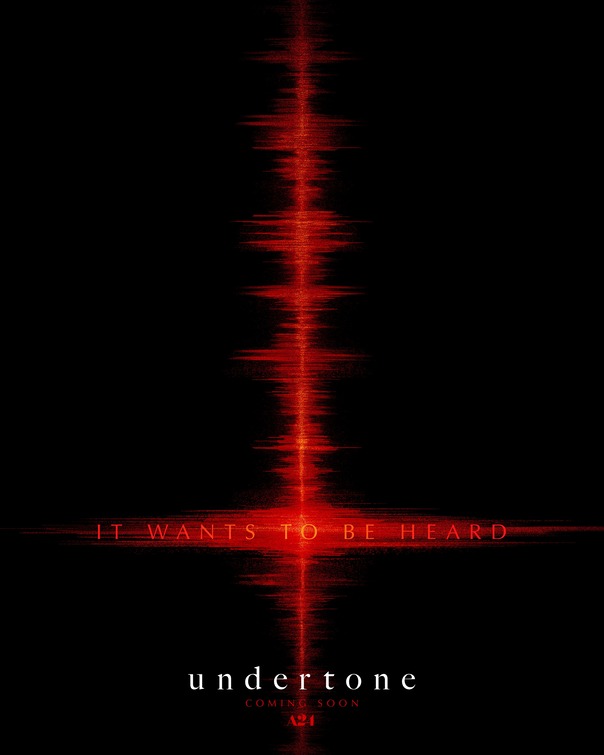
I am not a horror person. I spent a meaningful portion of undertone with both hands covering my face, and at several points my ears too, which I suspect is the intended response. So let me give credit where it is absolutely due: the film works. The sound design is extraordinary, and the central concept, building dread almost entirely through audio rather than image, is genuinely inventive and, within a genre that too often relies on cheap visual shocks, admirably committed. Director Ian Tuason understood something real about the nature of fear. What you hear and cannot locate is more unsettling than what you can see and confront. The marketing promised it would be deeply unsettling. That promise is kept.
Evy is a paranormal podcast host who returns to her childhood home to care for her dying mother. She and her co-host Justin are sent a series of mysterious recordings by an unknown listener, and what begins as podcast material slowly spirals into something far darker and more personal. It as a clever structure, found-footage horror without the footage. Using the podcast format and audio files as the vessel for dread rather than a camera is an inspired idea. The children’s songs, the distorted nursery rhymes, and the barely audible whispers in the recordings all accumulate into a genuinely oppressive atmosphere. When the sound closes in, it really closes in.
But the film that surrounds that atmosphere is a less confident construction. The storyline does not resolve toward anything coherent at the end, leaving you not with productive ambiguity but with a genuine sense of narrative incompletion, as if the film trusted its sonic architecture so completely that it stopped worrying about where the story was actually going. The mythology of the demons and monsters is introduced and then blended together in ways that feel arbitrary rather than intentional. You stop trying to understand the rules of the horror because the film never establishes them clearly enough to follow. The film is frustratingly nonspecific, when specificity is precisely what a storyline this fragile needed.
The visual language compounds the problem. Long camera movements and drifting pans attempt to build tension, yet they often reveal nothing. When the camera repeatedly pans across empty rooms without payoff, the technique becomes tedious rather than suspenseful. The first few slow traversals across a dark corridor carry genuine menace. By the eighth or ninth, you have learned that nothing is coming, and the device has exhausted itself. A technique that works through the promise of what might appear loses all power the moment the audience stops believing the promise. undertone burns through that goodwill faster than it realizes.
There is a stronger film buried somewhere inside this one, a tighter, more narratively disciplined version that trusts its extraordinary sound design to carry a story that actually lands somewhere. What we have instead is a film of remarkable formal ambition and real sensory achievement wrapped around a storyline that dissipates before it concludes.
Worth seeing in a good theatre, hands optional.