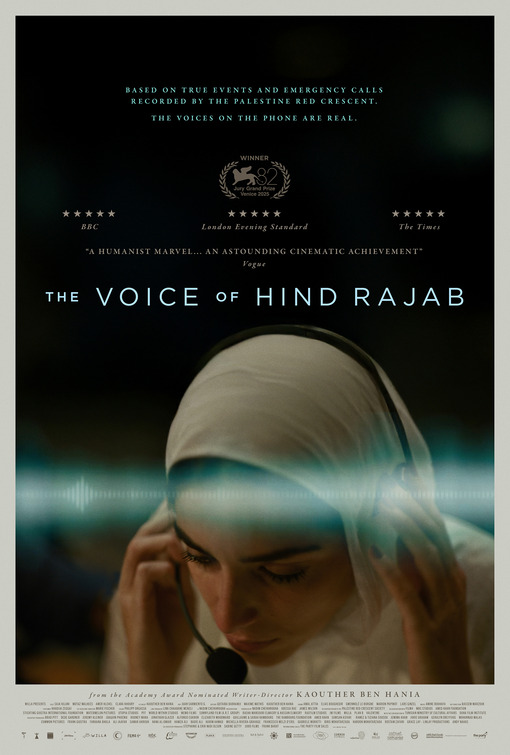
There are films that document atrocity, and there are films that make you live inside it. The Voice of Hind Rajab belongs to the second category, and that distinction is what makes it almost unbearable to watch and absolutely necessary to see. This is not a war film in the conventional sense. There are no battle sequences, no soldiers, and no sweeping aerial shots of destruction. The entire weight of a genocide is channeled through a single room, a whiteboard, a telephone, and the voices of people who knew exactly what needed to be done and were systematically prevented from doing it.
What the film captures with devastating precision is not the violence itself but the bureaucratic machinery that enables it. The central tension is not between Israeli forces and Palestinian civilians; it is between the dispatchers who want to move and the coordinators who remind them that moving requires approval. That internal friction, that “mini-conflict” between people on the same side who are not actually on the same side in terms of power, is where the film finds something genuinely rare: an honest portrait of institutional paralysis as a form of complicity. Nobody in that room is indifferent to Hind. That is precisely what makes the watching so difficult. The horror is not cruelty within the room. It is competence and care rendered entirely inert by a system designed to exhaust the people trying to navigate it.
The eight minutes keeps returning. Someone writes it on the whiteboard. Someone says it aloud. It becomes a kind of cruel refrain: eight minutes is all it would take, eight minutes to reach her, eight minutes between a child surviving and a child not surviving. Instead the clock runs in the opposite direction. Hours pass. The number on the whiteboard stops meaning rescue and starts meaning indictment. The “8” shape of the approval process, the loops through departments, the dead ends, and the callbacks to people who refer you to other people, is the film’s sharpest visual metaphor, because an infinity symbol is exactly what institutional obstruction looks like when a child’s life is the unit of measurement.
Hind Rajab was six years old. She was hidden inside a wrecked car surrounded by the bodies of her family. She could hear what was outside the car. She stayed on the phone because the voice on the other end of the line promised she was coming, promised it would be soon, and promised just a little longer. The first responders kept that promise alive for hours, not because they believed it but because what else do you say to a six-year-old who is asking you not to hang up. The performances carry the weight of people doing the most human thing imaginable, staying present, staying calm, staying connected, while being denied the ability to do the only thing that would actually matter.
The green light came eventually. That the ambulance was shot anyway, that the voice on the line went silent and was never explained as anything other than what it almost certainly was, is the film’s final and most devastating statement. The system that prevented the rescue and the system that ended any possibility of it are not separate systems. That is the argument the film makes without ever stating it directly, and it is more powerful because of the restraint.
Credit goes to the filmmakers for refusing to aestheticize or sensationalize any of this. There is no score swelling at the moments of maximum anguish. There is no camera movement designed to tell you how to feel. The film trusts the facts, and the facts are enough. Credit goes to every actor in that room for delivering something that does not feel like performance at all, just people trapped in an impossible position, trying to hold something together that the world outside the room is actively destroying.
Hind Rajab was real. Her voice was real. The three hours she spent waiting were real. The film does not let you forget that, and it should not. She deserved eight minutes. She got a film made about why she did not receive them.
That has to mean something. It has to.