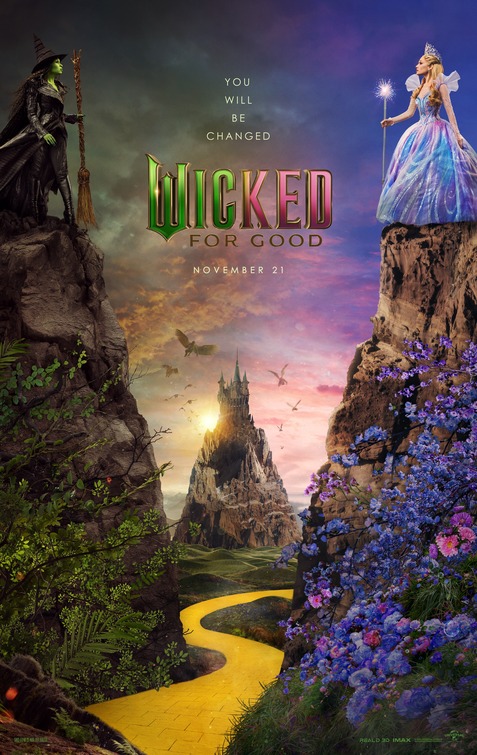
Let me be upfront: reviewing a direct adaptation of a beloved musical is a particular kind of challenge, because the baseline is fixed before the film even begins. For Good is the second act of a story already in motion, and judged purely as a cinematic experience for someone who isn’t a Wicked devotee, it is decent, occasionally more than decent, but noticeably a step below the first film in almost every dimension that matters.
This installment is far from a total misfire. Thank goodness Erivo and Grande are such captivating performers perfectly suited to these roles, but the over-padding and stuffing meant to justify this bifurcated packaging becomes readily apparent. The middle section in particular loses its footing, with a parade of supporting characters and subplots pulling focus from what the film does best: the relationship between Elphaba and Glinda. The love story threading through it all doesn’t deepen the central themes so much as dilute them, consuming screen time that the friendship between the two leads needed more urgently.
What works, works well. Cynthia Erivo remains extraordinary; her vocal power is not in question at any point, and “No Good Deed” is genuinely a showstopper, an excellent showcase for everything she does best. The real special effects come from the deeply felt performances from Cynthia Erivo and Ariana Grande, as the relationship between Elphaba and Glinda evolves in complicated ways. And Grande is markedly more mature here than in the first film. She navigates Glinda’s complications, trying to be the good witch the world needs while quietly grieving her friendship with Elphaba, with more dramatic depth than the first film gave her room to demonstrate. The character’s moral ambiguity suits her, and she rises to meet it.
Over the prolonged runtime, we meet the Cowardly Lion, learn the lovelorn origin story of the Tin Man, discover how the Scarecrow became a living burlap sack full of straw, and see where the pink-strewn and magic-less Glinda got her bubble-mobile and wand. For anyone who grew up with The Wizard of Oz, these connective moments carry a warm, nostalgic charge that the film earns without overplaying. The scarecrow, the tin man, the cowardly lion: seeing their origins sketched in gives the whole exercise a sense of mythology that briefly makes the two-film structure feel justified.
The ending delivers on what the title promises. Erivo and Grande find just the right amount of tenderness and sadness with “For Good,” and that bond between them shines bright once more. The sacrifices are real, the cost is real, and the film honors them without flinching. That at its core this is a story about the price of doing what is right rather than what is easy gives it a moral weight that the messier middle sections threatened to undermine.
Within the landscape of movie musicals, both Wicked films serve as a triumph and tribute to creative fortitude. Taken together they are something worth having. Taken separately, the second is the lesser half: not because it fails, but because the first film’s sense of discovery is, by definition, unrepeatable.
Still, the friendship endures. So does the film, just barely, and just enough.