| Price (6/8/26) | Market Cap | FY26E Revenue | Non-GAAP EPS FY26E | NVIDIA Commitment | Ref. Target |
|---|---|---|---|---|---|
| $376.99 | $79B | ~$7.5B (+30%) | ~$5.45 | $2B equity + multi-yr purchase | $395 ($320–$470) |
Prepared June 8, 2026, following Q3 FY26 results (reported May 6, 2026). Initiating coverage — no formal BUY/HOLD/SELL rating assigned. Valuation figures are analytical reference only.
Table of Contents
- Position in the Optical Production Chain
- Company History & Identity
- Business Segments
- The NVIDIA Partnership & AI Optics Opportunity
- Q3 FY26 Earnings Analysis
- Industry Landscape & Competitive Set
- Financial Analysis & Key Ratios
- Bull / Base / Bear Scenarios
- Valuation
- Forward Catalysts
- Risk Assessment
- Sources
Investment Summary
Coherent Corp. is the leading Western pure-play photonics and optical networking company and one of the most directly exposed public equity beneficiaries of the AI infrastructure capex cycle through datacom optical transceivers. Q3 FY26 (reported May 6, 2026) delivered record results: revenue $1.81B (+21% YoY, +27% pro forma); GAAP EPS $0.97; non-GAAP EPS $1.41; GAAP gross margin 37.7%. The Datacenter & Communications segment, now 75% of revenue, grew 41% YoY, while the Industrial segment grew 2%. Management guided Q4 FY26 revenue to $1.91–2.05B, implying full-year FY26 revenue of approximately $7.5B (+30% YoY).
The strategic story crystallized on March 2, 2026 when NVIDIA announced a $2 billion strategic investment in Coherent alongside a multi-year, multi-billion-dollar purchase commitment and future capacity-rights for advanced laser and optical networking products. The investment was part of NVIDIA’s $4B combined commitment to Coherent and Lumentum, signaling that NVIDIA views optical interconnects as the next bottleneck in AI infrastructure scaling and is using its balance sheet to lock in Western photonics supply.
Our triangulated reference target of $395 (5% upside) reflects a triangulation across DCF, multiples, and scenarios. The stock has already priced in much of the AI optical opportunity (up ~221% over the past 12 months), and the asymmetric risk-reward is now genuinely two-sided: bull case to $560 / bear case to $240. No formal rating is assigned — position sizing should reflect the wide outcome distribution.
Key Investment Themes:
- Unique multi-stage vertical integration. Most peers operate at one stage (laser chip OR module assembly OR DSP); Coherent participates at substrate/wafer (InP, GaAs, SiC), laser-diode/chip (EML, VCSEL, CW), and module assembly — capturing more value per port and providing strategic visibility across demand layers.
- NVIDIA partnership materially de-risks FY26–FY28. The $2B investment + multi-billion-dollar purchase commitment provides revenue visibility and signals NVIDIA’s strategic preference for non-Chinese optical supply.
- Clear gross margin expansion path. Non-GAAP gross margin moved from 30.8% (FY24) to 39.6% (Q3 FY26); projected 43%+ by FY28E as 1.6T transceivers (higher-margin) become the dominant mix.
- Chinese competition is the central risk. InnoLight and Eoptolink collectively manufacture 60%+ of 800G modules and lead the 1.6T transition. Their 20–25% price advantage is the core bear case.
- Valuation already reflects much of the optimism. At 36× forward P/E and 28.5× EV/EBITDA, the bar for incremental re-rating is higher than in prior years.
1. Position in the Optical Production Chain
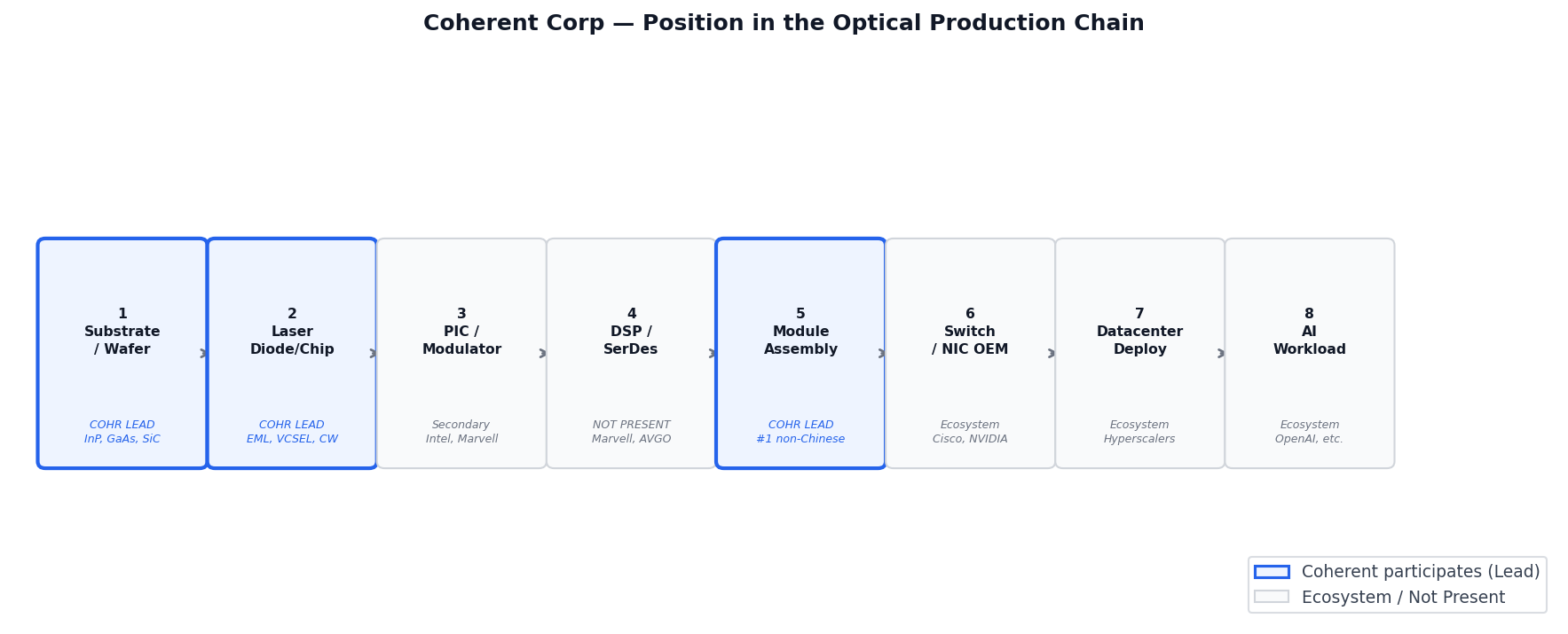
Understanding Coherent requires understanding the optical production chain that connects raw compound-semiconductor wafers to deployed datacenter infrastructure. The chain has eight identifiable stages, and Coherent participates in three of them — substrate/wafer, laser-diode/chip, and module assembly — making it one of the few vertically integrated optical suppliers in the world.
Stage-by-Stage Walkthrough
Stage 1 — Substrate / Wafer [COHR LEAD] The chain begins with compound-semiconductor wafers — typically InP (indium phosphide) for high-speed lasers, GaAs (gallium arsenide) for shorter-reach optics, and SiC (silicon carbide) for power applications. Coherent grows InP and SiC boules in its Pennsylvania and North Carolina facilities, then slices and polishes them into wafers used internally and sold externally. This stage carries some of the highest margins in the chain (40%+) but is small in absolute revenue.
Stage 2 — Laser Diodes & Optical Chips [COHR LEAD] The laser is the heart of an optical transceiver, accounting for roughly 60% of module cost. Three laser types matter for AI datacom: EML (electroabsorption modulated) for high-speed long-reach single-mode links, VCSELs for short-reach multi-mode within-rack links, and CW (continuous-wave) lasers paired with external silicon-photonics modulators. Coherent is one of the top three EML producers globally (alongside Lumentum and Mitsubishi Electric) and a major VCSEL supplier. EML supply has been the most acute bottleneck in the 800G/1.6T ramp — Coherent’s EML wafer-out capacity is a critical strategic asset.
Stage 3 — PIC / Modulator [COHR SECONDARY] The PIC integrates modulators, waveguides, and detectors onto a single chip. Coherent has internal PIC capability through its acquired II-VI and Finisar lineages but is not the technology leader — Intel/Cisco-Acacia, Marvell-Inphi, and Broadcom hold that distinction.
Stage 4 — DSP / SerDes ASIC [NOT PRESENT] The digital signal processor is dominated by Marvell (Inphi), Broadcom, MaxLinear, and increasingly NVIDIA’s own silicon. Coherent does not compete here.
Stage 5 — Module Assembly [COHR LEAD] The pluggable transceiver module integrates the laser, modulator, detector, DSP, optical packaging, and electrical interface. The major assemblers are InnoLight (largest globally, ~50–60% of 1.6T), Coherent, Eoptolink, and Lumentum. Coherent is firmly in the top three globally and the largest non-Chinese assembler.
Stages 6–8 — Ecosystem Downstream — switch/NIC OEMs (Cisco, Arista, NVIDIA), datacenter deployment, and AI workload providers — Coherent does not compete but participates through joint engineering with NVIDIA and direct relationships with all major switch OEMs.
Strategic Implications of the Multi-Stage Position
Coherent’s participation at three non-adjacent stages (1, 2, and 5) confers three strategic advantages: (i) cost control on the most expensive transceiver sub-component by sourcing lasers internally; (ii) information advantage on real-time demand across both chip and module stages; (iii) credible Western alternative to Chinese assemblers independent of Chinese substrate or chip supply.
The principal disadvantage is capital dilution — rather than concentrating R&D and capex on a single high-return stage, Coherent must invest across three. The NVIDIA $2B investment directly targets this: NVIDIA’s capital is allocated to expanding US-based manufacturing across all three Coherent stages.
2. Company History & Identity
II-VI Foundation and Materials Heritage (1971–2015)
Coherent Corp. traces its origin to II-VI Incorporated, founded in 1971 in Saxonburg, Pennsylvania by Carl Johnson as a manufacturer of high-purity zinc selenide and zinc sulfide for CO₂ laser optics. The name ‘II-VI’ refers to the periodic table columns of the compound-semiconductor materials the company specialized in. II-VI went public on NASDAQ in 1987 and grew through organic R&D and materials-focused acquisitions, building deep expertise in silicon carbide, indium phosphide, gallium arsenide, and other substrates foundational to laser and photonic applications.
Diversification and Optical Networking Push (2016–2021)
Through the 2010s, II-VI executed a strategic pivot toward optical networking and laser systems. Key acquisitions included Finisar (2019, $3.2B) — which brought 3D-sensing VCSELs (the Apple Face ID technology), datacom transceivers, and a major silicon-photonics platform. By 2021 II-VI had grown to roughly $3B of revenue with a portfolio spanning industrial lasers, datacom optics, 3D sensing, and compound-semiconductor materials.
Coherent Acquisition and Rebranding (2022–2024)
On July 1, 2022, II-VI completed the acquisition of Coherent Inc. (the legacy industrial-laser company founded in 1966) for approximately $7 billion in a cash-and-stock transaction. The combined entity adopted the ‘Coherent’ brand in 2023. The deal was strategically logical but was completed at the peak of the post-COVID optical cycle — the combined business immediately faced a 2022–2024 communications downturn that pressured margins and EPS.
Jim Anderson Era and AI Inflection (2024–Present)
On June 3, 2024, Jim Anderson was appointed CEO (previously CEO of Lattice Semiconductor, where he drove FPGA margins to industry-leading levels). Anderson’s priorities: focus on AI datacom opportunity, drive operating margin expansion, simplify segment structure from three to two (D&C + Industrial), pursue selective divestitures of non-core assets. The AI inflection materialized through 2025–2026: D&C revenue grew 26% in FY25 and accelerated to +41% YoY in Q3 FY26. The stock has compounded approximately 4× since Anderson’s appointment, with the bulk of the move coming after the March 2026 NVIDIA partnership.
3. Business Segments
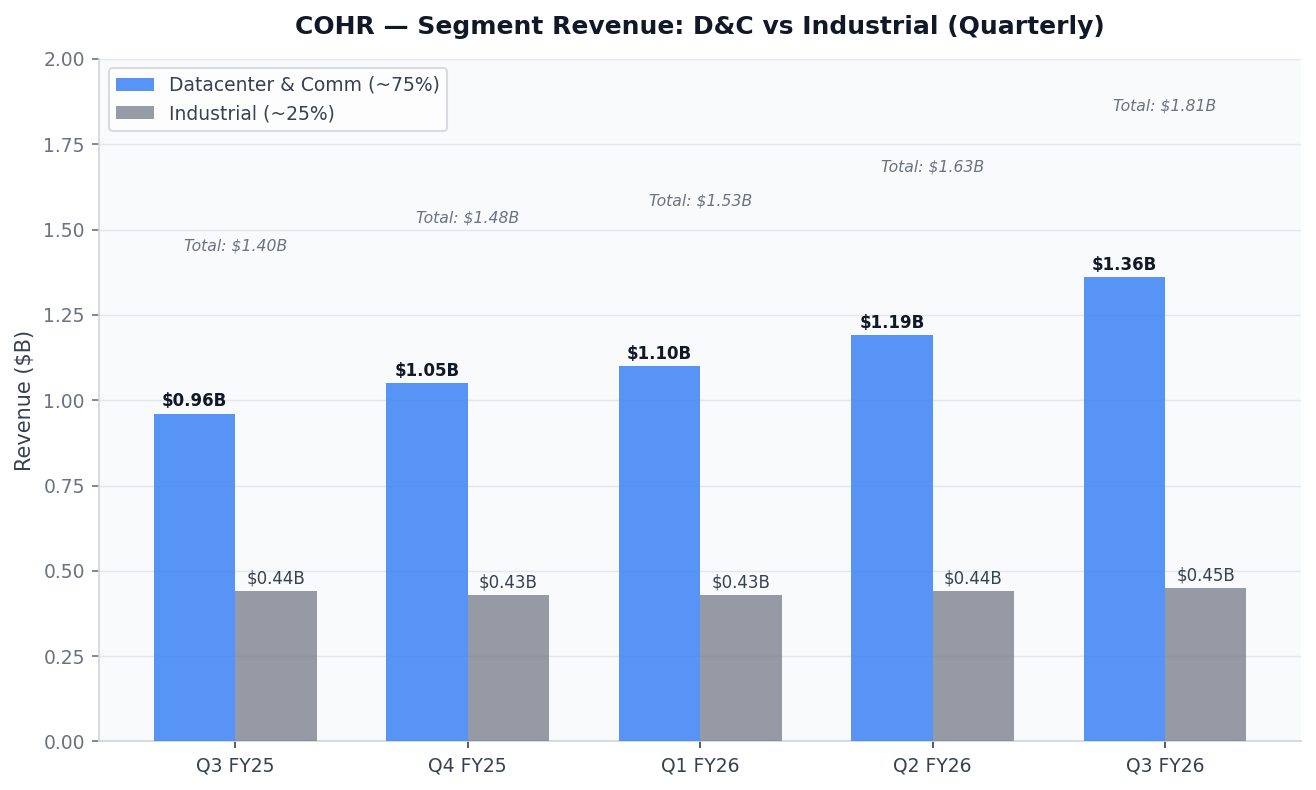
Datacenter & Communications (~75% of FY26 Revenue)
The D&C segment includes datacom optical transceivers (400G/800G/1.6T), telecom optics (ROADM, coherent transceivers, submarine), and the underlying laser and PIC components. Q3 FY26 segment revenue: ~$1.36B, up 41% YoY. The growth driver is overwhelmingly datacom AI: 1.6T transceiver shipments are projected to exceed 5 million units industry-wide in 2026, with Coherent capturing an estimated 15–25% of 1.6T units.
The segment’s strategic positioning rests on three pillars: (i) vertical integration through internal laser and substrate production; (ii) NVIDIA partnership providing demand visibility through 2028; (iii) US-based manufacturing increasingly preferred by hyperscalers diversifying away from Chinese supply. Non-GAAP gross margin reached 39.6% in Q3 FY26, up from 30.8% in FY24.
Industrial (~25% of FY26 Revenue)
The Industrial segment combines the legacy II-VI laser-optics business (CO₂ laser optics, beam delivery, scientific instruments) with the legacy Coherent Inc. industrial laser business (high-power fiber lasers, excimer lasers, ultrafast lasers for semiconductor manufacturing, materials processing). Q3 FY26 segment revenue: ~$450M, up 2% YoY. Industrial carries lower-but-stable gross margins (mid-30s%) and serves as a cash flow stabilizer for the higher-volatility D&C business.
Sub-categories include EUV lithography optics (sold to ASML), semiconductor capital equipment lasers, aerospace and defense systems, and medical laser components.
Strategic question: should Coherent divest Industrial? The case for retaining: cross-platform technology synergies, customer diversification, EUV/semicap exposure as a secular growth pocket. The case for divesting: free up capital and management attention for AI optics; simplify the equity story.
4. The NVIDIA Partnership & AI Optics Opportunity
Anatomy of the March 2026 NVIDIA Deal
On March 2, 2026, NVIDIA and Coherent announced a multi-year strategic agreement comprising three components:
- A $2 billion equity investment by NVIDIA in Coherent (alongside a separate $2B investment in Lumentum, for $4B combined)
- A multi-year, multi-billion-dollar purchase commitment for advanced laser and optical networking products
- Future access and capacity rights as Coherent builds out US-based manufacturing for advanced optics
The structural significance goes beyond the immediate dollars. NVIDIA has historically been a customer-of-choice rather than a financial investor in its suppliers, and the willingness to deploy $4B of equity capital into two specific Western optical vendors signals three judgments: (i) optical interconnect bandwidth is the next AI infrastructure bottleneck after compute and memory; (ii) Chinese module supply concentration is a strategic risk NVIDIA wants to reduce; (iii) US-based manufacturing capacity needs to scale faster than market mechanisms alone would deliver.
The 1.6T Volume Ramp
2026 is broadly recognized as the volume year for 1.6T optical transceivers — shipments are projected to exceed 5 million units globally, up from approximately 1 million in 2025 and 300,000 in late 2024. The 1.6T transition is the fastest generational shift in optical transceiver history, driven entirely by AI cluster requirements: NVIDIA Blackwell-class GPU systems require dense 1.6T networking to scale beyond a few hundred GPUs per cluster.
Within 1.6T, market share is led by InnoLight (50–60% per industry estimates), with Coherent in a clear secondary position. Coherent’s competitive positioning is differentiated by access to internally produced EML lasers (the binding constraint for many competitors) and NVIDIA-validated qualification on Blackwell platforms.
The China Competition Question
The single most important risk: Chinese optical vendors — primarily InnoLight (300308.SZ, ~$3.3B 2024 revenue, +114% YoY) and Eoptolink (~$1.2B, +175% YoY). These vendors collectively manufacture 60%+ of global 800G modules and have demonstrated the ability to scale 1.6T capacity at 20–25% price discounts to Western competitors. The cost advantage comes from Chinese labor economics, vertical integration into substrate and chip supply, and aggressive capacity expansion subsidized by domestic state policy.
Coherent’s defenses: (i) US-based manufacturing increasingly preferred by hyperscalers for strategic/regulatory reasons; (ii) NVIDIA partnership creating a quasi-captive demand channel; (iii) deep vertical integration that Chinese assemblers do not yet match at substrate and EML stages; (iv) ability to serve sovereign and enterprise AI customers requiring trusted supply chains.
5. Q3 FY26 Earnings Analysis
Q3 FY26 quarter ended March 31, 2026; reported May 6, 2026
Headline Results vs. Consensus
Coherent’s Q3 FY26 print was a clean beat across every line — the third consecutive quarter of acceleration in the Datacenter & Communications segment.
| Metric | Q3 FY26A | Consensus | Beat / (Miss) |
|---|---|---|---|
| Revenue | $1.81B | $1.74B | +$70M (+4.0%) |
| Non-GAAP Gross Margin | 39.6% | ~38.4% | +120 bps |
| Non-GAAP Operating Margin | 20.4% | ~18.7% | +170 bps |
| Non-GAAP EPS | $1.41 | $1.18 | +$0.23 (+19%) |
| GAAP EPS | $0.97 | $0.73 | +$0.24 (+33%) |
| D&C Segment Revenue | $1.36B | $1.28B | +$80M (+6%) |
| Industrial Segment Revenue | $0.45B | $0.46B | ($10M) |
Source: Q3 FY26 8-K (May 6, 2026); Bloomberg consensus aggregated May 5, 2026
Segment-Level Drilldown
The divergence between segments is the most consequential observation. D&C revenue of $1.36B grew 41% YoY (+47% pro forma) — a sharp re-acceleration from +28% in Q2 FY26 and +21% in Q1 FY26. Drivers per management commentary:
- 800G transceiver volumes remained near-record as hyperscalers continued retrofitting AI clusters
- 1.6T volumes ramped meaningfully — shipments now exceeding 250,000 units quarterly, tracking ahead of internal plan
- EML laser wafer-out reached a new record, satisfying both internal consumption and third-party sales
- Telecom optics returned to modest growth (~5% YoY) after several quarters of decline
- Segment operating margin reached approximately 24% — a record level
Industrial segment revenue of $0.45B grew just 2% YoY, slightly missing consensus. Within Industrial, semicap-related lasers (EUV optics for ASML, excimer for KLA) grew at low-double-digits but were offset by softness in general-industrial materials processing.
Key Earnings Call Takeaways
Five qualitative data points from the May 6, 2026 conference call materially shaped our view:
(1) NVIDIA partnership commercial cadence. CEO Jim Anderson confirmed that revenue tied to the NVIDIA strategic agreement began ramping in Q3 FY26 and is expected to be a ‘material contributor’ in Q4 FY26 and FY27. The engagement spans ‘multiple product categories across multiple Coherent segments’ — confirming a commercial flywheel, not just a financial transaction.
(2) EML supply remains tight industry-wide. Anderson reiterated that EML laser supply continues to be the binding constraint for the 800G/1.6T industry. Coherent is investing capex to expand EML wafer-out capacity through calendar 2026 and 2027.
(3) Gross margin trajectory. CFO Sherri Luther guided non-GAAP gross margin to 40–41% for Q4 FY26 and indicated 42%+ is achievable in FY27 as 1.6T mix grows and operational efficiencies scale.
(4) Customer concentration acknowledged. The top customer (likely NVIDIA-related) now represents approximately 15–20% of D&C revenue, up from high single digits a year ago — a concentration that warrants monitoring.
(5) FY26 guidance raised. Q4 FY26 revenue guide of $1.91–2.05B implies full-year FY26 revenue of approximately $7.4–7.5B (+27–30% YoY), meaningfully above the prior implied trajectory. Non-GAAP EPS Q4 guide of $1.55–$1.70 implies FY26 non-GAAP EPS of ~$5.40–5.55 vs. Street at $5.10 entering the print.
6. Industry Landscape & Competitive Set
Total Addressable Market
The high-speed datacom optics market (400G/800G/1.6T combined) reached approximately $9B in 2024 and is projected to approach $12B in 2026, with continued double-digit growth through 2030 driven by AI infrastructure scaling. Within this, 1.6T module shipments alone are projected to exceed 5M units in 2026, generating $4–6B of revenue depending on ASPs. The longer-term opportunity in co-packaged optics (CPO) and on-board optics could represent another $10–20B incremental TAM by 2030.
Comparable Companies
| Company (Ticker) | Mkt Cap | P/E NTM | EV/EBITDA | Position vs COHR |
|---|---|---|---|---|
| Coherent (COHR) | $79B | 36.0× | 28.5× | Vertically integrated; NVIDIA strategic partner |
| Lumentum (LITE) | $20B | 30.0× | 20.0× | Direct module/laser competitor; NVIDIA $2B partner |
| Marvell (MRVL) | $95B | 38.0× | 27.0× | DSP/SerDes for transceivers; complementary |
| Broadcom (AVGO) | $1.1T | 32.0× | 25.0× | Networking ASIC + co-packaged optics roadmap |
| Fabrinet (FN) | $15B | 26.0× | 16.0× | Contract manufacturer for optics; key COHR/LITE supplier |
| InnoLight (300308.SZ) | $28B | 24.0× | 16.0× | #1 module assembler globally (50–60% of 1.6T) |
| MACOM (MTSI) | $9B | 38.0× | 28.0× | Smaller diversified RF/photonics player |
| II-VI / COHR FY24 (hist) | — | 60.0× | 14.0× | Reference point — pre-AI inflection multiples |
Source: Bloomberg consensus & pricing as of June 8, 2026
Coherent trades at 36× forward P/E and 28.5× EV/EBITDA — broadly in line with the peer median P/E of ~30× and modestly above the EV/EBITDA median of ~22×. The current multiples are 2.5–3× higher than where the company traded as recently as 2024, reflecting the AI re-rating. The premium to peers is justified by Coherent’s NVIDIA strategic partnership and vertical integration; the absolute multiple level is debatable and creates downside risk if the AI optical narrative compresses.
7. Financial Analysis & Key Ratios
Margin & EPS Trajectory
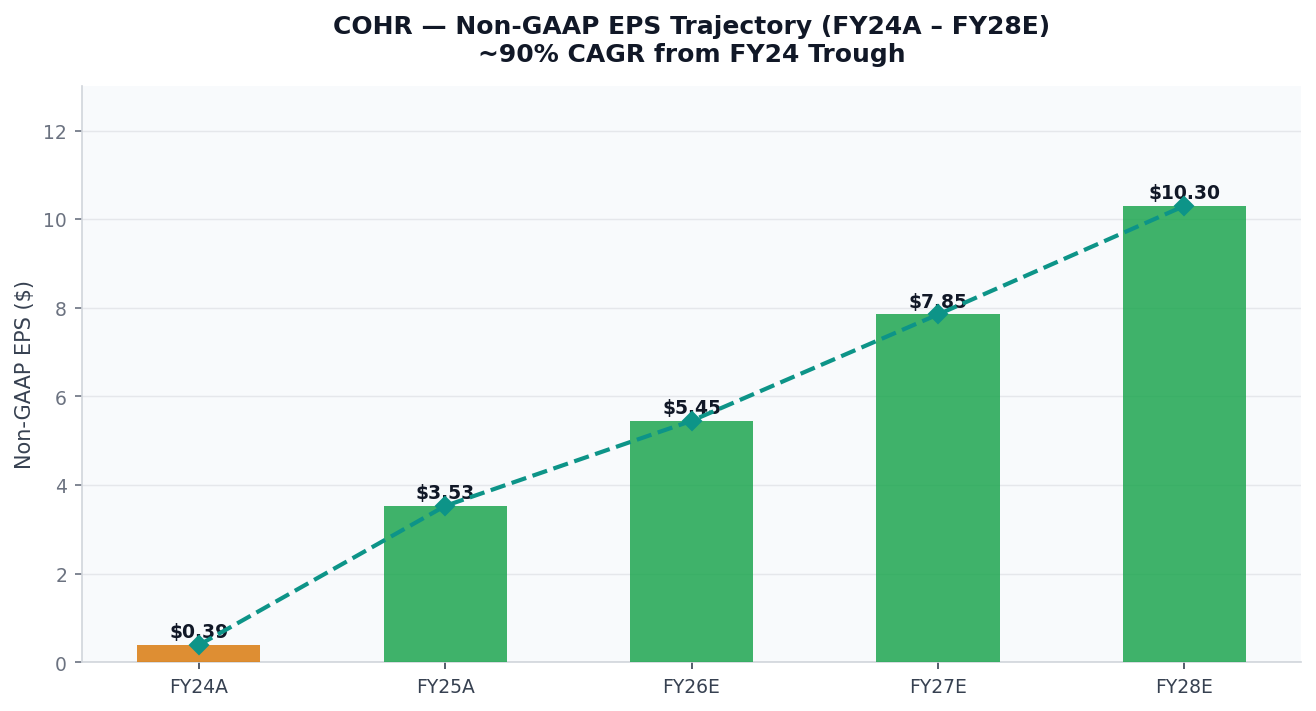
The fundamental story is operating leverage. Non-GAAP gross margin moved from 30.8% (FY24) to 39.6% (Q3 FY26), and we project continued expansion to 43%+ by FY28E. Operating margin expansion is steeper given fixed-cost leverage on R&D and SG&A: projected to move from 0.7% GAAP (FY24) to 23.7% (FY27E) and 25.7% (FY28E). Non-GAAP EPS trajectory: $0.39 (FY24) → $3.53 (FY25) → $5.45 (FY26E) → $7.85 (FY27E) → $10.30 (FY28E) — implying a ~90% CAGR from the FY24 trough.
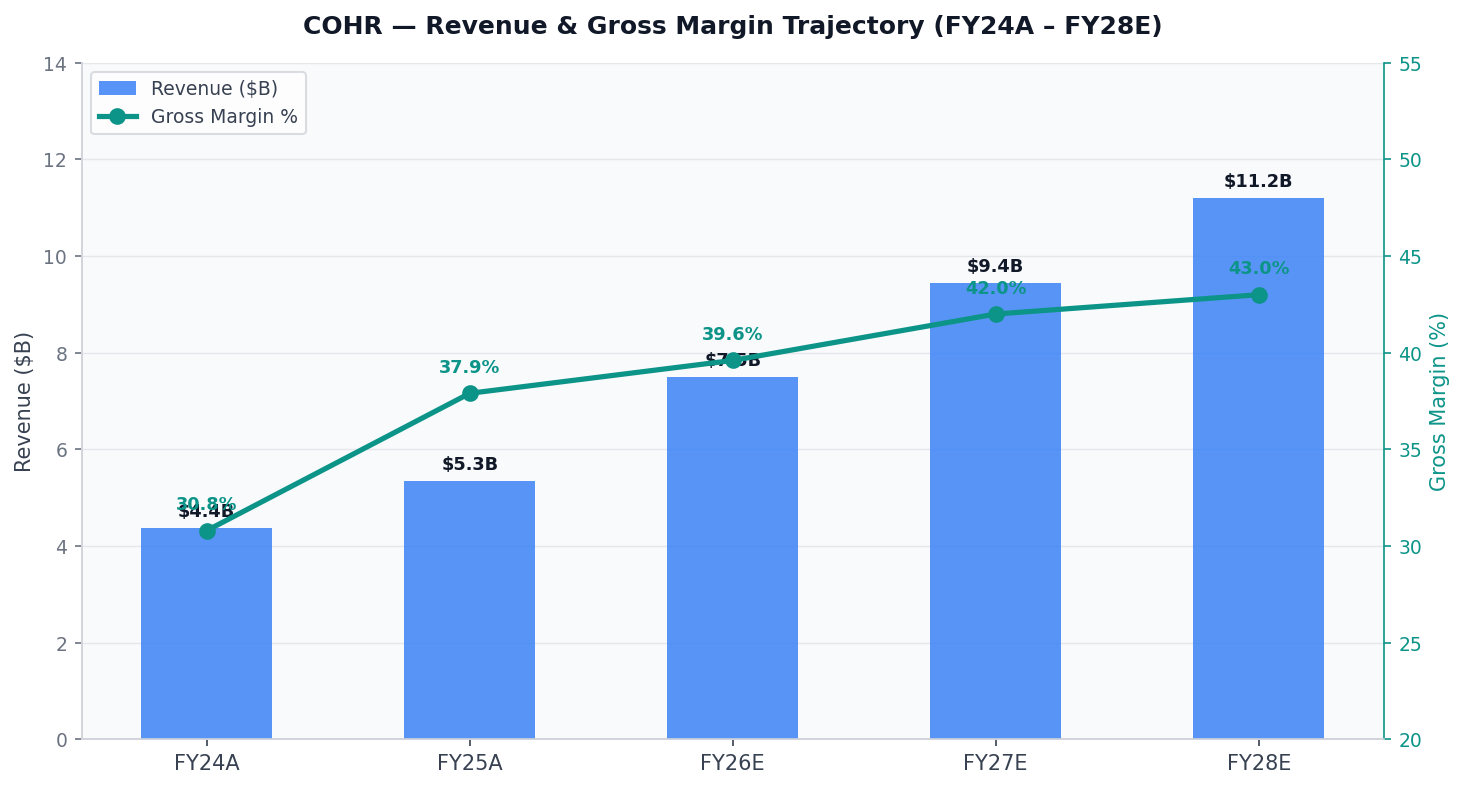
Three mechanical drivers underpin the EPS compounding: (i) revenue growth of ~26% projected for FY27 and ~19% for FY28; (ii) gross margin expansion of ~300–400 bps from FY26 to FY28 as 1.6T mix grows and Coherent captures more value from internally produced EMLs; (iii) opex leverage — R&D and SG&A combined are projected to grow at roughly half the pace of revenue, contributing ~250–300 bps of additional operating margin expansion.
Key Ratios Summary
| Ratio | FY24A | FY25A | FY26E | FY27E | FY28E |
|---|---|---|---|---|---|
| Gross Margin (GAAP) | 30.8% | 37.9% | 39.6% | 42.0% | 43.0% |
| Operating Margin | 0.7% | 13.1% | 18.9% | 23.7% | 25.7% |
| EBITDA Margin | 9.9% | 20.3% | 24.3% | 28.1% | 29.6% |
| Net Margin | –6.1% | 7.1% | 13.4% | 18.0% | 20.0% |
| ROIC | n/m | 6% | 13% | 21% | 28% |
| FCF Margin | 5.3% | 10.0% | 14.0% | 17.1% | 19.5% |
| Debt / EBITDA | 8.8× | 3.3× | 1.95× | 1.18× | 0.83× |
| Non-GAAP EPS ($) | $0.39 | $3.53 | $5.45 | $7.85 | $10.30 |
| FCF per Share ($) | $1.63 | $3.45 | $5.90 | $9.00 | $12.25 |
Source: Coherent historical filings; Cowork Research projections
What the Ratios Say
Profitability: The gross margin expansion of ~1,220 bps from FY24 to FY28E is unusually large for a mid-cycle hardware franchise. Three drivers: AI datacom mix shift (1.6T carries ~5–7 pts higher gross margin than 800G); vertical-integration capture from internal EML production; Industrial de-emphasis at the consolidated level lifting blended margins. Principal caveat: if 1.6T transitions to 3.2T faster than expected, there could be intermediate margin compression before re-accelerating.
Returns on Capital: ROIC moves from non-meaningful (FY24) to projected 21% by FY27E and 28% by FY28E — compares favorably to Lumentum (~18% by FY27), and reflects operating leverage on a stable invested-capital base post-merger integration.
Balance Sheet: Debt/EBITDA moves from 8.8× (post-merger peak) to projected 0.8× in FY28E. Net debt has effectively gone negative on a pro-forma basis (~$600M net debt vs. $79B equity market cap). The balance sheet creates optionality for additional capital return.
8. Bull / Base / Bear Scenarios
| Metric (FY28E) | Bear | Base | Bull |
|---|---|---|---|
| D&C Revenue | $7.5B | $8.96B | $10.5B |
| Total Revenue | $9.5B | $11.2B | $13.0B |
| Operating Margin | 18.0% | 25.7% | 30.0% |
| Non-GAAP EPS | $7.50 | $10.30 | $14.00 |
| Implied Multiple | 32× | 36× | 40× |
| Implied Price | $240 | $371 | $560 |
Bear Case — $240 Implied (~37% Downside)
What has to happen: Chinese pricing pressure intensifies rather than abates. InnoLight and Eoptolink expand 1.6T capacity faster than expected and combine for >70% of global 1.6T shipments by 2028 — squeezing Coherent’s share below 12%. Pluggable module assembly gross margins compress 300–400 bps industry-wide. The NVIDIA partnership delivers ~$1–1.5B/yr rather than the $2–3B/yr we model in the base case. Industrial remains flat.
Why this could happen: (i) Chinese government continues to subsidize domestic optical capacity expansion; (ii) hyperscalers prioritize price over geopolitical considerations; (iii) NVIDIA accelerates internal optical R&D, diluting external suppliers. The combination of cyclical and structural pressure would compress both growth and margins simultaneously. Bear case multiple: 32× × $7.50 = $240.
Base Case — $371 Implied (~2% Downside, ~Current Price)
What we expect: Continued AI optical ramp consistent with current trajectory. Coherent maintains 18–22% share of 1.6T units, with EML supply differentiation supporting modest pricing premium. NVIDIA partnership ramps to ~$2–2.5B of annualized revenue by FY28. Gross margin expansion proceeds as guided (43% by FY28). Industrial holds at low-single-digit growth. Total FY28E revenue: $11.2B, operating margin 25.7%, non-GAAP EPS $10.30. Base case multiple: 36× × $10.30 = $371.
Why this is the central case: The base case effectively extrapolates the trajectory implied by Q3 FY26 results and management guidance. It does not require any structural improvement in Chinese competition; it does not require an additional major strategic partnership; it does not require breakthrough technology adoption. It is essentially a ‘momentum continues’ case.
Bull Case — $560 Implied (~49% Upside)
What has to happen: NVIDIA partnership delivers materially above expectations — revenue from the strategic agreement reaches $3.5–4.5B annualized by FY28. Coherent captures 25%+ share of 3.2T transceivers as it co-develops with NVIDIA on Rubin-class systems. The CPO transition benefits Coherent more than peers due to vertical integration. SiC datacenter power scales to $500M+ revenue. FY28E revenue: $13B, operating margin 30%, non-GAAP EPS $14.00. Bull case multiple: 40× × $14.00 = $560.
Probability-Weighted View
Subjective probability weights (inputs for position-sizing, not precise estimates): Bull 25% / Base 55% / Bear 20%. Probability-weighted implied value: approximately $385 — within 2% of the current $376.99 price. The market is roughly pricing the base case correctly; the path to upside requires conviction in the bull case unfolding over the next 24–36 months.
9. Valuation
DCF Framework
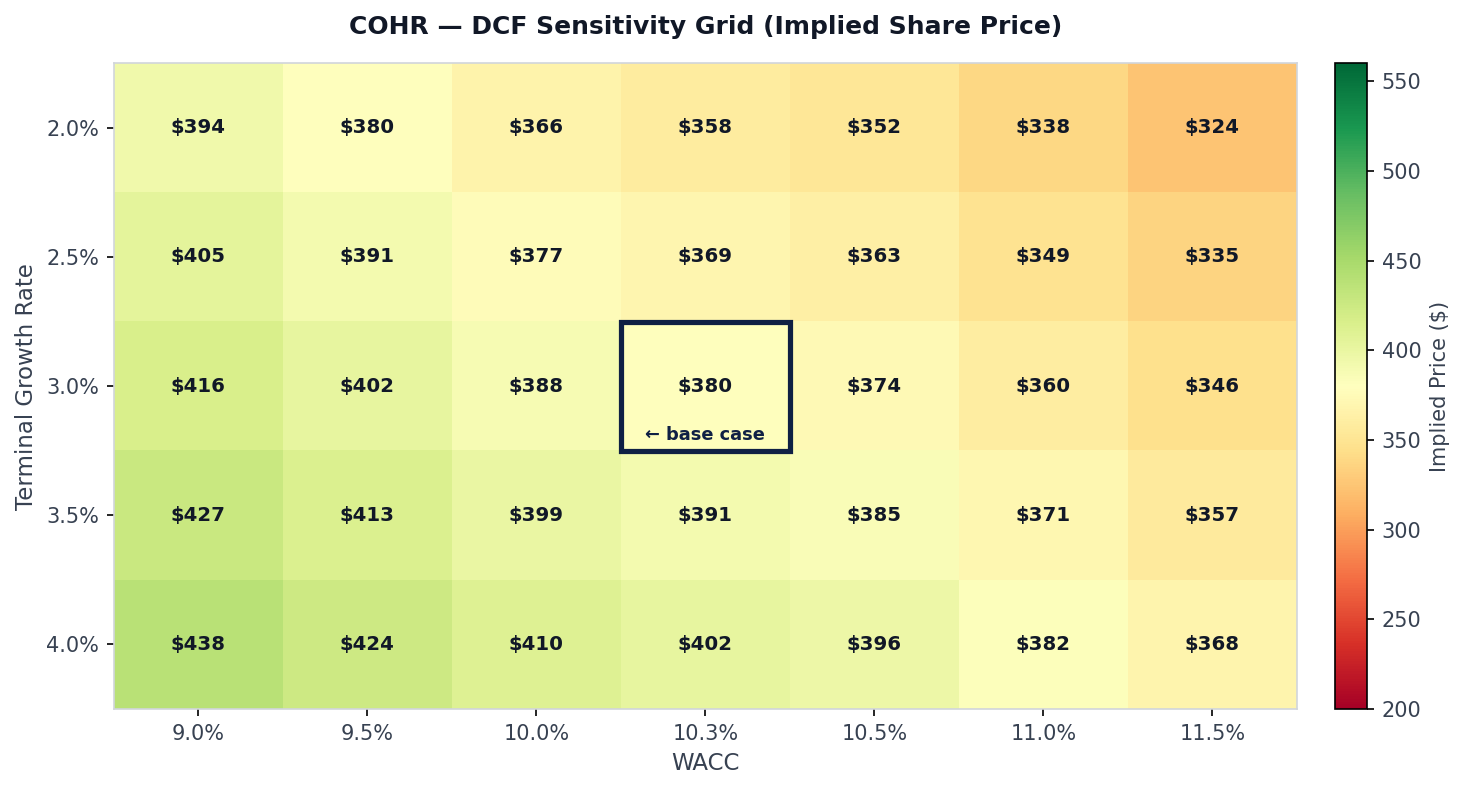
We use a DCF as one of several valuation inputs rather than a primary anchor — the optical sector’s beta is structurally higher than the broader hardware comps, and out-year UFCF visibility is genuinely limited. DCF inputs: risk-free rate 4.3%, equity risk premium 5.5%, beta 1.35, cost of equity 11.7%, after-tax cost of debt 4.5%, target debt/capital 20%, WACC ~10.3%, terminal growth 3.0%, 5-year explicit forecast (FY27–FY31). Central DCF output: $380/share.
Valuation Triangulation
| Methodology | Low | Mid | High | Notes |
|---|---|---|---|---|
| DCF (WACC 10.3%, g 3%, β 1.35) | $290 | $380 | $470 | Sensitivity-driven |
| P/E on FY27E NG-EPS ($7.85) | $250 | $314 | $392 | 32×–50× range |
| P/E on FY28E NG-EPS ($10.30) | $330 | $412 | $515 | 32×–50× range |
| EV/EBITDA on FY27E ($2.66B) | $295 | $378 | $444 | 20×–30× range |
| Peer Median Multiple | $320 | $380 | $440 | Peer-relative discipline |
| Scenario Analysis (FY28E) | $240 | $371 | $560 | Bull/Base/Bear |
| Reference Triangulated Target | $320 | $395 | $470 | Cross-method midpoint |
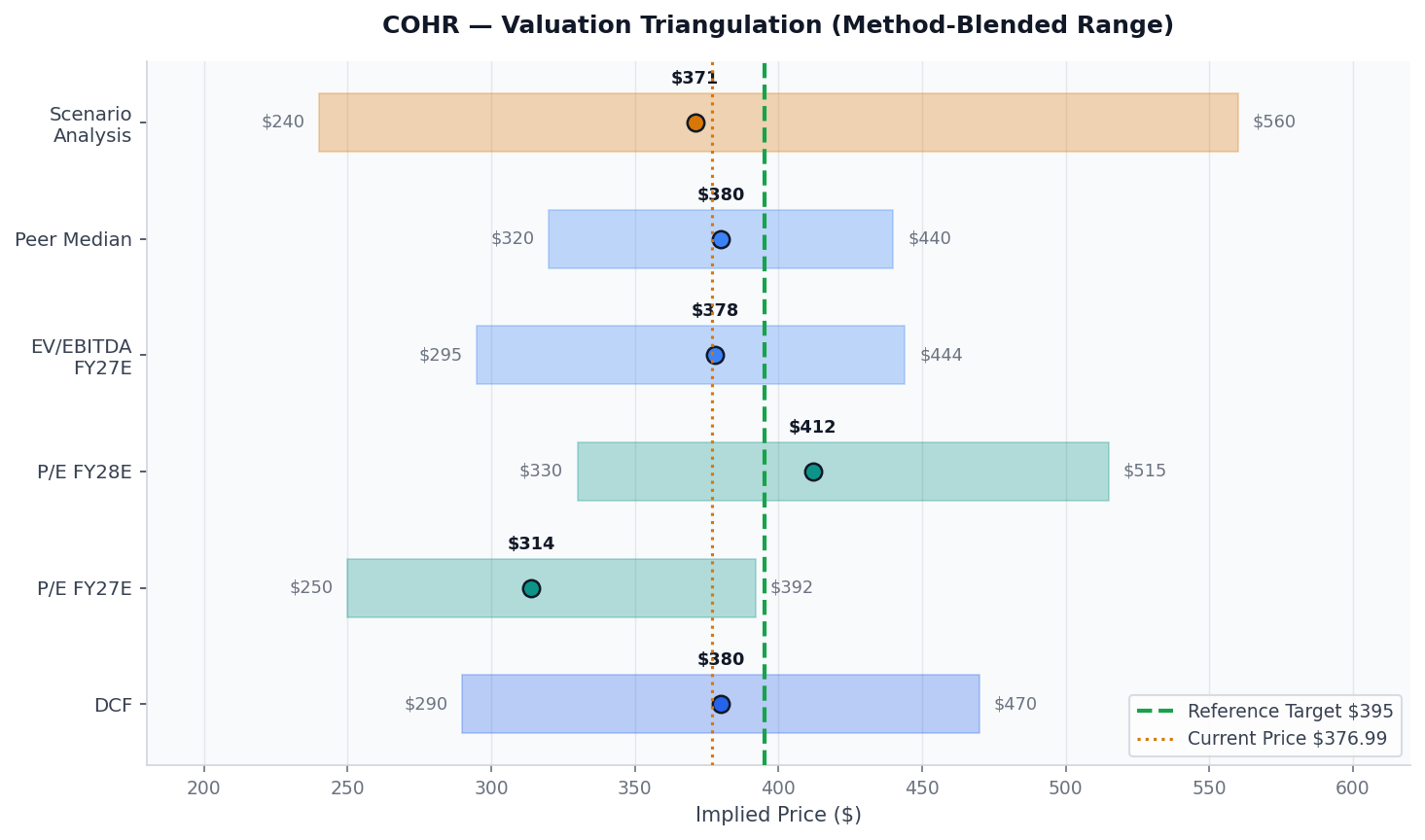
The triangulated reference target of $395 sits at the midpoint of a method-blended range of $320–$470. Implied upside vs. the current $376.99 is approximately 5%. We deliberately do not assign a formal rating — the appropriate position decision depends more on conviction in scenario probabilities than on a point-estimate target.
10. Forward Catalysts
| Timing | Catalyst | Direction | Why It Matters |
|---|---|---|---|
| Aug 2026 | Q4 FY26 earnings (FY end Jun 30, 2026) | +/– | First read on full-year FY26 vs. guide; FY27 guidance the key data point |
| Sep–Oct 2026 | OFC / ECOC industry conferences | +/– | Customer commitments, roadmaps, and competitive positioning crystallize publicly |
| Q3 CY 2026 | Hyperscaler CY26 capex guide updates | + | If hyperscaler optical attach budgets grow, COHR is a direct beneficiary |
| Nov 2026 | Q1 FY27 earnings + NVIDIA partnership cadence | + | First quarter where NVIDIA agreement revenue should be ‘material contributor’ |
| Late 2026 | 1.6T volume ramp confirmation | + | Industry needs to deliver 5M+ 1.6T units in CY26 — COHR share is the key data point |
| Q4 CY 2026 | Potential Industrial divestiture announcement | + | Clean separation would simplify equity story and unlock capital |
| Q1 CY 2027 | 3.2T optical roadmap visibility | +/– | Next-gen platform alongside NVIDIA Rubin; share-of-spec decisive for FY28–FY29 |
| Q1 CY 2027 | First FY28 guidance framing | +/– | Gross margin trajectory and capex intensity are key disclosures |
| Mid-2027 | Possible CPO qualification | + | Hyperscaler CPO qualification with COHR supports vertical-integration thesis |
| Ongoing | Chinese pricing / regulatory developments | – | Further US-China optical export restrictions tailwind; Chinese capacity headwind |
The Three Catalysts That Matter Most
(i) NVIDIA Revenue Cadence in Q1–Q2 FY27 — Decisive for the Bull Case. Management indicated NVIDIA-related revenue would be a ‘material contributor’ starting Q4 FY26 with meaningful step-up in Q1–Q2 FY27. The actual run-rate (whether $2B/yr or $4B/yr annualized) is the single most consequential data point.
(ii) 1.6T Share Visibility — Defines the Base Case. Industry-level 1.6T shipment data emerging through OFC, ECOC, and hyperscaler disclosures will clarify whether Coherent maintains 18–22% share (base) or compresses below 15% (bear). InnoLight commentary at industry conferences is the principal external benchmark.
(iii) Margin Trajectory — Confirms the Operating Leverage Thesis. Non-GAAP gross margin must continue trending toward 42–43% by FY27 for the EPS compounding thesis to hold. Q4 FY26 (40–41% guide) is the first test; Q1 FY27 the second.
11. Risk Assessment
Competitive & Operational
-
Chinese Optical Competition (Primary Risk). InnoLight, Eoptolink, and emerging Chinese assemblers manufacture 60%+ of global 800G modules and lead the 1.6T transition with 50–60% combined share. Their structural cost advantage (20–25% pricing) and aggressive capacity expansion threaten Coherent’s module-assembly margins. Mitigants include NVIDIA’s strategic preference for non-Chinese supply, US-based manufacturing geopolitical premium, and vertical integration.
-
NVIDIA Concentration Risk. The NVIDIA partnership is central to the equity story. Any deterioration — shift to a different optical partner, more in-house photonics, cooling AI demand — would directly impact growth trajectory and revaluation.
-
EML Supply / Pricing. EML lasers are the binding constraint in 800G/1.6T module supply. Coherent benefits as a major EML producer, but EML wafer-out capacity expansion is capital intensive and lumpy.
-
Co-Packaged Optics (CPO) Transition. If CPO accelerates faster than pluggable architectures, value-capture shifts toward silicon photonics PIC producers. Coherent participates in PIC but is not a leader. CPO timing is the most consequential strategic uncertainty.
Financial & Macro
-
Margin Compression. Pluggable module assembly is structurally a mid-margin business. As mix shifts toward AI datacom modules, blended gross margin could plateau or compress despite within-module mix gains.
-
Cyclical Industrial Exposure. Industrial segment serves semicap, defense, and broader industrial laser markets that are cyclical. A capex pullback would pressure consolidated results.
-
Capital Allocation & M&A Risk. Coherent has historically been an active acquirer. The post-2022 II-VI/Coherent integration is still being optimized; additional large M&A could disrupt the operating leverage story.
-
Geopolitical / Export Controls. US export controls on advanced optics to China and possible retaliatory measures could affect supply chains and customer access.
12. Sources
Primary Company Materials
- Coherent Q3 FY26 8-K (May 6, 2026)
- Coherent Q3 FY26 Earnings Press Release & Conference Call Transcript
- Coherent Q3 FY26 10-Q
- Coherent FY25 Annual Results
NVIDIA Partnership & Industry Coverage
- NVIDIA/Coherent $2B Strategic Partnership (March 2, 2026)
- NVIDIA’s $4B Optics Investment Analysis
- Coherent at Morgan Stanley Conference (March 2026)
- Coherent OFC 2026 AI Optics Coverage
Supply Chain & Market Data
- AI Data Center Optical Transceiver Market 2025–2030
- Top Optical Transceiver Manufacturers in 2026
- Beyond Chips: Silicon Photonics Ecosystem
- Networking Bottleneck Analysis (FPX Research)
- Optics Primer — Co-Packaged Optics
Stock & Consensus Data
- Bloomberg consensus as of June 8, 2026
- Stockanalysis.com — COHR Forecast
This report has been prepared by Cowork Equity Research. Estimates, scenarios, and the triangulated reference price target reflect the analyst’s view as of the report date. The analyst certifies that all views expressed accurately reflect personal views about the subject company. Compensation is not linked to specific recommendations. This report does not include a formal BUY/HOLD/SELL rating designation. This report is not investment advice; readers should conduct their own due diligence.