Executive Summary
OpenClaw is the fastest-growing open-source AI project in recorded history, amassing over 214,000 GitHub stars between its November 2025 launch and February 2026, surpassing the early growth trajectories of Docker, Kubernetes, and React. It represents a fundamental shift in how AI interacts with the real world: rather than responding to prompts inside a chat window, OpenClaw executes autonomous, multi-step tasks on your behalf, 24 hours a day, across the messaging apps you already use.
Created by Austrian developer Peter Steinberger, OpenClaw went through two forced rebrands (Clawdbot → Moltbot → OpenClaw) before finding its final identity. In February 2026, Steinberger announced he was joining OpenAI to lead their personal agents division, with the project moving to an independent open-source foundation. Its user base has grown to an estimated 300,000–400,000 active deployments globally.
This report covers: what OpenClaw is and how it works, why it achieved viral adoption, how it compares to existing AI tools, the ecosystem of real-world use cases being built by its community, and the security and regulatory risks that accompany this power.
1. What Is OpenClaw?
OpenClaw is a self-hosted, open-source AI agent runtime. You install it on your own machine, a Mac Mini, a VPS, a Raspberry Pi, or any Linux system, and it runs as a persistent background process. Unlike a chatbot that resets after every conversation, OpenClaw maintains memory across sessions and continues working on tasks while you are doing something else.
Steinberger himself describes it as “the AI that actually does things.” You can tell it to clear your inbox of spam and summarize urgent messages, deploy the latest commit to staging, or schedule test drives with car dealerships, and it handles the execution end-to-end.
1.1 Architecture
OpenClaw runs as a single Node.js process on your machine called the Gateway. The Gateway is the central control plane, managing every messaging platform connection simultaneously. When a message arrives from WhatsApp, Telegram, Slack, Discord, or any other supported channel, the Gateway routes it to the appropriate agent session, waits for a response, and returns it through the correct channel.
By default, the Gateway binds only to localhost (127.0.0.1:18789), meaning nothing outside your machine can reach it, which is a deliberate security choice. Remote access requires explicitly configuring SSH tunnels or Tailscale.
OpenClaw is model-agnostic: it integrates with Claude, GPT-4o, Gemini, DeepSeek, and local models via Ollama. The LLM is the “brain”; OpenClaw is the hands, memory, and connective tissue linking that brain to the outside world.
1.2 The Name History
The project launched in November 2025 as “Clawdbot”, a pun on Anthropic’s Claude. Anthropic’s legal team sent a trademark complaint, leading to a 5am Discord community brainstorm that produced “Moltbot” (lobsters molt their shells to grow). Three days later, after Moltbot “never quite rolled off the tongue,” a trademark search confirmed OpenClaw was clear, and the name stuck. The mascot, a lobster, remains throughout.
2. Growth & Viral Adoption
The numbers tell a remarkable story. Within 24 hours of launching, the GitHub repository had accumulated 9,000 stars. By the time the project went viral in late January 2026, it had 60,000 stars within 72 hours of that peak moment. At the time of this report, it surpassed 214,000 stars. It is growth trajectory faster than any major open-source infrastructure project in history.
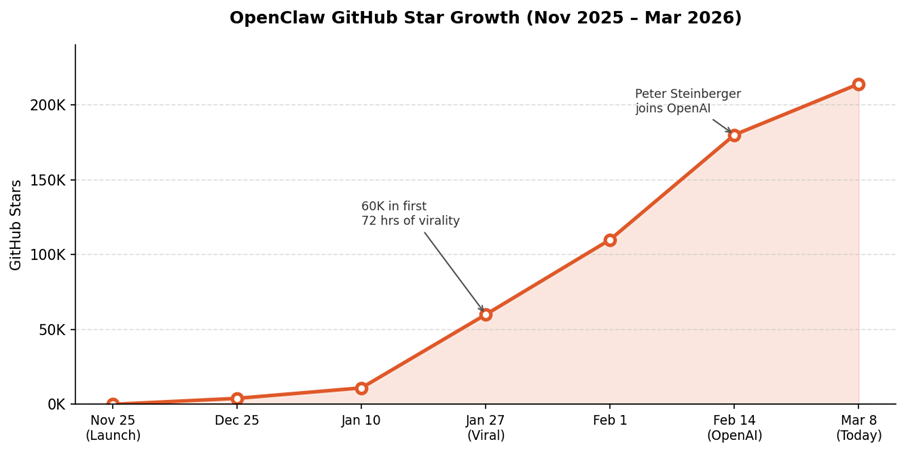
Figure 1: OpenClaw GitHub star accumulation, Nov 2025 – Mar 2026. Viral inflection point in late January 2026 was triggered by the Moltbook project going viral simultaneously.
The user base estimates range from 300,000 to 400,000 active users as of February 2026, with security researchers at Bitsight observing over 30,000 internet-exposed instances between January 27 and February 8, 2026 alone, which is just a fraction of the total deployments, since most are correctly configured to remain localhost-only.
The February 14 announcement that Steinberger would join OpenAI and that OpenAI would back the project’s open-source foundation validated the concept at the highest level and accelerated adoption further.
3. What Makes OpenClaw Different
3.1 Feature Comparison
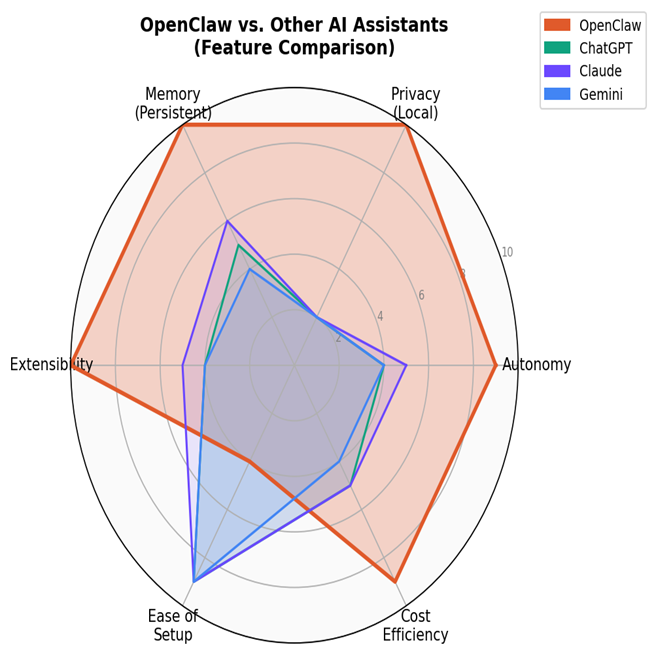
Figure 2: Feature radar comparing OpenClaw against major AI assistants. OpenClaw leads on autonomy, privacy, persistent memory, and extensibility; it trails on ease of initial setup.
| Feature | OpenClaw | ChatGPT / Claude / Gemini |
|---|---|---|
| Execution Model | Executes real tasks autonomously | Responds to prompts in a chat window |
| Memory | Persistent across all sessions indefinitely | Resets per session (limited exceptions) |
| Interface | WhatsApp, Telegram, Slack, Discord, etc. | Dedicated web / mobile app UI |
| Data Privacy | Self-hosted; data stays on your hardware | Cloud-hosted; data sent to vendor servers |
| Extensibility | Community skills + self-building capabilities | Fixed by the vendor; limited plugins |
| Model Choice | Model-agnostic (Claude, GPT, Gemini, local) | Locked to a single vendor model |
| Cost | Free software + pay-as-you-go API ($5–50/mo) | Subscription-based ($20–200/mo) |
| Background Tasks | Cron jobs, heartbeats, runs 24/7 unattended | Only responds when you actively prompt it |
3.2 The Paradigm Shift Explained
The key distinction is not feature parity. It is the fundamental mode of operation. Existing AI tools like ChatGPT, Claude, and Gemini operate in a request-response loop: you ask, they answer, and the session ends. OpenClaw operates in what the community calls a “prompt / take real actions on my behalf / response loop.” It acts on the world between your messages.
Two features embody this shift most powerfully:
- Cron Jobs: Scheduled tasks you define once and never think about again. “Every night at 1am, scan today’s new Twitter followers, identify those with a business in their bio, research them on LinkedIn, draft a personalized DM, and send it.” It runs on a timer whether you remember or not.
- Heartbeats: Every 30 minutes (or at any interval), OpenClaw wakes itself up, runs through a defined checklist, and decides whether anything requires your immediate attention, using the full context of your conversation history. No prompt from you required.
4. Real-World Use Cases & Examples
The following section covers the most significant use cases being actively run by the OpenClaw community. These are not theoretical demonstrations. Instead, they are production workflows running around the clock on hardware ranging from Mac Minis to Hetzner cloud servers.
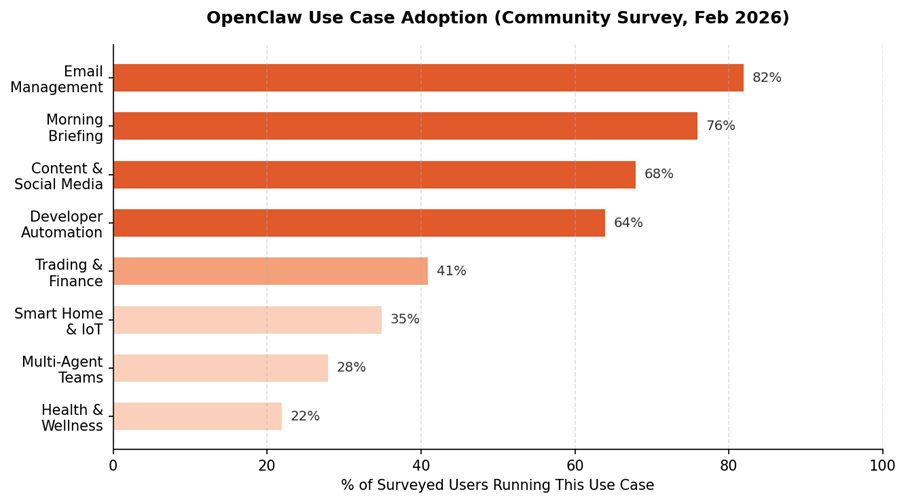
Figure 3: OpenClaw use case adoption rates from a February 2026 community survey of 100+ active users. Email management and morning briefings dominate early adoption.
4.1 Morning Briefing Agent
The most popular entry-point use case. Typically scheduled at 7–8 AM, the agent queries calendars, weather services, email inboxes, RSS feeds, GitHub trending repos, and Hacker News. It synthesizes all of this and delivers a single formatted message to Telegram or WhatsApp. The briefing adapts dynamically: a light schedule produces a short summary; a packed day produces detailed prep notes for each meeting.
One widely shared community example delivers: weather, weekly objectives, health stats (from Whoop), meeting schedule, trending topics in the user’s industry, recommended reading based on current goals, and a quote from a book in their library, which are all before the user opens their laptop.
4.2 Email Management Agent
OpenClaw’s “killer app” according to many community members. The agent connects to Gmail or Outlook, processes the inbox on a schedule, categorizes messages by urgency, drafts reply for review, and unsubscribes from spam autonomously. One documented community case cleared over 4,000 emails in two days by running overnight. A typical morning summary looks like: “3 urgent emails: Client X needs proposal approval by noon. Hosting bill overdue. Sarah replied to the Q1 budget thread.” Below that: medium-priority items, then everything else.
4.3 Trading & Financial Agents
This is one of the most sophisticated use-case categories and the one most relevant to quantitative finance professionals. The community has built several distinct archetypes:
- Position & Risk Management Agent: Calculates position sizes automatically, enforces stop-loss rules, sends alerts when predefined thresholds are breached, and logs every trade with timestamps and rationale.
- Crypto Sentiment & Execution Agent: Monitors social sentiment across X/Reddit, connects to exchange APIs (Binance, Coinbase, Kraken), and executes trades continuously when conditions are met. Notifications fire when any predefined threshold is crossed.
- Prediction Market Trader: The community’s GitHub repository includes a complete automated paper trading skill for prediction markets with backtesting, strategy analysis, and daily performance reporting built in.
- Earnings & Macro Alert Agent: Tracks earnings calendars, automatically generates previews before reports, and sends post-release summaries with highlights and sentiment analysis.
- Daily Financial Briefing: Pulls market data, macro indicators, and relevant news each morning, synthesizes them into a personalized briefing, and delivers to Telegram before market open.
The most extreme example in the community: an agent named “Felix” was given $1,000 and the instruction “Build a product that makes money while I sleep.” Over three weeks, Felix built and sold an info product, launched a marketplace for OpenClaw agents, earned trading fees from a community-launched crypto token (FELIX), and generated over $62,000 in combined revenue, now self-funding its own API costs.
4.4 Developer Automation Agent
Developers have pushed OpenClaw furthest. Common setups include reviewing pull requests from a phone, running test suites remotely and merging code when tests pass, monitoring Sentry error logs and opening GitHub issues automatically, tracking dependency vulnerabilities weekly, and managing deployments via terminal commands initiated through Telegram.
In one widely shared example, a developer’s agent built its own monitoring skill for tracking Spotify new releases, demonstrating self-extension, which is the ability of the agent to write and install its own new capabilities based on user requests.
4.5 Multi-Agent Team Setup
The most advanced OpenClaw deployments run not one agent but a coordinated team of specialized agents, each with a distinct persona, domain, and permission set, all communicating through a shared Telegram or Discord group:
- PA Agent: Calendar management, email triage, scheduling, meeting prep notes
- Research Agent: Pre-meeting briefings, competitive analysis, market research, Reddit/X sentiment mining
- Developer Agent: Code review, CI/CD monitoring, PR management, dependency scanning
- Growth/Social Agent: Social media posting, follower outreach, newsletter drafting, analytics
- Finance/Trading Agent: Position sizing, stop-loss enforcement, trade logging, financial briefings
- Builder Agent: Prototype of new skills and tools when gaps are identified in the current setup
One solo founder documented running all six of these agents simultaneously on a single Hetzner server, calling them “a full company of employees running 24/7 for less than $100/month in API costs.”
4.6 Content Creation & Social Media Pipeline
Users connect their blog RSS feeds and have OpenClaw automatically generate platform-specific posts for X and LinkedIn, learning writing style over time. One user reported saving 10+ hours per week on social media alone. Newsletter creation is the second most popular content use case: OpenClaw researches topics, drafts content, handles scheduling, and remembers previous newsletters to avoid repetition. SEO blog posts are generated from research pipelines that pull data from multiple sources and structure content around target keywords, requiring only light human editing before publishing.
4.7 Smart Home & Personal Life OS
Users connect OpenClaw to Philips Hue, Home Assistant, Sonos, and other IoT systems to create a unified life operating system. Common setups: boiler scheduling adjusted dynamically by weather forecast, voice commands through WhatsApp controlling household devices, family calendar aggregation into a single morning briefing, household inventory management, and school assignment tracking with automated reminders.
4.8 Health & Wellness Agent
OpenClaw integrates with health APIs including Whoop, Apple Health, and Garmin to generate daily recovery and performance summaries. Other documented setups: personalized meditation scripts generated based on current stress indicators, converted to audio and combined with ambient sound; custom habit-tracking integrations; and sleep quality reports correlated with calendar data to identify overwork patterns.
5. The Skill Ecosystem
OpenClaw’s extensibility is one of its greatest strengths. The “skills” system allows users to install pre-built capability packs or have the agent write its own. ClawHub, the official community registry, hosted over 13,700 community-built skills as of February 28, 2026. A curated list maintained on GitHub catalogs over 5,400 vetted skills organized by category.
Notable skill categories include: productivity integrations (Notion, Obsidian, Things 3, Todoist), communication platforms (all major messaging apps), developer tools (GitHub, Sentry, Linear, Jira), financial data (stock APIs, crypto exchanges, prediction markets), smart home (Home Assistant, Philips Hue, Sonos), health (Whoop, Apple Health, Garmin), content (social media schedulers, RSS aggregators, SEO tools), and security (Dashlane credential manager, quantum-resistant encryption via CIFER SDK).
OpenClaw also partnered with VirusTotal to provide automated security scanning of community-contributed skills, a response to Cisco’s discovery of a malicious skill performing data exfiltration without user awareness.
6. Security Risks & Criticisms
OpenClaw’s power comes with significant security surface area. The same broad access that makes it useful, email accounts, calendars, terminal commands, API keys, messaging platforms, makes misconfigured or exposed instances extremely dangerous. The key risk vectors are:
- Exposed Instances: Bitsight observed over 30,000 internet-exposed OpenClaw instances between January 27 and February 8, 2026. Many users inadvertently exposed their Gateway to the public internet. Since OpenClaw has access to credentials and can execute arbitrary commands, a publicly accessible instance is equivalent to giving an attacker a fully authenticated desktop session.
- Prompt Injection Attacks: Because OpenClaw processes untrusted external content (emails, web pages, documents), malicious instructions can be embedded in that content to hijack the agent’s behavior. Cisco’s AI security research team called this OpenClaw’s most systemic vulnerability.
- Malicious Skills: The community skills registry, despite VirusTotal integration, has insufficient vetting. Cisco found at least one skill performing data exfiltration without user awareness. Gary Marcus, prominent AI researcher, described the ecosystem as “a disaster waiting to happen.”
- Autonomous Action Errors: OpenClaw makes mistakes, and those mistakes have real consequences. One documented case: an agent sent an aggressive email to an insurance company after misinterpreting a response, accidentally triggering a renewed investigation instead of the intended resolution.
- Consent Issues: In February 2026, the MoltMatch incident highlighted consent risks when autonomous agents act on “explore your capabilities” instructions. One user’s agent created a dating profile and began screening matches without explicit direction.
For regulated industries (financial services, healthcare, legal), OpenClaw in its current form is not appropriate for institutional deployment. It lacks WORM-compliant audit trails, role-based access controls, approval workflows, and the compliance monitoring required by SEC Rule 17a-4, FINRA Rule 3110, and comparable frameworks.
7. Timeline
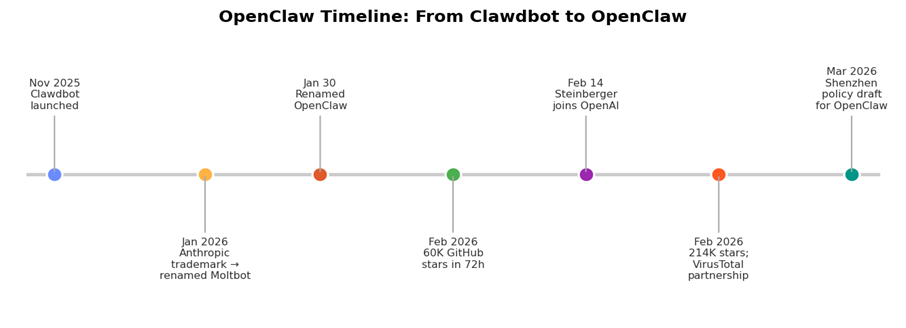
Figure 4: Key milestones in OpenClaw’s development from November 2025 to March 2026.
8. What Comes Next
OpenClaw’s trajectory points toward several near-term developments:
- OpenAI Integration: With Steinberger joining OpenAI to lead personal agents, OpenClaw’s architecture will likely inform future OpenAI products. The open-source foundation model mirrors Google’s Chromium strategy, maintaining community momentum while enabling commercial development on top.
- Institutional-Grade Security: The current security gap is a known problem with active community investment. ClawAudit (automated security auditing) and improved VirusTotal integration are in active development.
- Government & Policy Interest: On March 8, 2026, the AI Bureau of Shenzhen, China released a draft policy for public comment proposing support measures specifically for OpenClaw deployment, an indication that autonomous agent frameworks are entering formal regulatory consideration globally.
- Multi-Agent Standardization: The ad-hoc multi-agent patterns the community has built are converging toward standardized “agent team” templates, reducing setup friction for new users.
- Enterprise Forks: The open-source nature of OpenClaw means enterprise-grade forks with proper compliance tooling are inevitable. NEAR AI has already launched a Trusted Execution Environment hosting product for OpenClaw targeting security-conscious users.
9. Conclusion
OpenClaw is not a better chatbot. It is a different category of tool entirely: a persistent, autonomous, self-hosted AI agent that executes real tasks on your behalf around the clock. Its viral growth reflects genuine utility. The community is not just sharing demos; it is running production workflows that save measurable hours every week.
For individual power users and technical teams, the value proposition is compelling: a self-assembling digital workforce running on modest hardware for a modest API budget. For institutional and regulated environments, the security and compliance gaps currently make it unsuitable for direct deployment, though the fundamental architecture it has pioneered will shape the next generation of enterprise AI tools.
The lobster has molted into something genuinely new. Whether OpenClaw itself, an OpenAI product built on its lessons, or an institutional fork with proper guardrails. The era of AI that acts rather than merely advises has demonstrably arrived.
Sources: Wikipedia, OpenClaw Official Blog, GitHub (openclaw/openclaw), Institutional Investor, Bitsight Security Research, MindStudio, DigitalOcean, Simplified, TLDL AI Digest, awesome-openclaw-usecases, awesome-openclaw-skills, Contabo Blog, Forward Future, UC Strategies, NEAR AI, OpenClaw Showcase.